Department of Women's and Children's Health, Uppsala University, Uppsala, Sweden.
Department of Surgical Sciences, Uppsala University, Uppsala, Sweden.
Transl Vis Sci Technol. 2020 Dec 8;9(13):14. doi: 10.1167/tvst.9.13.14. eCollection 2020 Dec.
Growth factors and inflammatory and angiogenetic proteins are involved in the development of retinopathy of prematurity (ROP). However, no early biochemical markers are in clinical use to predict ROP. By performing cluster analysis of multiple biomarkers, we aimed to determine patient groups with high and low risk for developing ROP.
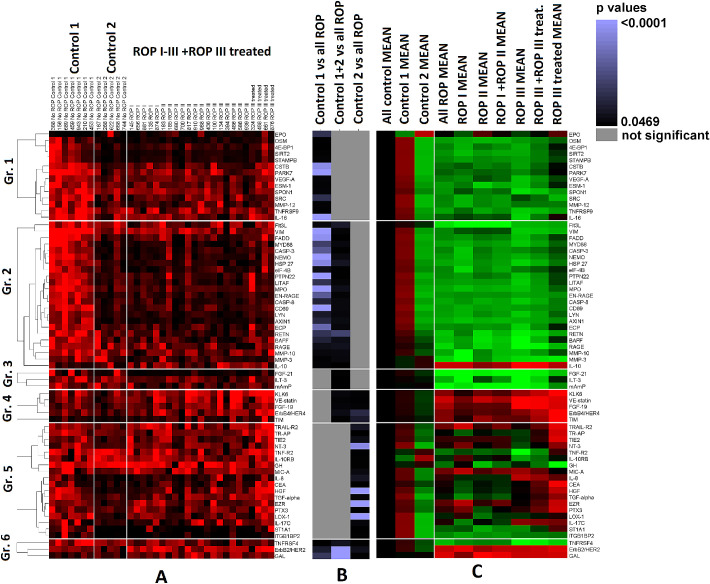
In total, 202 protein markers in plasma were quantified by proximity extension assay from 35 extremely preterm infants on day 2 of life. Infants were sorted in groups by automated two-dimensional hierarchical clustering of all biomarkers. ROP was classified as stages I to III with or without surgical treatment. Predictive biomarkers were evaluated by analysis of variance and detected differences by two-sided paired -test with Bonferroni corrections for multiple comparisons.
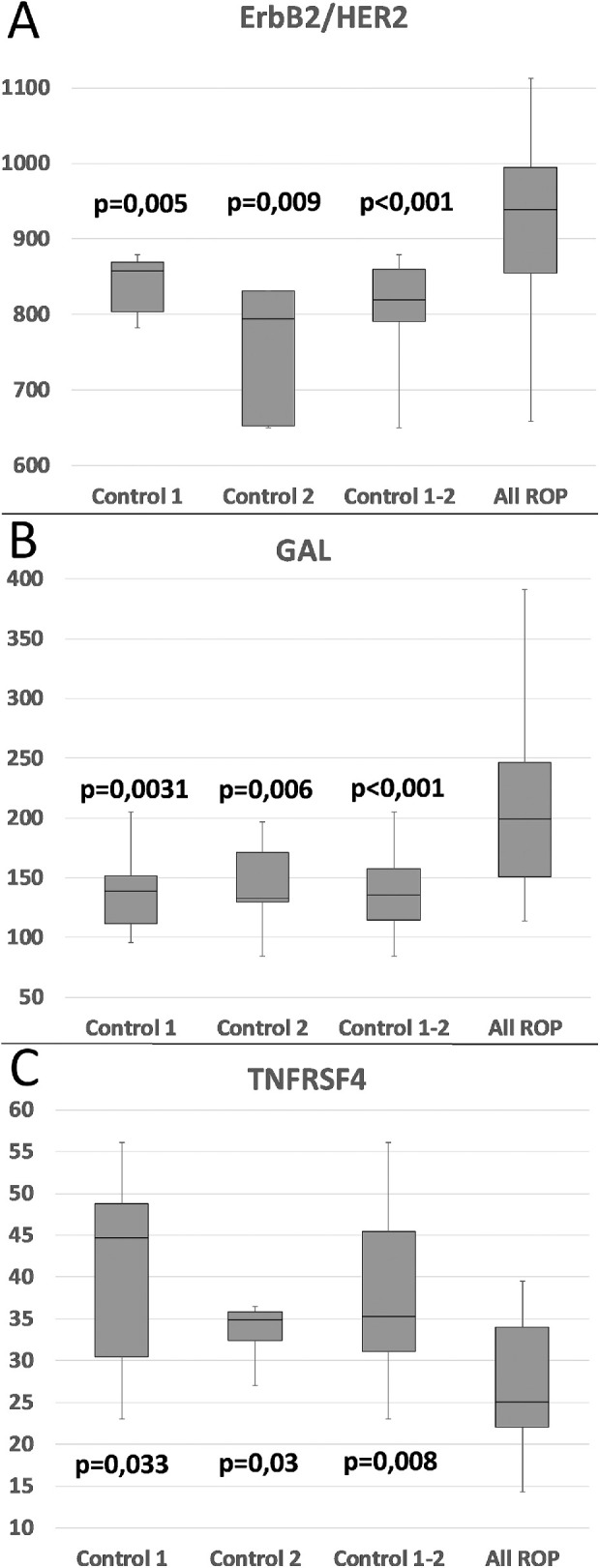
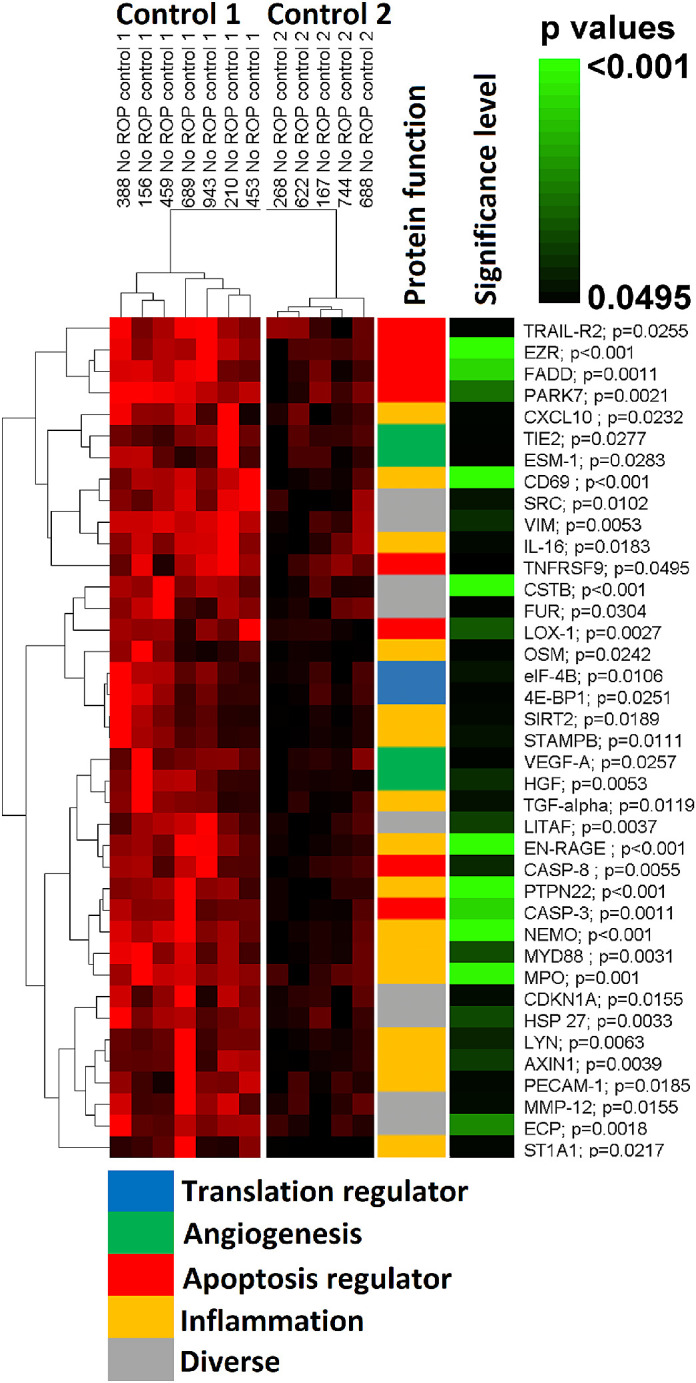
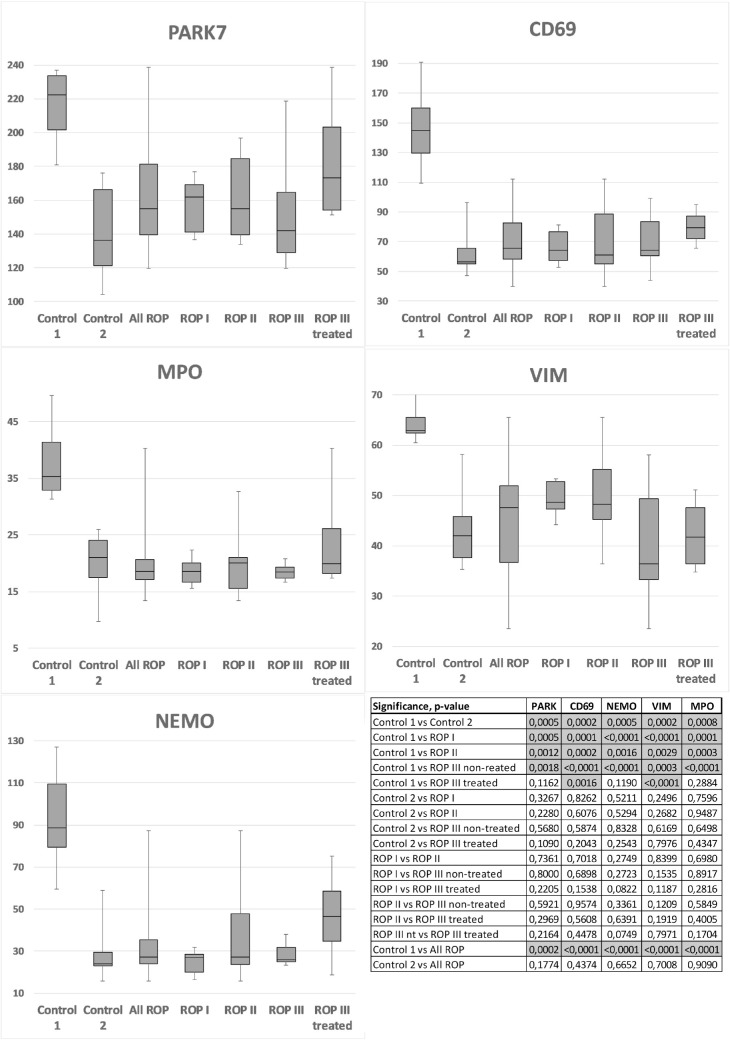
Differences in 39 biochemical markers divided infants without ROP into two control groups (control 1, = 7; control 2, = 5; < 0.05). Sixty-six biochemical markers defined differences between the control groups ( = 13) and all ROP infants ( = 23; < 0.05). PARK7, VIM, MPO, CD69, and NEMO were markedly increased in control 1 compared to all ROP infants ( < 0.001). Lower TNFRSF4 and higher HER2 and GAL appeared in infants with ROP as compared to control 1 and/or 2 ( < 0.05, respectively).
Our data suggest that early elevated levels of PARK7, VIM, MPO, CD69, and NEMO may be associated with lower risk of developing ROP. Lower levels of TNFRSF4 with higher levels of HER2 and GAL may predict ROP development.
Cluster analysis of early postnatal biomarkers may help to identify infants with low or high risk of developing ROP.
生长因子、炎症和血管生成蛋白参与早产儿视网膜病变(ROP)的发生。然而,目前尚无用于预测 ROP 的早期生化标志物。通过对多个生物标志物进行聚类分析,我们旨在确定发生 ROP 风险高和低的患者群体。
共对 35 名极早产儿出生后第 2 天的血浆中的 202 个蛋白标志物进行了接近延伸测定法定量检测。通过对所有生物标志物进行自动二维层次聚类,将婴儿分为不同组。ROP 根据有无手术治疗分为 1 至 3 期。通过方差分析评估预测生物标志物,并通过双侧配对检验检测差异,并用 Bonferroni 校正进行多重比较。
39 种生化标志物的差异将无 ROP 的婴儿分为两组对照(对照组 1, = 7;对照组 2, = 5; < 0.05)。66 种生化标志物定义了对照组( = 13)和所有 ROP 婴儿( = 23)之间的差异( < 0.05)。与所有 ROP 婴儿相比,对照组 1 中 PARK7、VIM、MPO、CD69 和 NEMO 明显升高( < 0.001)。与对照组 1 和/或 2 相比,ROP 婴儿的 TNFRSF4 水平较低,HER2 和 GAL 水平较高( < 0.05,分别)。
我们的数据表明,早期升高的 PARK7、VIM、MPO、CD69 和 NEMO 水平可能与发生 ROP 的风险较低相关。较低的 TNFRSF4 水平与较高的 HER2 和 GAL 水平可能预测 ROP 的发生。
医学博士贝恩德·里德尔(Bernd Rieger)及其同事在《美国生理学杂志-内分泌与代谢》上发表了一篇文章,标题为“早期生物标志物与早产儿视网膜病变的风险分层”。