Tewawong Nipaporn, Kowaboot Siriporn, Pimainog Yaowaluk, Watanagul Naiyana, Thongmee Thanunrat, Poovorawan Yong
Faculty of Medical Technology, Rangsit University, Muang, Pathumthani, Thailand.
Department of Microbiology, Nopparat Rajathanee Hospital, Khannayao, Bangkok, Thailand.
PeerJ. 2020 Dec 2;8:e10453. doi: 10.7717/peerj.10453. eCollection 2020.
Urinary tract infections (UTIs) are the most common bacterial infections and are often caused by uropathogenic (UPEC). We investigated the distribution of phylogenetic groups, adhesin genes, antimicrobial resistance, and biofilm formation in isolated from patients with UTIs.
In the present study, 208 UPEC isolated from Thai patients were classified into phylogenetic groups and adhesin genes were detected using multiplex PCR. Antimicrobial susceptibility testing was performed using agar disk diffusion. The Congo red agar method was used to determine the ability of the UPEC to form biofilm.
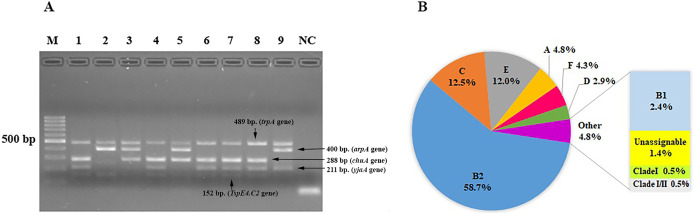
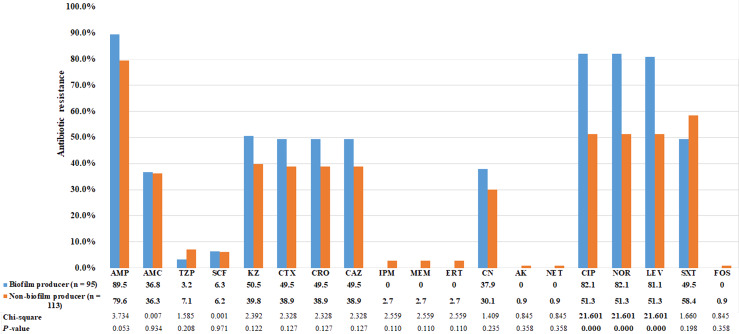
The most prevalent UPEC strains in this study belonged to phylogenetic group B2 (58.7%), followed by group C (12.5%), group E (12.0%), and the other groups (16.8%). Among adhesin genes, the prevalence of (91.8%) was highest, followed by (79.3%), (12.0%), and (7.7%). The rates of resistance to fluoroquinolones, trimethoprim-sulfamethoxazole, and amoxicillin-clavulanate were 65%, 54.3%, and 36.5%, respectively. The presence of adhesin genes and antibiotic resistance were more frequent in groups B2 and C compared to the other groups. Of the 129 multidrug-resistant UPEC strains, 54% were biofilm producers. Our findings further indicated that biofilm production was significantly correlated with the adhesin gene ( ≤ 0.05).
These findings provide molecular epidemiologic data, antibiotic resistance profiles, and the potential for biofilm formation among UPEC strains that can inform further development of the appropriate prevention and control strategies for UTIs in this region.
尿路感染(UTIs)是最常见的细菌感染,通常由尿路致病性大肠杆菌(UPEC)引起。我们调查了从UTIs患者中分离出的大肠杆菌的系统发育群分布、黏附素基因、抗菌药物耐药性和生物膜形成情况。
在本研究中,将从泰国患者中分离出的208株UPEC进行系统发育群分类,并使用多重PCR检测黏附素基因。采用琼脂纸片扩散法进行抗菌药物敏感性试验。使用刚果红琼脂法测定UPEC形成生物膜的能力。
本研究中最常见的UPEC菌株属于系统发育群B2(58.7%),其次是C群(12.5%)、E群(12.0%)和其他群(16.8%)。在黏附素基因中, fimH(91.8%)的流行率最高,其次是 papC(79.3%)、 sfa/foc(12.0%)和 afa/draBC(7.7%)。对氟喹诺酮类、甲氧苄啶 - 磺胺甲恶唑和阿莫西林 - 克拉维酸的耐药率分别为65%、54.3%和36.5%。与其他群相比,B2群和C群中黏附素基因的存在和抗生素耐药性更为常见。在129株多重耐药UPEC菌株中,54%是生物膜产生菌。我们的研究结果进一步表明,生物膜产生与 fimH黏附素基因显著相关(P≤0.05)。
这些发现提供了分子流行病学数据、抗生素耐药谱以及UPEC菌株中生物膜形成的可能性,可为该地区UTIs的进一步制定适当的预防和控制策略提供参考。