Uchida Masataka, Horii Naoki, Hasegawa Natsuki, Fujie Shumpei, Oyanagi Eri, Yano Hiromi, Iemitsu Motoyuki
Faculty of Sport and Health Science, Ritsumeikan University, Kusatsu, Japan.
Japan Society for the Promotion of Science, Tokyo, Japan.
Front Sports Act Living. 2019 Oct 18;1:50. doi: 10.3389/fspor.2019.00050. eCollection 2019.
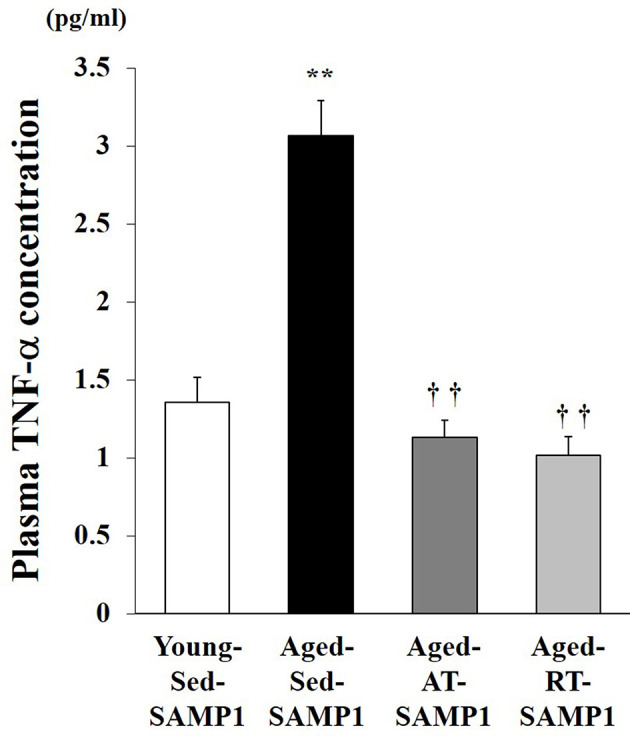
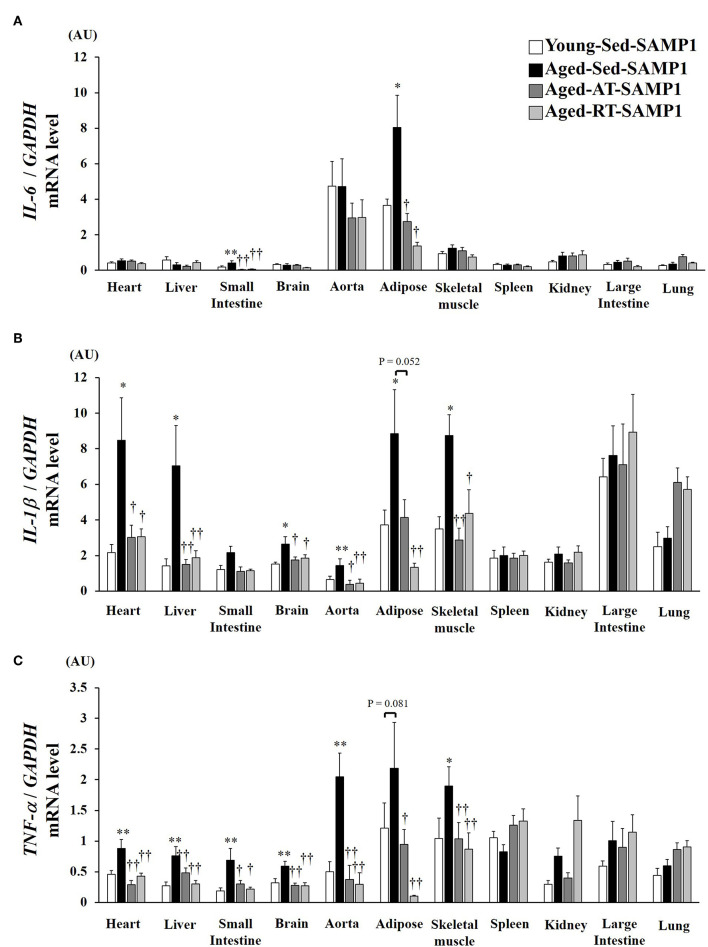
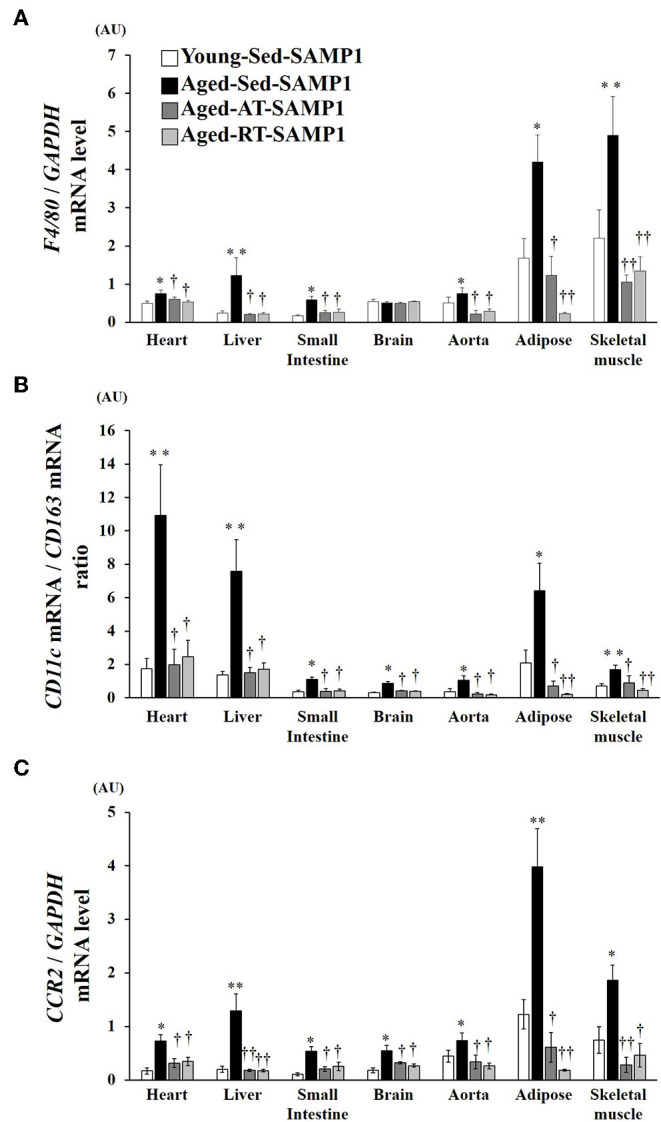
Age-induced chronic inflammation is prevented by aerobic and resistance exercise training. However, the effects of the mechanism of exercise on chronic inflammation in each tissue remains unclear. The aim of this study was to investigate the effects of resistance and aerobic training on gene expression profiles for macrophage infiltration and polarization (M1/M2 ratio) with chronic inflammation in various tissues of aged model mice. Male 38-week-old SAMP1 (senescence-accelerated prone mouse 1) mice were randomly divided into three groups-sedentary (Aged-Sed-SAMP1), aerobic training (Aged-AT-SAMP1; voluntary running), and resistance training-for 12 weeks (Aged-RT-SAMP1; climbing ladder). Resistance and aerobic exercise training prevented an increase in circulating TNF-α levels (a marker of systemic inflammation) in aged SAMP1 mice, along with decreases in tissue inflammatory cytokine (TNF-α and IL-1β) mRNA expression in the heart, liver, small intestine, brain, aorta, adipose, and skeletal muscle, but it did not change the levels in the lung, spleen, and large intestine. Moreover, resistance and aerobic exercise training attenuated increases in F4/80 mRNA expression (macrophage infiltration), the ratio of CD11c/CD163 mRNA expression (M1/M2 macrophage polarization), and MCP-1 mRNA expression (chemokine: a regulator of chronic inflammation) in the chronic inflamed tissues of aged SAMP1 mice. These results suggested that resistance and aerobic exercise training-induced changes in gene expression for macrophage infiltration and polarization in various tissues might be involved in the prevention of age-related tissue chronic inflammation, and lead to a reduction of the increase in circulating TNF-α levels, as a marker of systemic inflammation, in aged SAMP1 mice.
有氧运动和抗阻运动训练可预防年龄诱导的慢性炎症。然而,运动机制对各组织慢性炎症的影响仍不清楚。本研究旨在探讨抗阻训练和有氧运动训练对老年模型小鼠各组织慢性炎症中巨噬细胞浸润和极化(M1/M2 比值)基因表达谱的影响。将 38 周龄的雄性 SAMP1(衰老加速易感性小鼠 1)小鼠随机分为三组:久坐组(老年 - 久坐 - SAMP1)、有氧运动训练组(老年 - 有氧运动训练 - SAMP1;自愿跑步)和抗阻训练组(老年 - 抗阻训练 - SAMP1;爬梯),为期 12 周。抗阻运动和有氧运动训练可防止老年 SAMP1 小鼠循环 TNF-α 水平(全身炎症标志物)升高,同时降低心脏、肝脏、小肠、大脑、主动脉、脂肪和骨骼肌中组织炎症细胞因子(TNF-α 和 IL-1β)的 mRNA 表达水平,但对肺、脾脏和大肠中的水平没有影响。此外,抗阻运动和有氧运动训练可减轻老年 SAMP1 小鼠慢性炎症组织中 F4/80 mRNA 表达(巨噬细胞浸润)、CD11c/CD163 mRNA 表达比值(M1/M2 巨噬细胞极化)和 MCP-1 mRNA 表达(趋化因子:慢性炎症调节剂)的升高。这些结果表明,抗阻运动和有氧运动训练诱导的各组织巨噬细胞浸润和极化基因表达变化可能参与预防与年龄相关的组织慢性炎症,并导致作为全身炎症标志物的老年 SAMP1 小鼠循环 TNF-α 水平升高幅度降低。