Flurin Pierre Henri, Tams Carl, Simovitch Ryan W, Knudsen Christopher, Roche Christopher, Wright Thomas W, Zuckerman Joseph, Schoch Bradley S
Clinique du Sport, Bordeaux, France.
Exactech, Gainesville, FL, USA.
JSES Int. 2020 Jul 27;4(4):923-928. doi: 10.1016/j.jseint.2020.07.001. eCollection 2020 Dec.
Contemporary studies note sustained clinical benefit and decreasing complications after reverse total shoulder arthroplasty (RTSA), which warrant a comparison with the standard anatomic total shoulder arthroplasty (ATSA). The purpose of this study is to evaluate and compare differences in midterm survivorship between ATSA and RTSA patients treated with a single platform shoulder prosthesis. Secondary objectives include a comparison of the clinical outcomes and complication profile for each procedure.
A prospective analysis of all primary ATSA and RTSA performed by 3 surgeons between 2007 and 2012 was conducted. Selection of the ATSA or RTSA implant configuration was determined by the surgeons per their clinical understanding of each individual patient's glenoid morphology, rotator cuff, and patient expectations. All 778 procedures were performed using a single platform shoulder system.
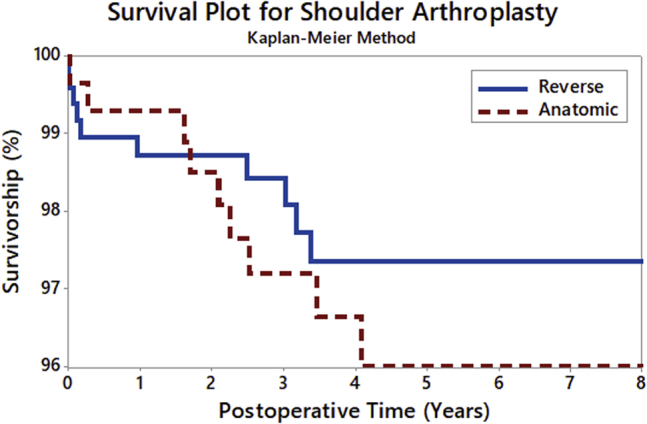
Survivorship for ATSA was similar to that for RTSA at all time points; ATSA at 2 and 8 years was 98.5% and 96.0%, whereas RTSA at 2 and 8 years was 98.7% and 96.0%, respectively ( = .392). All postoperative range of motion scores for ATSA patients were greater than those for RTSA patients. The overall rate of complications between the ATSA and RTSA groups was similar (6.3% vs. 4.9%, = .414).
On the basis of this cohort comparison, both ATSA and RTSA demonstrated similar survivorship at 8 years after surgery with multiple surgeons practicing in different countries. Our results demonstrate that the RTSA and ATSA implants have comparable results and can be expected to provide similar implant longevity over the midterm with excellent functional outcomes.
当代研究指出,反向全肩关节置换术(RTSA)术后具有持续的临床益处且并发症减少,这值得与标准解剖型全肩关节置换术(ATSA)进行比较。本研究的目的是评估和比较接受单平台肩关节假体治疗的ATSA和RTSA患者的中期生存率差异。次要目标包括比较每种手术的临床结果和并发症情况。
对2007年至2012年间3位外科医生进行的所有初次ATSA和RTSA手术进行前瞻性分析。ATSA或RTSA植入物配置的选择由外科医生根据他们对每个患者的关节盂形态、肩袖和患者期望的临床理解来确定。所有778例手术均使用单平台肩关节系统进行。
在所有时间点,ATSA的生存率与RTSA相似;ATSA在2年和8年时分别为98.5%和96.0%,而RTSA在2年和8年时分别为98.7%和96.0%(P = 0.392)。ATSA患者术后所有活动范围评分均高于RTSA患者。ATSA组和RTSA组的总体并发症发生率相似(6.3%对4.9%,P = 0.414)。
基于这一队列比较,在不同国家执业的多位外科医生进行手术的情况下,ATSA和RTSA在术后8年的生存率相似。我们的结果表明,RTSA和ATSA植入物具有可比的结果,并且在中期可以预期提供相似的植入物使用寿命以及出色的功能结果。