Department of Human Molecular Genetics & Biochemistry, Sackler Faculty of Medicine & Sagol School of Neuroscience, Tel Aviv University, Tel Aviv, Israel.
School of Neurobiology, Biochemistry and Biophysics, George S. Wise Faculty of Life Sciences, Tel Aviv University, Tel Aviv, Israel.
EMBO Mol Med. 2021 Feb 5;13(2):e13259. doi: 10.15252/emmm.202013259. Epub 2020 Dec 22.
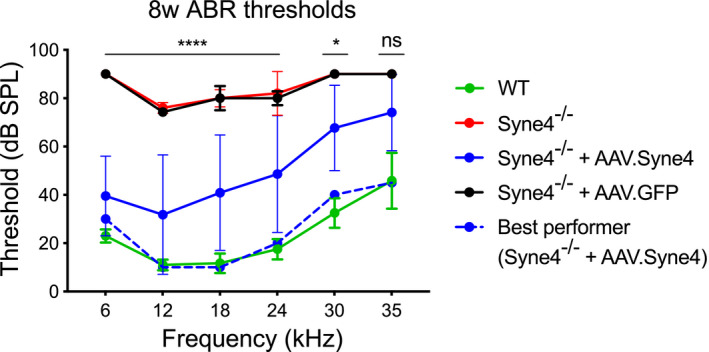
Genetic variants account for approximately half the cases of congenital and early-onset deafness. Methods and technologies for viral delivery of genes into the inner ear have evolved over the past decade to render gene therapy a viable and attractive approach for treatment. Variants in SYNE4, encoding the protein nesprin-4, a member of the linker of nucleoskeleton and cytoskeleton (LINC), lead to DFNB76 human deafness. Syne4 mice have severe-to-profound progressive hearing loss and exhibit mislocalization of hair cell nuclei and hair cell degeneration. We used AAV9-PHP.B, a recently developed synthetic adeno-associated virus, to deliver the coding sequence of Syne4 into the inner ears of neonatal Syne4 mice. Here we report rescue of hair cell morphology and survival, nearly complete recovery of auditory function, and restoration of auditory-associated behaviors, without observed adverse effects. Uncertainties remain regarding the durability of the treatment and the time window for intervention in humans, but our results suggest that gene therapy has the potential to prevent hearing loss in humans with SYNE4 mutations.
遗传变异约占先天性和早发性耳聋病例的一半。在过去十年中,用于将基因递送到内耳的病毒传递方法和技术已经发展起来,使得基因治疗成为一种可行且有吸引力的治疗方法。编码核纤层和细胞骨架(LINC)连接蛋白 nesprin-4 的 SYNE4 蛋白变异导致 DFNB76 型人类耳聋。Syne4 小鼠表现出严重至重度进行性听力损失,并表现出毛细胞核的定位错误和毛细胞变性。我们使用了最近开发的合成腺相关病毒 AAV9-PHP.B,将 Syne4 的编码序列递送到新生 Syne4 小鼠的内耳中。在这里,我们报告了毛细胞形态和存活的恢复,听觉功能几乎完全恢复,以及听觉相关行为的恢复,没有观察到不良反应。关于治疗的持久性和人类干预的时间窗口仍存在不确定性,但我们的结果表明,基因治疗有可能预防具有 SYNE4 突变的人类听力损失。