Departments of Otolaryngology and Neurology, Boston Children's Hospital and Harvard Medical School, Boston, MA 02115, USA.
Brain Mind Institute, Ecole Polytechnique Fédérale de Lausanne, Station 19, 1015 Lausanne, Switzerland.
Mol Ther. 2021 Mar 3;29(3):973-988. doi: 10.1016/j.ymthe.2020.11.016. Epub 2020 Nov 17.
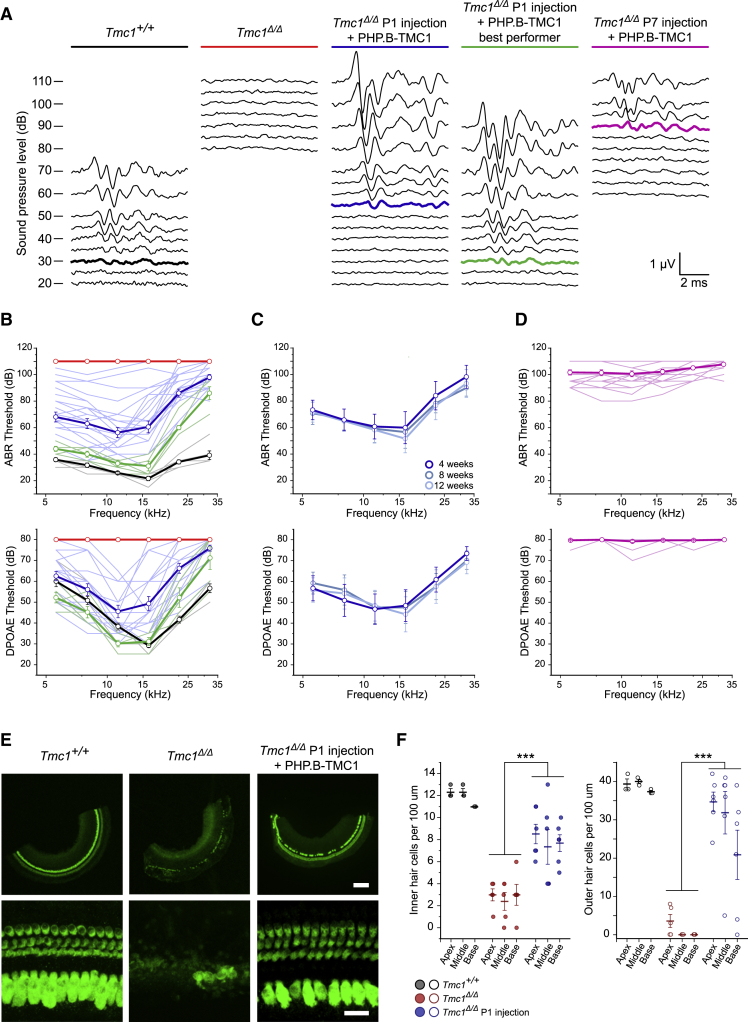
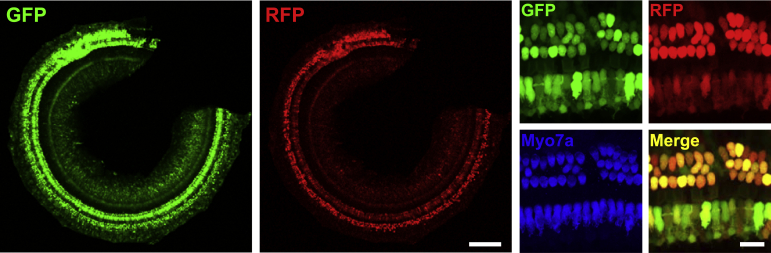
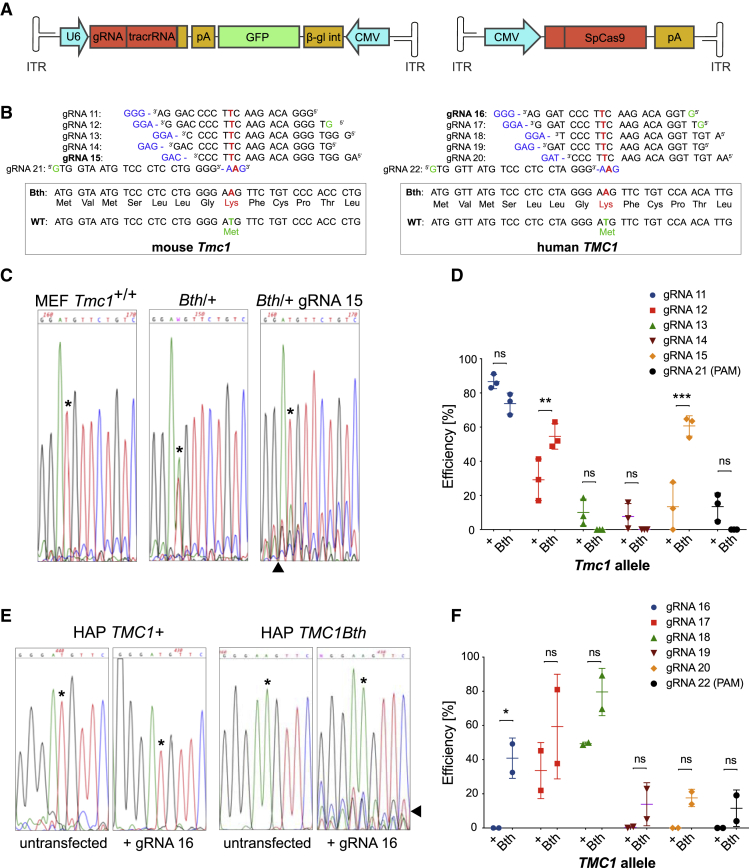
AAV-mediated gene therapy is a promising approach for treating genetic hearing loss. Replacement or editing of the Tmc1 gene, encoding hair cell mechanosensory ion channels, is effective for hearing restoration in mice with some limitations. Efficient rescue of outer hair cell function and lack of hearing recovery with later-stage treatment remain issues to be solved. Exogenous genes delivered with the adeno-associated virus (AAV)9-PHP.B capsid via the utricle transduce both inner and outer hair cells of the mouse cochlea with high efficacy. Here, we demonstrate that AAV9-PHP.B gene therapy can promote hair cell survival and successfully rescues hearing in three distinct mouse models of hearing loss. Tmc1 replacement with AAV9-PHP.B in a Tmc1 knockout mouse rescues hearing and promotes hair cell survival with equal efficacy in inner and outer hair cells. The same treatment in a recessive Tmc1 hearing-loss model, Baringo, partially recovers hearing even with later-stage treatment. Finally, dual delivery of Streptococcus pyogenes Cas9 (SpCas9) and guide RNA (gRNA) in separate AAV9-PHP.B vectors selectively disrupts a dominant Tmc1 allele and preserves hearing in Beethoven mice, a model of dominant, progressive hearing loss. Tmc1-targeted gene therapies using single or dual AAV9-PHP.B vectors offer potent and versatile approaches for treating dominant and recessive deafness.
腺相关病毒(AAV)介导的基因治疗是治疗遗传性听力损失的一种很有前途的方法。对编码毛细胞机械感觉离子通道的 Tmc1 基因进行替换或编辑,对于某些局限性的小鼠听力恢复是有效的。外毛细胞功能的有效挽救以及后期治疗缺乏听力恢复仍然是需要解决的问题。通过耳石转导,腺相关病毒(AAV)9-PHP.B 衣壳携带的外源性基因可以高效转导小鼠耳蜗的内毛细胞和外毛细胞。在这里,我们证明 AAV9-PHP.B 基因治疗可以促进毛细胞的存活,并成功挽救三种不同的听力损失小鼠模型的听力。用 AAV9-PHP.B 替换 Tmc1 敲除小鼠中的 Tmc1,可以挽救听力,并在内毛细胞和外毛细胞中具有同等的效果促进毛细胞的存活。在隐性 Tmc1 听力损失模型 Baringo 中,相同的治疗方法即使在后期治疗也能部分恢复听力。最后,在单独的 AAV9-PHP.B 载体中双重递送酿脓链球菌 Cas9(SpCas9)和向导 RNA(gRNA)选择性地破坏显性 Tmc1 等位基因,并保留贝多芬小鼠(一种显性、进行性听力损失的模型)的听力。使用单或双 AAV9-PHP.B 载体的 Tmc1 靶向基因治疗提供了治疗显性和隐性耳聋的有效和多功能方法。