Department of Biomedical Engineering, The Hong Kong Polytechnic University, Hong Kong, China.
Sensors (Basel). 2020 Dec 19;20(24):7317. doi: 10.3390/s20247317.
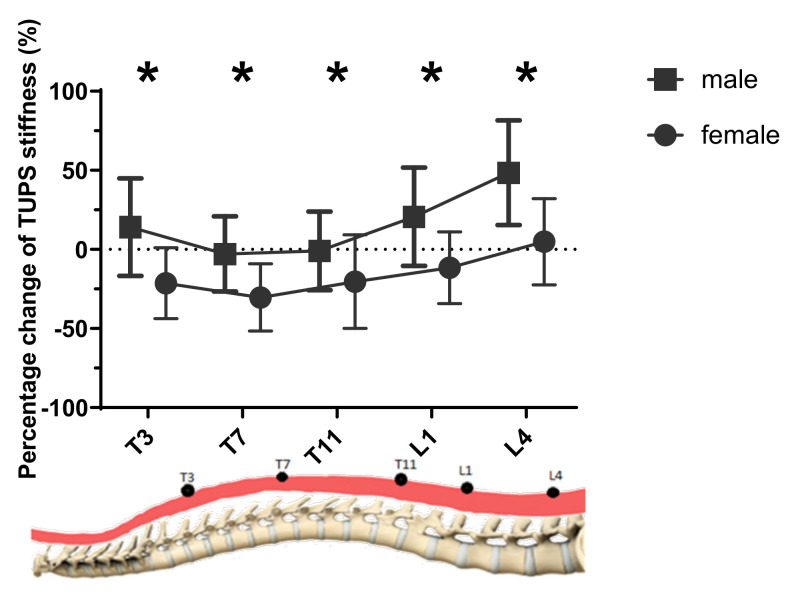
Muscle stiffness in the spinal region is essential for maintaining spinal function, and might be related to multiple spinal musculoskeletal disorders. However, information on the distribution of muscle stiffness along the spine in different postures in large subject samples has been lacking, which merits further investigation. This study introduced a new protocol of measuring bilateral back muscle stiffness along the thoracic and lumbar spine (at T3, T7, T11, L1 & L4 levels) with both ultrasound shear-wave elastography (SWE) and tissue ultrasound palpation system (TUPS) in the lying and standing postures of 64 healthy adults. Good inter-/intra-reliability existed in the SWE and TUPS back muscle stiffness measurements (ICC ≥ 0.731, < 0.05). Back muscle stiffness at the L4 level was found to be the largest in the thoracic and lumbar regions ( < 0.05). The back muscle stiffness of males was significantly larger than that of females in both lying and standing postures ( < 0.03). SWE stiffness was found to be significantly larger in standing posture than lying among subjects ( < 0.001). It is reliable to apply SWE and TUPS to measure back muscle stiffness. The reported data on healthy young adults in this study may also serve as normative reference data for future studies on patients with scoliosis, low back pain, etc.
脊柱区域的肌肉僵硬对于维持脊柱功能至关重要,并且可能与多种脊柱肌肉骨骼疾病有关。然而,缺乏关于在大样本中不同姿势下脊柱肌肉僵硬在脊柱上分布的信息,这值得进一步研究。本研究在 64 名健康成年人的仰卧位和站立位时,引入了一种新的测量双侧背部肌肉僵硬的方案,使用超声剪切波弹性成像(SWE)和组织超声触诊系统(TUPS)分别测量胸腰椎(T3、T7、T11、L1 和 L4 水平)的背部肌肉僵硬。SWE 和 TUPS 背部肌肉僵硬测量具有良好的组内/间可靠性(ICC≥0.731, < 0.05)。在胸腰椎区域,L4 水平的背部肌肉僵硬最大( < 0.05)。在仰卧位和站立位时,男性的背部肌肉僵硬均显著大于女性( < 0.03)。与仰卧位相比,站立位时 SWE 硬度显著增加( < 0.001)。SWE 和 TUPS 可用于测量背部肌肉僵硬,其可靠性已得到验证。本研究中报告的健康年轻成年人的数据也可以作为未来研究脊柱侧凸、腰痛等患者的参考标准数据。