He Chen, Yang Jian-Tao, Zheng Qian, Mei Zhao, Ma Christina Zong-Hao
Institute of Rehabilitation Engineering and Technology, University of Shanghai for Science and Technology, Shanghai 200093, China.
Department of Rehabilitation Medicine, Tongji Hospital, Tongji Medical College, Huazhong University of Science and Technology, Wuhan 430030, China.
Bioengineering (Basel). 2022 May 27;9(6):234. doi: 10.3390/bioengineering9060234.
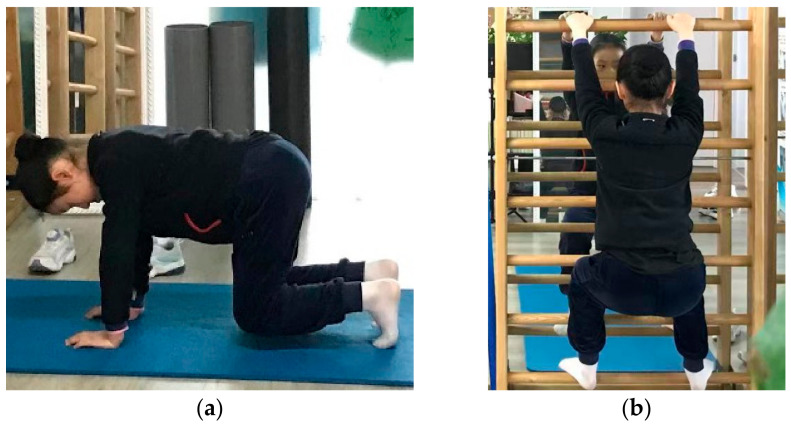
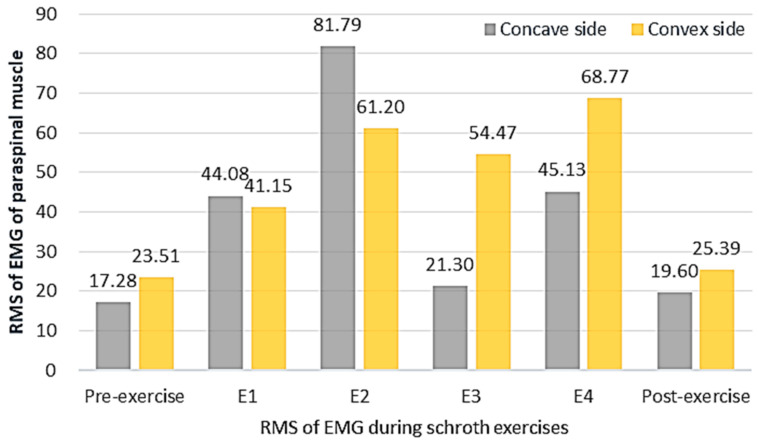
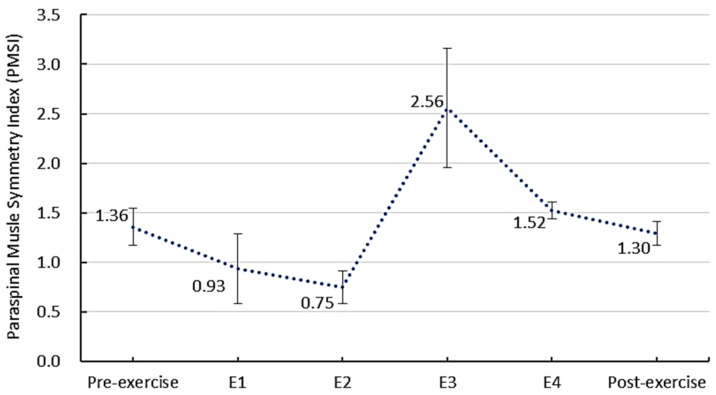
The Schroth exercise can train the paraspinal muscles of patients with adolescent idiopathic scoliosis (AIS), however, muscle performance during the training remains unknown. This study applied surface electromyography (sEMG) to investigate the paraspinal muscle activities before, during and after Schroth exercise in nine AIS patients. This study found that after the Schroth exercise, the paraspinal muscle symmetry index (PMSI) was significantly reduced (PMSI = 1.3), while symmetry exercise significantly lowered the PMSI (PMSI = 0.93 and 0.75), and asymmetric exercise significantly increased the PMSI (PMSI = 2.56 and 1.52) compared to relax standing (PMSI = 1.36) in participants (p < 0.05). Among the four exercises, the PMSI of on all fours (exercise 1) and kneeling on one side (exercise 3) was the most and the least close to 1, respectively. The highest root mean square (RMS) of sEMG at the concave and convex side was observed in squatting on the bar (exercise 2) and sitting with side bending (exercise 4), respectively. This study observed that the asymmetric and symmetric exercise induced more sEMG activity on the convex and concave side, respectively, and weight bearing exercise activated more paraspinal muscle contractions on both sides of the scoliotic curve in the included AIS patients. A larger patient sample size needs to be investigated in the future to validate the current observations.
施罗斯疗法可以训练青少年特发性脊柱侧弯(AIS)患者的椎旁肌,然而,训练过程中的肌肉表现尚不清楚。本研究应用表面肌电图(sEMG)来调查9例AIS患者在施罗斯疗法之前、期间和之后的椎旁肌活动。本研究发现,施罗斯疗法后,椎旁肌对称指数(PMSI)显著降低(PMSI = 1.3),而对称运动显著降低了PMSI(PMSI = 0.93和0.75),与参与者放松站立(PMSI = 1.36)相比,不对称运动显著增加了PMSI(PMSI = 2.56和1.52)(p < 0.05)。在这四种运动中,四肢着地(运动1)和单侧跪立(运动3)的PMSI分别最接近和最远离1。在杠铃深蹲(运动2)和侧屈坐姿(运动4)中,分别观察到凹侧和凸侧sEMG的均方根(RMS)最高。本研究观察到,不对称运动和对称运动分别在凸侧和凹侧诱导了更多的sEMG活动,负重运动激活了纳入研究的AIS患者脊柱侧弯曲线两侧更多的椎旁肌收缩。未来需要研究更大的患者样本量来验证当前的观察结果。