Basu Sandip, Parghane Rahul V, Naik Chinna
Radiation Medicine Centre, Bhabha Atomic Research Centre, Tata Memorial Centre Annexe, Mumbai, Maharashtra, India.
Homi Bhabha National Institute, Mumbai, Maharashtra, India.
World J Nucl Med. 2020 Jul 1;19(3):205-210. doi: 10.4103/wjnm.WJNM_21_19. eCollection 2020 Jul-Sep.
This study aimed at assessing the performance of Lu-DOTATATE-based peptide receptor radionuclide therapy (PRRT) in de-differentiated thyroid carcinoma thyroglobulin-elevated negative iodine scintigraphy (TENIS) in terms of clinical efficacy and outcome. This is a retrospective analysis of patients of TENIS who had undergone PRRT in a tertiary care setting. The selected patients were analyzed for the following parameters: (i) the patient characteristics, (ii) the metastatic burden, (iii) study of PRRT cycles and activity, (iv) response assessment (undertaken by three-parameter scale: symptomatic including Karnofsky/Lansky Performance scoring, biochemical and scan features) employing predefined criteria (detailed in methods), and (v) Grade III/IV hematological or renal toxicity. According to the qualitative uptake of the tracer in somatostatin receptor (SSTR)-based imaging (with either Tc-HYNIC-TOC/Ga-DOTATATE), the lesions were divided into the following four categories: Grade 0: no uptake, Grade I: uptake less than the liver but more than background, Grade II: uptake equal to the liver, and Grade III: uptake more than the liver. A total of eight patients of TENIS who had undergone Lu-DOTATATE were retrieved. Among those eight patients, the follow-up duration (from the time of the 1 PRRT cycle) at the time of analysis ranged from 7 to 52 months, with an average of 34 months. At the time of assessment, two (25%) out of the eight patients had expired due to extensive metastatic disease and 6 (75%) were alive. On symptomatic response, complete disappearance of symptoms was found in one patient (12.5%), whereas three patients (37.5%) showed partial improvement in symptoms after PRRT and four patients (50%) showed worsening of and appearance of new symptoms. On biochemical response, reduction in serum thyroglobulin (TG) was found in three patients (37.5%) after PRRT and increase in serum TG was noticed in the rest of five patients (62.5%). Imaging response showed stable scan in two patients (25%) and progressive disease (PD) in six patients (75%), following a progression-free survival ranging from 7 to 16 months, when they were considered for tyrosine kinase inhibitors in view of PD. There was no obvious evidence of Grade III/IV hematological or renal toxicity in any of the patients, suggesting that the therapy in this group of patients is well tolerated. In addition, we also observed that most patients of TENIS showed low-grade uptake on SSTR-based imaging (Grade II as per our semi-quantitative scale), with only one patient showing Grade III uptake. Lu-DOTATATE PRRT demonstrates modest response in SSTR-positive metastatic TENIS patients: (i) low SSTR expression and tracer avidity, and correspondingly lesser degree of targeting by the therapeutic agent and (ii) the fact that most of the TENIS patients usually have fluorodeoxyglucose (FDG)-avid disease, where high FDG avidity is commensurate with aggressive biology and could be the reason for the relatively less response documented. Larger prospective data need to be accrued in this domain in view of its well tolerability and nonavailability of better efficacious and less toxic treatment at present; however, this needs to be tried in receptor-positive cases with high-grade uptake (Score III/IV) for a definitive conclusion.
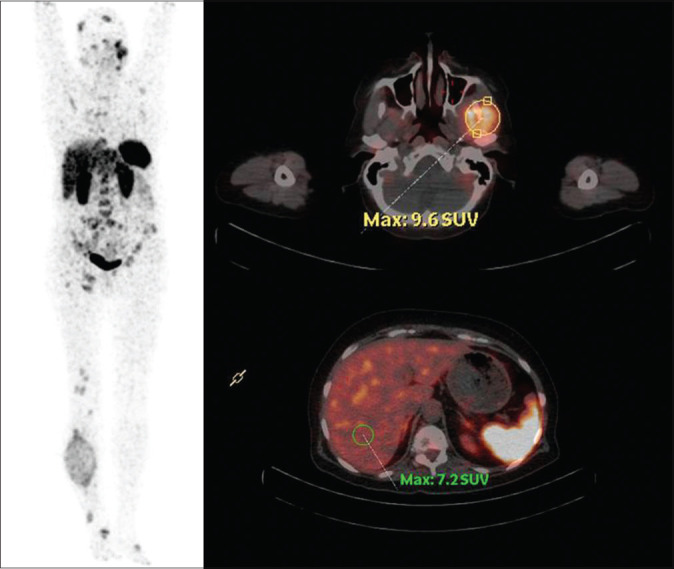
本研究旨在评估基于镥- DOTATATE的肽受体放射性核素治疗(PRRT)在去分化甲状腺癌甲状腺球蛋白升高的碘阴性闪烁扫描(TENIS)中的临床疗效和结果。这是一项对在三级医疗机构接受PRRT治疗的TENIS患者的回顾性分析。对所选患者分析了以下参数:(i)患者特征,(ii)转移负担,(iii)PRRT周期和活性研究,(iv)使用预定义标准(方法中详述)进行反应评估(采用三参数量表:包括卡诺夫斯基/兰斯基表现评分的症状、生化和扫描特征),以及(v)III/IV级血液学或肾脏毒性。根据基于生长抑素受体(SSTR)成像(使用Tc - HYNIC - TOC/Ga - DOTATATE)中示踪剂的定性摄取,病变分为以下四类:0级:无摄取,I级:摄取低于肝脏但高于背景,II级:摄取等于肝脏,III级:摄取高于肝脏。共检索到8例接受镥- DOTATATE治疗的TENIS患者。在这8例患者中,分析时的随访时间(从第1次PRRT周期开始)为7至52个月,平均34个月。评估时,8例患者中有2例(25%)因广泛转移性疾病死亡,6例(75%)存活。在症状反应方面,1例患者(12.5%)症状完全消失,而3例患者(37.5%)PRRT后症状部分改善,4例患者(50%)症状恶化并出现新症状。在生化反应方面,3例患者(37.5%)PRRT后血清甲状腺球蛋白(TG)降低,其余5例患者(62.5%)血清TG升高。成像反应显示2例患者(25%)扫描稳定,6例患者(75%)疾病进展(PD),在考虑使用酪氨酸激酶抑制剂治疗PD时,无进展生存期为7至16个月。所有患者均无明显的III/IV级血液学或肾脏毒性证据,表明该组患者对该治疗耐受性良好。此外,我们还观察到大多数TENIS患者在基于SSTR的成像中显示低级别摄取(根据我们的半定量量表为II级),只有1例患者显示III级摄取。镥- DOTATATE PRRT在SSTR阳性转移性TENIS患者中显示出适度反应:(i)SSTR表达和示踪剂亲和力低,相应地治疗剂靶向程度较低;(ii)大多数TENIS患者通常患有氟脱氧葡萄糖(FDG)摄取阳性疾病,其中高FDG摄取与侵袭性生物学相关,可能是记录的反应相对较少的原因。鉴于其良好的耐受性以及目前缺乏更好的有效且低毒的治疗方法,需要在该领域积累更多的前瞻性数据;然而,需要在高级别摄取(评分III/IV)的受体阳性病例中进行尝试以得出明确结论。
