Parghane Rahul V, Talole Sanjay, Basu Sandip
Radiation Medicine Centre, Bhabha Atomic Research Centre, Tata Memorial Hospital Annexe, Mumbai, Maharashtra, India.
Homi Bhabha National Institute, Mumbai, Maharashtra, India.
World J Nucl Med. 2019 Apr-Jun;18(2):160-170. doi: 10.4103/wjnm.WJNM_39_18.
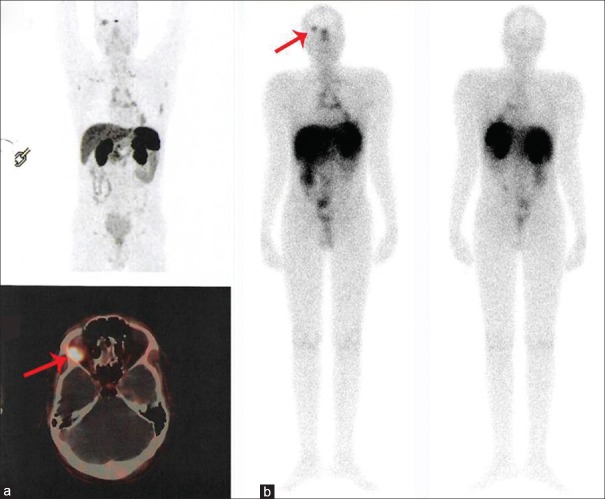
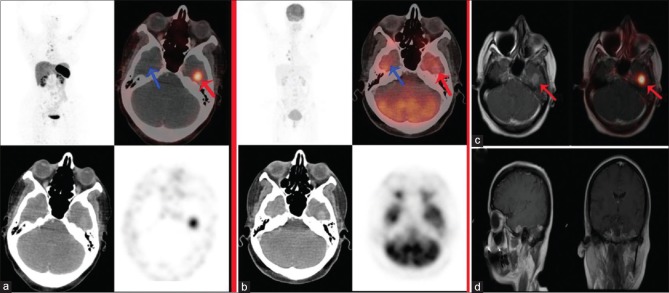
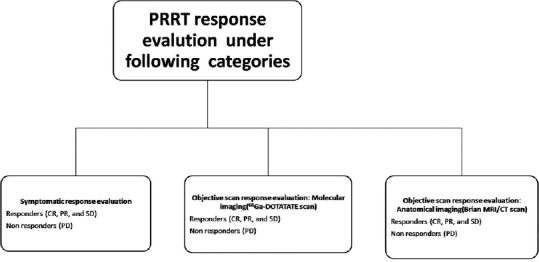
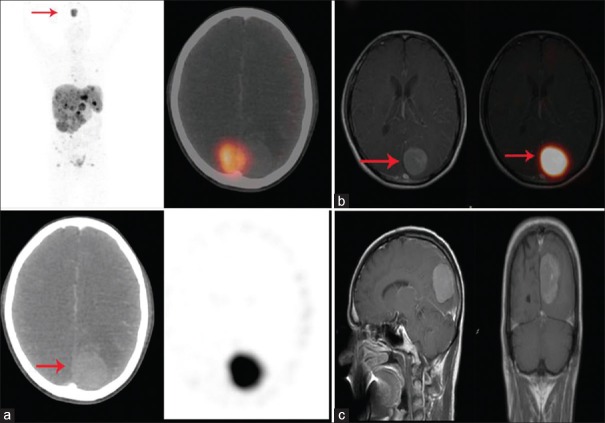
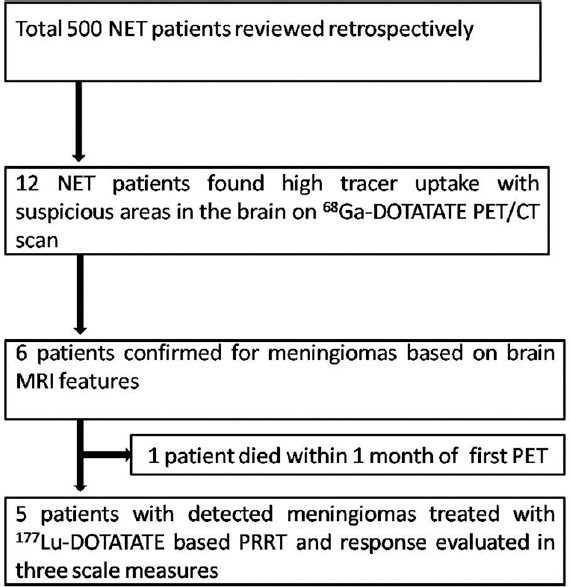
There is a relative paucity of data in the literature regarding the prevalence of meningiomas and their detection in the clinical setting of neuroendocrine tumors (NETs). The primary aim of this study was to study incidentally detected meningiomas (on Ga-DOTATATE/ F fluorodeoxyglucose positron-emission tomography/computed tomography [F-FDG PET/CT]) in metastatic NET patients referred for peptide receptor radionuclide therapy (PRRT). The secondary aims of this study were to evaluate the response rate of these incidentally detected meningiomas following PRRT and determine progression-free survival (PFS) in this group of patients. This was a retrospective analysis of 500 metastatic/advanced NET patients who had undergone Ga-DOTATATE PET/CT and F-FDG PET/CT before PRRT workup. The case records were searched to identify cases of hitherto unknown meningiomas detected on PET images; subsequently, these patients underwent brain magnetic resonance imaging (MRI) for confirmation of diagnosis. Following Lu-DOTATATE PRRT, posttreatment functional and structural imaging response evaluation of the meningiomas were undertaken by Ga-DOTATATE PET/CT, MRI, or CT brain, respectively, along with clinical neurological evaluation. The patients were designated as responders and nonresponders based on predefined response assessment criteria. The PFS of these incidentally detected meningiomas following PRRT was estimated using the Kaplan-Meier product-limit method. Twelve NET patients were retrospectively identified with abnormal focal brain uptake on Ga-DOTATATE PET/CT. Of these, meningiomas were finally diagnosed on brain MRI examination in six patients (M: =3:3; age range: 30-66 years; and mean age: 45 years), with a prevalence of 1.2%. Standardized uptake value (SUVmax) of meningiomas on Ga-DOTATATE and F-FDG PET/CT ranged from 7.0 to 22.0 (average 17.0) and 10.19-13.70 (mean: 12.10), respectively, and lesion-to-normal brain parenchyma SUVmax ratio ranged from 140 to 400 (mean: 340) and 1.02-1.07 (mean: 1.04), respectively. Of six patients with incidentally detected meningiomas, one patient died within 1 month and five patients received Lu-DOTATATE PRRT, the number of cycles ranging from two to six (average: 4) and cumulative therapeutic dose ranging from 13.28 to 29.97GBq (average dose: 19.86GBq). Follow-up in these patients ranged from 8 to 36 months (mean: 19.4 months) after the first dose of PRRT. Complete disappearance of neurological symptoms was found in two of five patients (40%), partial response in one of five (20%), and worsening of symptoms in two of five patients (40%). The overall "responder" and "nonresponder" of the meningiomas after PRRT were three patients (60%) and two patients (40%), respectively. Two patients (40%) died of advanced NET at the time of analysis of these data. The observed mean PFS of the meningioma lesions following PRRT was 26.25 months (95% confidence interval, 16.65-35.84 months). No major hematological and renal toxicity were documented in any of these patients. To conclude, Ga-DOTATATE PET/CT imaging is an effective technique for the incidental identification of meningioma in NET patients. Considering the limited therapeutic options in the palliative setting of advanced or metastatic NET patients and morbidity associated with the therapeutic procedures, PRRT could be a promising targeted therapeutic approach for such cases of incidentally detected meningiomas, which is also helpful in stabilizing the disease process without any significant toxicity.
关于脑膜瘤的患病率及其在神经内分泌肿瘤(NETs)临床环境中的检测,文献中的数据相对较少。本研究的主要目的是研究在接受肽受体放射性核素治疗(PRRT)的转移性NET患者中偶然发现的脑膜瘤(通过镓 - DOTATATE/氟脱氧葡萄糖正电子发射断层扫描/计算机断层扫描[F-FDG PET/CT])。本研究的次要目的是评估PRRT后这些偶然发现的脑膜瘤的缓解率,并确定该组患者的无进展生存期(PFS)。这是一项对500例转移性/晚期NET患者的回顾性分析,这些患者在PRRT检查前接受了镓 - DOTATATE PET/CT和F-FDG PET/CT检查。检索病例记录以识别PET图像上检测到的迄今未知的脑膜瘤病例;随后,这些患者接受脑磁共振成像(MRI)以确诊。在进行镥 - DOTATATE PRRT后,分别通过镓 - DOTATATE PET/CT、MRI或脑部CT对脑膜瘤进行治疗后功能和结构成像反应评估,同时进行临床神经学评估。根据预先定义的反应评估标准,将患者分为反应者和无反应者。使用Kaplan-Meier乘积限法估计PRRT后这些偶然发现的脑膜瘤的PFS。回顾性确定12例NET患者在镓 - DOTATATE PET/CT上有异常局灶性脑摄取。其中,6例患者最终通过脑MRI检查确诊为脑膜瘤(男性:3例;女性:3例;年龄范围:30 - 66岁;平均年龄:45岁),患病率为1.2%。脑膜瘤在镓 - DOTATATE和F-FDG PET/CT上的标准化摄取值(SUVmax)分别为7.0至22.0(平均17.0)和10.19 - 13.70(平均:12.10),病变与正常脑实质的SUVmax比值分别为140至400(平均:340)和1.02 - 1.07(平均:1.04)。在6例偶然发现脑膜瘤的患者中,1例患者在1个月内死亡,5例患者接受了镥 - DOTATATE PRRT,疗程数为2至6个(平均:4个),累积治疗剂量为13.28至29.97GBq(平均剂量:19.86GBq)。这些患者在首次PRRT剂量后的随访时间为8至36个月(平均:19.4个月)。5例患者中有2例(40%)神经症状完全消失,5例中有1例(20%)部分缓解,5例中有2例(40%)症状恶化。PRRT后脑膜瘤的总体“反应者”和“无反应者”分别为3例患者(60%)和2例患者(40%)。在分析这些数据时,2例患者(40%)死于晚期NET。PRRT后观察到的脑膜瘤病变的平均PFS为26.25个月(95%置信区间,16.65 - 35.84个月)。这些患者中均未记录到严重的血液学和肾脏毒性。总之,镓 - DOTATATE PET/CT成像对于NET患者中偶然发现脑膜瘤是一种有效的技术。考虑到晚期或转移性NET患者姑息治疗中的治疗选择有限以及治疗程序相关的发病率,PRRT可能是此类偶然发现脑膜瘤病例的一种有前景的靶向治疗方法,这也有助于稳定疾病进程且无任何明显毒性。