Chabbra S, Smith D M, Bell N L, Watson A J B, Bühl M, Cole-Hamilton D J, Bode B E
EaStCHEM School of Chemistry, University of St Andrews, St Andrews, Fife KY16 9ST, Scotland, UK.
Centre of Magnetic Resonance, University of St Andrews, St Andrews, Fife KY16 9ST, Scotland, UK.
Sci Adv. 2020 Dec 18;6(51). doi: 10.1126/sciadv.abd7057. Print 2020 Dec.
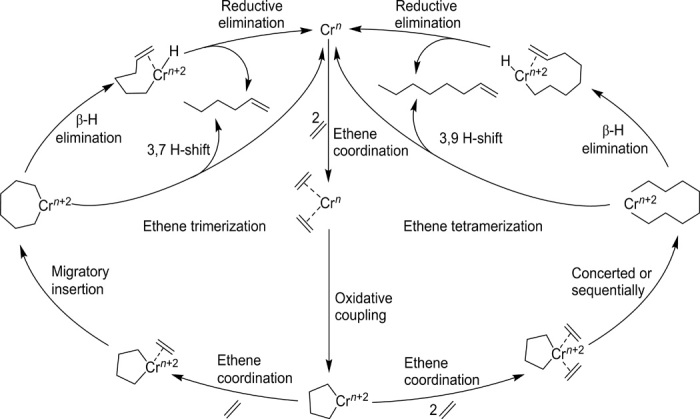
A bis-ethene chromium(I) species, which is the postulated key intermediate in the widely accepted metallacyclic mechanism for ethene oligomerization, is experimentally observed. This catalytic transformation is an important commercial route to linear α-olefins (primarily, 1-hexene and 1-octene), which act as comonomers for the production of polyethene. Here, electron paramagnetic resonance studies of a catalytic system based on [Cr(CO)(PNP)][Al(OC(CF))] [PNP = PhPN(Pr)PPh] activated with EtAl provide the first unequivocal evidence for a chromium(I) bis-ethene complex. The concentration of this species is enhanced under ethene and isotope labeling studies that confirm its composition as containing [Cr(CH)(CO)(PNP)] These observations open a new route to mechanistic studies of selective ethene oligomerization.
实验观察到一种双乙烯基铬(I)物种,它是广泛接受的乙烯齐聚金属环化机理中假定的关键中间体。这种催化转化是生产线性α-烯烃(主要是1-己烯和1-辛烯)的重要商业途径,这些α-烯烃用作生产聚乙烯的共聚单体。在此,对基于[Cr(CO)(PNP)][Al(OC(CF))] [PNP = PhPN(Pr)PPh]并用EtAl活化的催化体系进行的电子顺磁共振研究,为铬(I)双乙烯基配合物提供了首个明确证据。在乙烯下该物种的浓度会增加,同位素标记研究证实其组成为[Cr(CH)(CO)(PNP)]。这些观察结果为选择性乙烯齐聚的机理研究开辟了一条新途径。