Kirby Institute, University of New South Wales Sydney, Sydney, New South Wales, Australia.
Department of Health Systems and Populations, Macquarie University, Sydney, New South Wales, Australia.
JAMA Netw Open. 2020 Dec 1;3(12):e2030806. doi: 10.1001/jamanetworkopen.2020.30806.
There have been concerns that HIV preexposure prophylaxis (PrEP) may be associated with increases in sexually transmitted infections (STIs) because of subsequent reductions in condom use and/or increases in sexual partners.
To determine trends in STI test positivity among high-risk men who have sex with men (MSM) before and after the start of HIV PrEP.
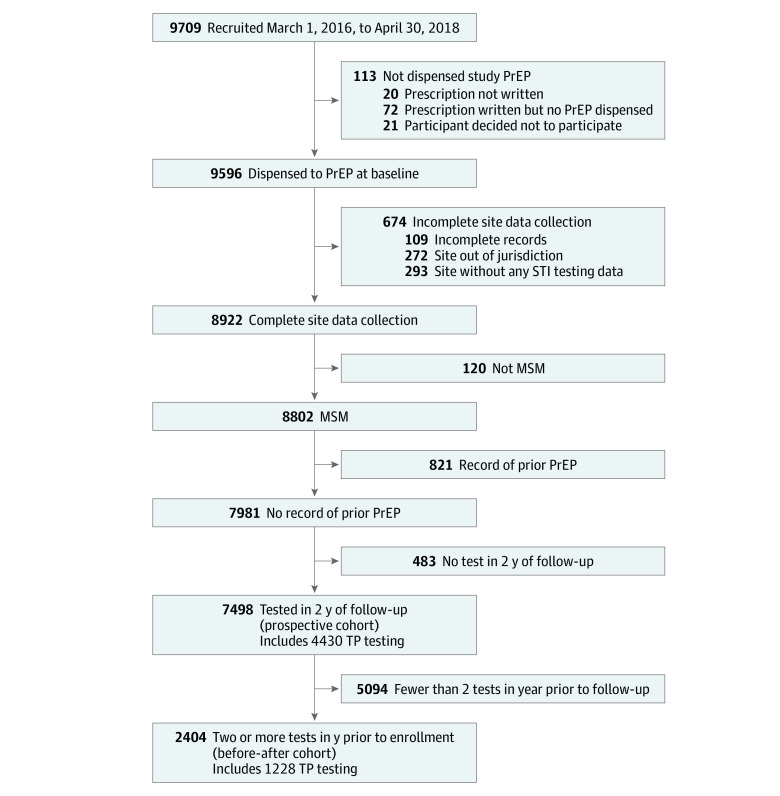
DESIGN, SETTING, AND PARTICIPANTS: A before-after analysis was conducted using a subcohort of a single-group PrEP implementation study cohort in New South Wales, Australia (Expanded PreEP Implementation in Communities in New South Wales [EPIC-NSW]), from up to 1 year before enrollment if after January 1, 2015, and up to 2 years after enrollment and before December 31, 2018. STI testing data were extracted from a network of 54 sexual health clinics and 6 primary health care clinics Australia-wide, using software to deidentify, encrypt, and anonymously link participants between clinics. A cohort of MSM dispensed PrEP for the first time during the study, with 2 or more STI tests in the prior year and who tested during follow-up, were included from the EPIC-NSW cohort of HIV-negative participants with high-risk sexual behavior. Data analysis was performed from June to December 2019.
Participants were dispensed coformulated tenofovir disoproxil fumarate (300 mg) and emtricitabine (200 mg) as HIV PrEP.
The main outcome was STI, measured using test positivity, defined as the proportion of participants testing positive for an STI at least once per quarter of follow-up. Outcomes were calculated for Chlamydia trachomatis and Neisseria gonorrhoea by site of infection (anorectal, pharyngeal, urethral, or any) and for syphilis.
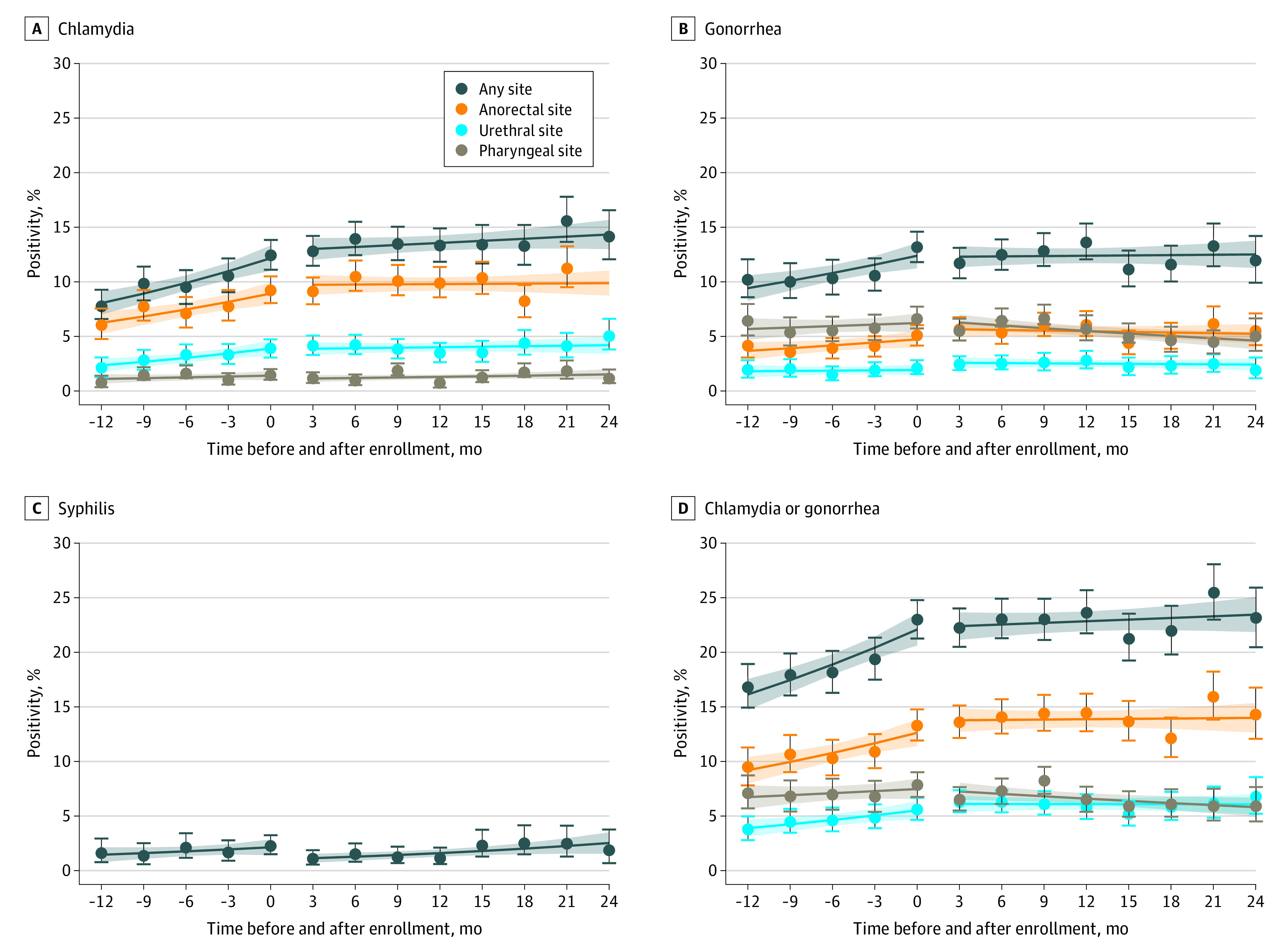
Of the EPIC-NSW cohort of 9709 MSM, 2404 were included in the before-after analysis. The mean (SD) age of the participants was 36 (10.4) years, and 1192 (50%) were Australia-born. STI positivity was 52% in the year after PrEP (23.3% per quarter; 95% CI, 22.5%-24.2% per quarter) with no significant trend (mean rate ratio [RR] increase of 1.01 per quarter [95% CI, 0.99-1.02]; P = .29), compared with 50% positivity in the year prior to PrEP (20.0% per quarter [95% CI, 19.04%-20.95% per quarter]; RR for overall STI positivity, 1.17 [95% CI, 1.10-1.24]; P < .001), with an increase in quarterly STI positivity (mean RR of 1.08 per quarter, or an 8% increase per quarter [95% CI, 1.05-1.11]; P < .001; RR, 0.93 [95% CI, 0.90-0.96]; P < .001). Findings were similar when stratified by specific STIs and anatomical site.
STI rates were high but stable among high-risk MSM while taking PrEP, compared with a high but increasing trend in STI positivity before commencing PrEP. These findings suggest the importance of considering trends in STIs when describing how PrEP use may be associated with STI incidence.
人们一直担心,由于随后避孕套使用减少和/或性伴侣增加,艾滋病毒暴露前预防(PrEP)可能与性传播感染(STI)的增加有关。
确定在澳大利亚新南威尔士州(EPIC-NSW)实施的一项 PrEP 实施研究队列中的高危男男性行为者(MSM)在开始 HIV PrEP 前后 STI 检测阳性率的趋势。
设计、地点和参与者:使用澳大利亚 54 家性健康诊所和 6 家初级保健诊所网络提取的 EPIC-NSW 队列中 HIV 阴性、高风险性行为的 MSM 队列的一项前瞻性分析,在 2015 年 1 月 1 日之后,如果在入组前一年,最多可在入组前一年,最多可在入组后 2 年,在 2018 年 12 月 31 日之前进行 STI 检测数据。从 EPIC-NSW 队列中首次开处 PrEP 的 MSM 队列中,在之前的一年中至少进行了两次 STI 检测且在随访期间进行了检测的 MSM 被纳入队列。使用软件对参与者进行去识别、加密和匿名链接,该软件可在澳大利亚各地的诊所之间进行链接。数据分析于 2019 年 6 月至 12 月进行。
参与者服用了替诺福韦二吡呋酯(300mg)和恩曲他滨(200mg)联合制剂作为 HIV PrEP。
主要结果是 STI,通过检测阳性率来衡量,定义为至少每季度一次检测呈阳性的参与者比例。根据感染部位(肛门直肠、咽、尿道或任何部位)和梅毒对沙眼衣原体和淋病奈瑟菌进行了结果计算。
在 EPIC-NSW 队列的 9709 名 MSM 中,有 2404 名纳入了前瞻性分析。参与者的平均(SD)年龄为 36(10.4)岁,其中 1192 名(50%)是澳大利亚出生的。PrEP 后一年的 STI 阳性率为 52%(每季度 23.3%;95%CI,每季度 22.5%-24.2%),无明显趋势(平均 RR 每季度增加 1.01 [95%CI,0.99-1.02];P = .29),而 PrEP 前一年的 STI 阳性率为 50%(每季度 20.0%;95%CI,每季度 19.04%-20.95%);总体 STI 阳性率的 RR 为 1.17 [95%CI,1.10-1.24];P < .001),STI 阳性率每季度增加 1.08(即每季度增加 8%;95%CI,1.05-1.11);P < .001;RR,0.93 [95%CI,0.90-0.96];P < .001)。按特定 STI 和解剖部位分层时,结果相似。
与开始使用 PrEP 前 STI 阳性率呈高但上升趋势相比,高危 MSM 在使用 PrEP 时 STI 发生率较高但稳定。这些发现表明,在描述 PrEP 使用如何与 STI 发病率相关时,考虑 STI 趋势的重要性。