Max Planck Institute for Polymer Research, Ackermannweg 10, 55128 Mainz, Germany.
Institute for Physical and Theoretical Chemistry, University of Regensburg, 93040 Regensburg, Germany.
Langmuir. 2021 Jan 12;37(1):469-477. doi: 10.1021/acs.langmuir.0c03132. Epub 2020 Dec 24.
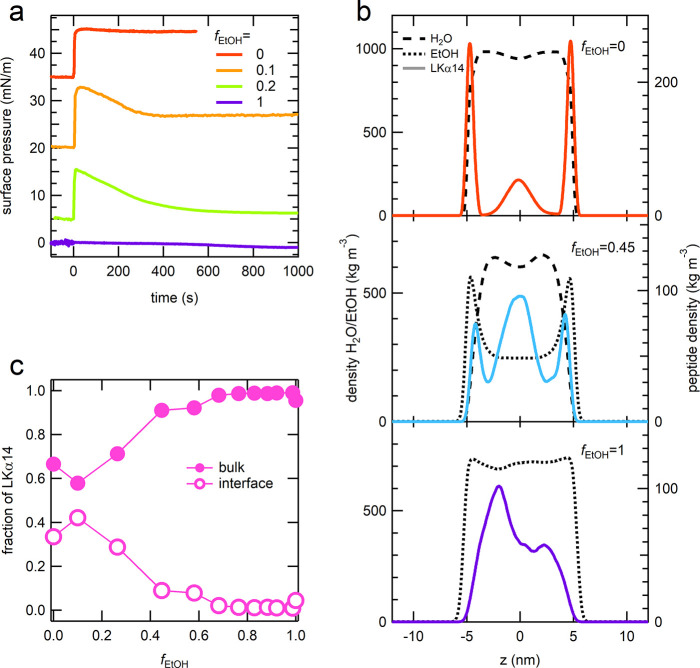
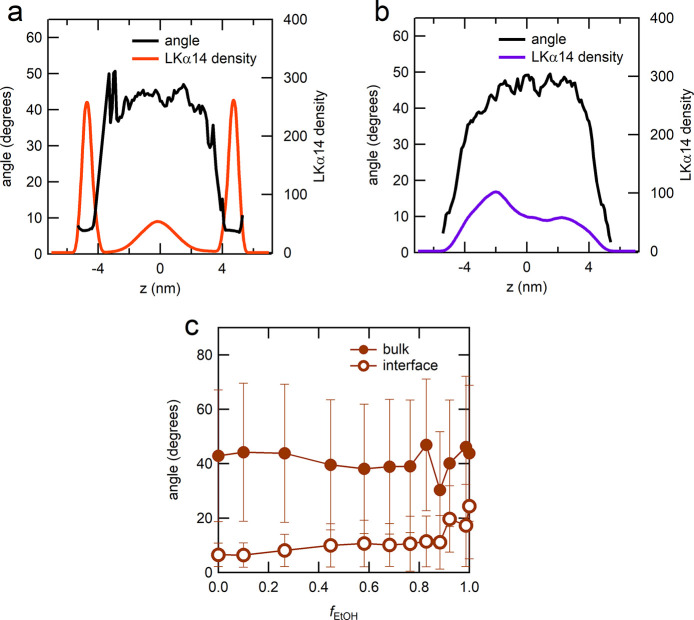
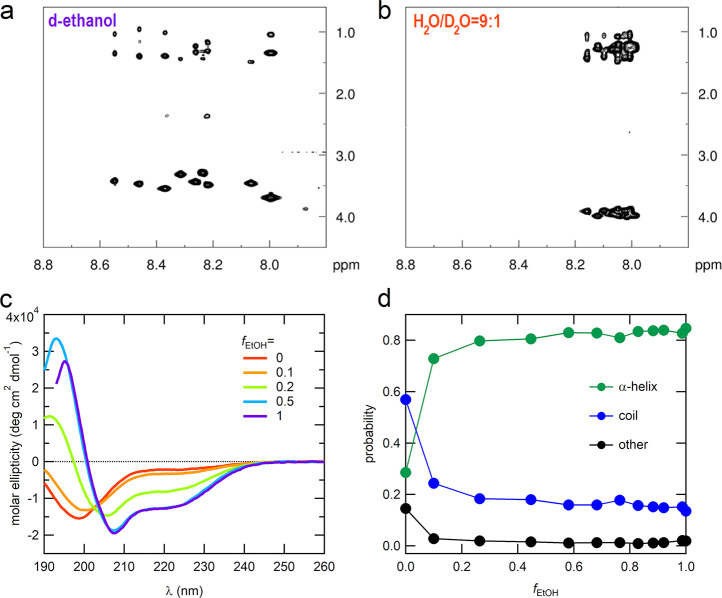
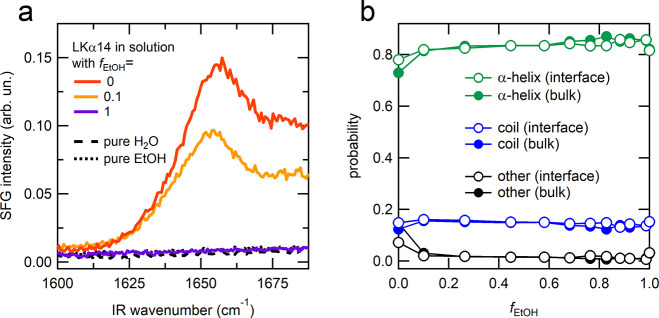
It is widely recognized that solvation is one of the major factors determining structure and functionality of proteins and long peptides, however it is a formidable challenge to address it both experimentally and computationally. For this reason, simple peptides are used to study fundamental aspects of solvation. It is well established that alcohols can change the peptide conformation and tuning of the alcohol content in solution can dramatically affect folding and, as a consequence, the function of the peptide. In this work, we focus on the leucine and lysine based LKα14 peptide designed to adopt an α-helical conformation at an apolar-polar interface. We investigate LKα14 peptide's bulk and interfacial behavior in water/ethanol mixtures combining a suite of experimental techniques (namely, circular dichroism and nuclear magnetic resonance spectroscopy for the bulk solution, surface pressure measurements and vibrational sum frequency generation spectroscopy for the air-solution interface) with molecular dynamics simulations. We observe that ethanol highly affects both the peptide location and conformation. At low ethanol content LKα14 lacks a clear secondary structure in bulk and shows a clear preference to reside at the air-solution interface. When the ethanol content in solution increases, the peptide's interfacial affinity is markedly reduced and the peptide approaches a stable α-helical conformation in bulk facilitated by the amphiphilic nature of the ethanol molecules.
人们普遍认为,溶剂化作用是决定蛋白质和长肽结构和功能的主要因素之一,但在实验和计算上都难以解决这个问题。出于这个原因,人们使用简单的肽来研究溶剂化的基本方面。已经确立的是,醇可以改变肽的构象,并且调节溶液中的醇含量可以显著影响折叠,从而影响肽的功能。在这项工作中,我们专注于基于亮氨酸和赖氨酸的 LKα14 肽,该肽旨在在非极性-极性界面处采用α-螺旋构象。我们通过一系列实验技术(即圆二色性和核磁共振波谱法用于研究本体溶液,表面压力测量和振动和频产生光谱法用于研究空气-溶液界面)结合分子动力学模拟,研究了 LKα14 肽在水/乙醇混合物中的本体和界面行为。我们观察到乙醇对肽的位置和构象都有很大的影响。在低乙醇含量下,LKα14 在本体中缺乏明确的二级结构,并且明显倾向于位于空气-溶液界面。当溶液中的乙醇含量增加时,肽的界面亲和力明显降低,并且由于乙醇分子的两亲性质,肽在本体中接近稳定的α-螺旋构象。