Biswas Abhijit, Maloverjan Maria, Padari Kärt, Abroi Aare, Rätsep Margus, Wärmländer Sebastian K T S, Jarvet Jüri, Gräslund Astrid, Kisand Vambola, Lõhmus Rünno, Pooga Margus
Institute of Technology, University of Tartu, 1 Nooruse Street, 50411 Tartu, Estonia.
Institute of Molecular and Cell Biology, University of Tartu, 23b Riia Street, 51010 Tartu, Estonia.
Pharmaceutics. 2023 Jan 24;15(2):396. doi: 10.3390/pharmaceutics15020396.
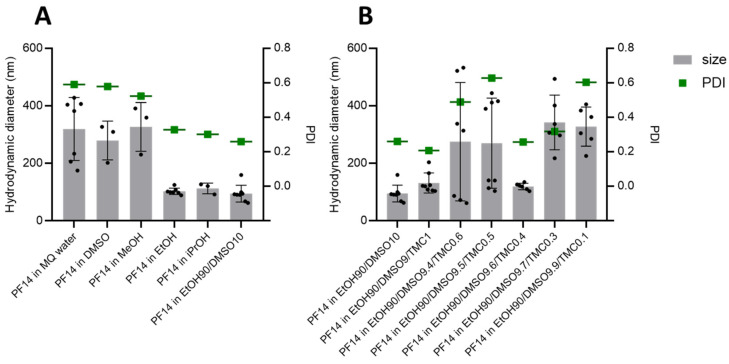
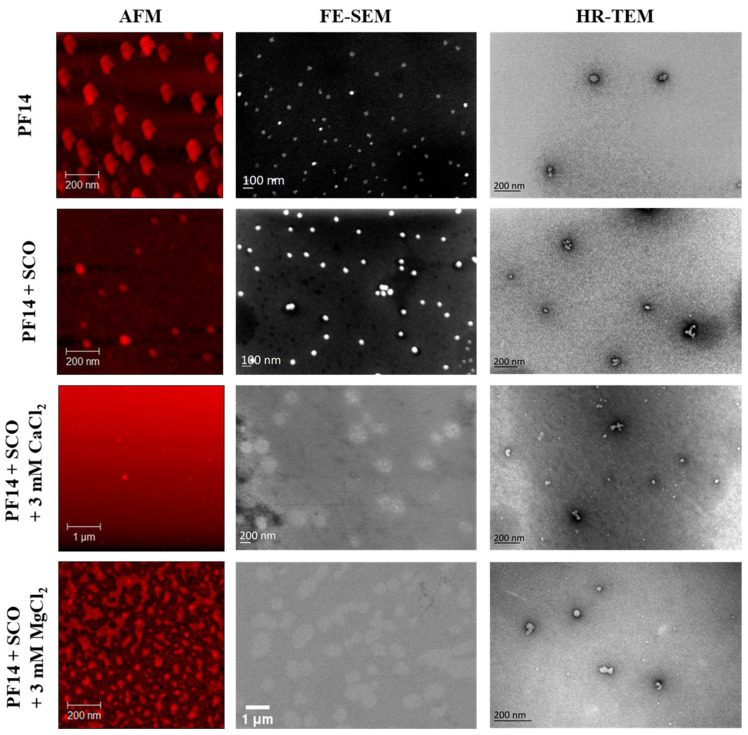
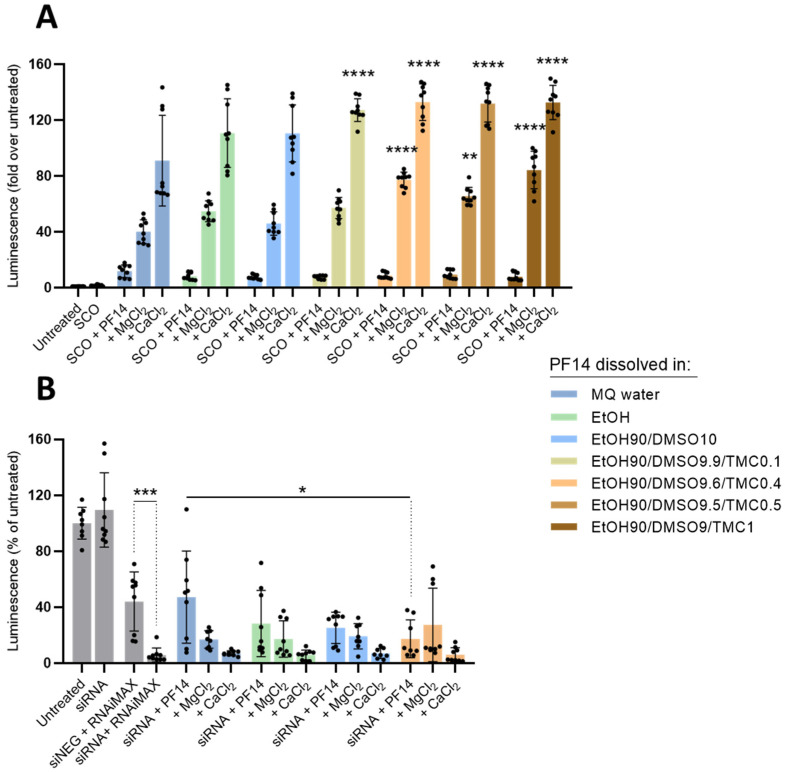
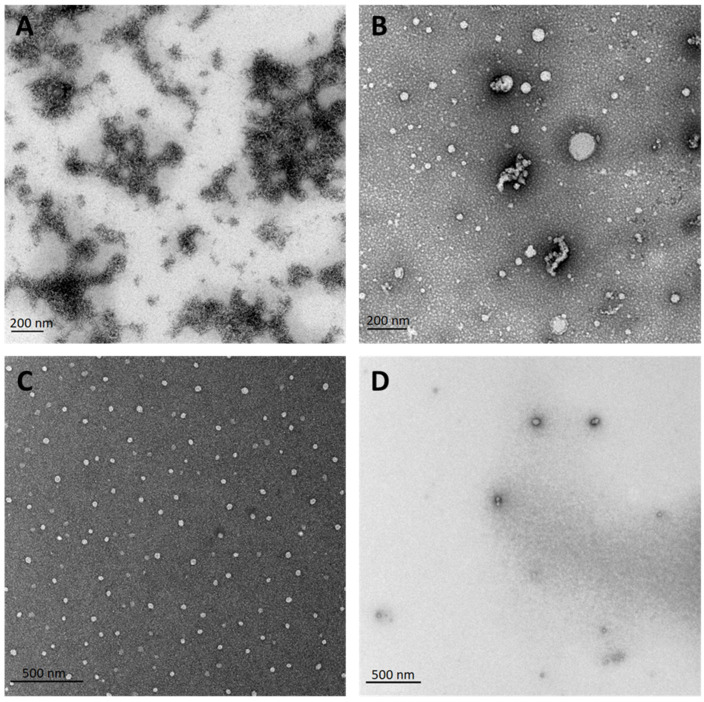
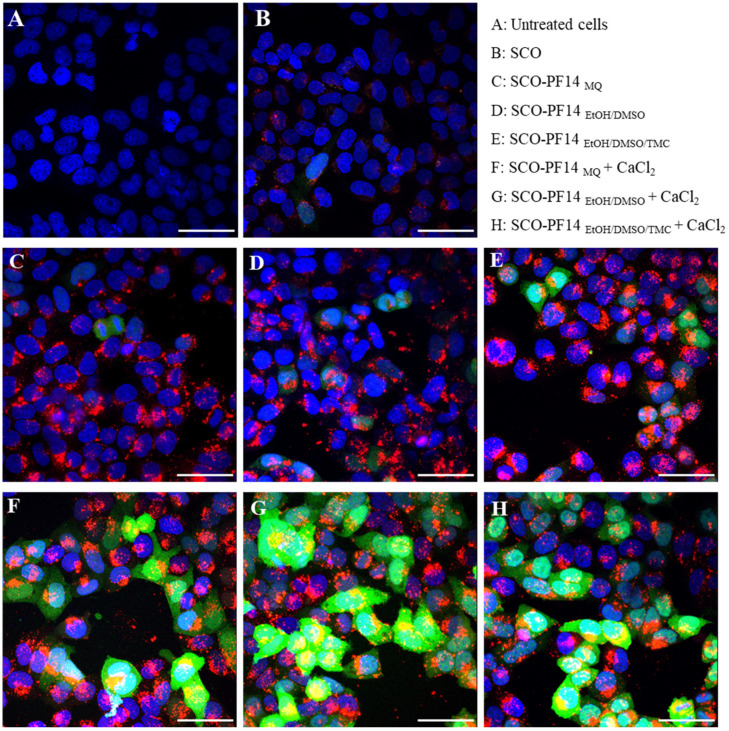
Cell-penetrating peptides (CPPs) are highly promising transfection agents that can deliver various compounds into living cells, including nucleic acids (NAs). Positively charged CPPs can form non-covalent complexes with negatively charged NAs, enabling simple and time-efficient nanoparticle preparation. However, as CPPs have substantially different chemical and physical properties, their complexation with the cargo and characteristics of the resulting nanoparticles largely depends on the properties of the surrounding environment, i.e., solution. Here, we show that the solvent used for the initial dissolving of a CPP determines the properties of the resulting CPP particles formed in an aqueous solution, including the activity and toxicity of the CPP-NA complexes. Using different biophysical methods such as dynamic light scattering (DLS), atomic force microscopy (AFM), transmission and scanning electron microscopy (TEM and SEM), we show that PepFect14 (PF14), a cationic amphipathic CPP, forms spherical particles of uniform size when dissolved in organic solvents, such as ethanol and DMSO. Water-dissolved PF14, however, tends to form micelles and non-uniform aggregates. When dissolved in organic solvents, PF14 retains its α-helical conformation and biological activity in cell culture conditions without any increase in cytotoxicity. Altogether, our results indicate that by using a solvent that matches the chemical nature of the CPP, the properties of the peptide-cargo particles can be tuned in the desired way. This can be of critical importance for in vivo applications, where CPP particles that are too large, non-uniform, or prone to aggregation may induce severe consequences.
细胞穿透肽(CPPs)是极具前景的转染剂,可将各种化合物导入活细胞,包括核酸(NAs)。带正电荷的CPPs可与带负电荷的NAs形成非共价复合物,从而实现简单且高效的纳米颗粒制备。然而,由于CPPs具有显著不同的化学和物理性质,它们与货物的复合以及所得纳米颗粒的特性在很大程度上取决于周围环境,即溶液的性质。在此,我们表明用于最初溶解CPP的溶剂决定了在水溶液中形成的所得CPP颗粒的性质,包括CPP-NA复合物的活性和毒性。使用不同的生物物理方法,如动态光散射(DLS)、原子力显微镜(AFM)、透射和扫描电子显微镜(TEM和SEM),我们发现阳离子两亲性CPP PepFect14(PF14)溶解于有机溶剂(如乙醇和二甲基亚砜)时会形成尺寸均匀的球形颗粒。然而,水溶的PF14倾向于形成胶束和不均匀的聚集体。当溶解于有机溶剂时,PF14在细胞培养条件下保持其α-螺旋构象和生物活性,且细胞毒性没有任何增加。总之,我们的结果表明,通过使用与CPP化学性质相匹配的溶剂,可以按所需方式调节肽-货物颗粒的性质。这对于体内应用可能至关重要,因为过大、不均匀或易于聚集的CPP颗粒可能会引发严重后果。