1Department of Cardiology, Joan XXIII University Hospital, Tarragona, Spain.
2Pere Virgili Health Research Institute (IISPV), Tarragona, Spain.
Am J Trop Med Hyg. 2020 Dec 23;104(2):540-545. doi: 10.4269/ajtmh.20-1427.
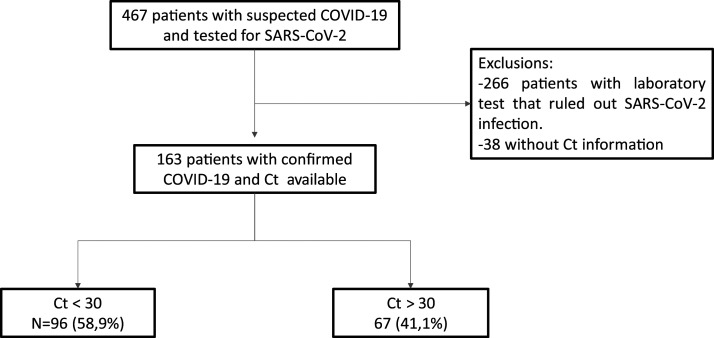
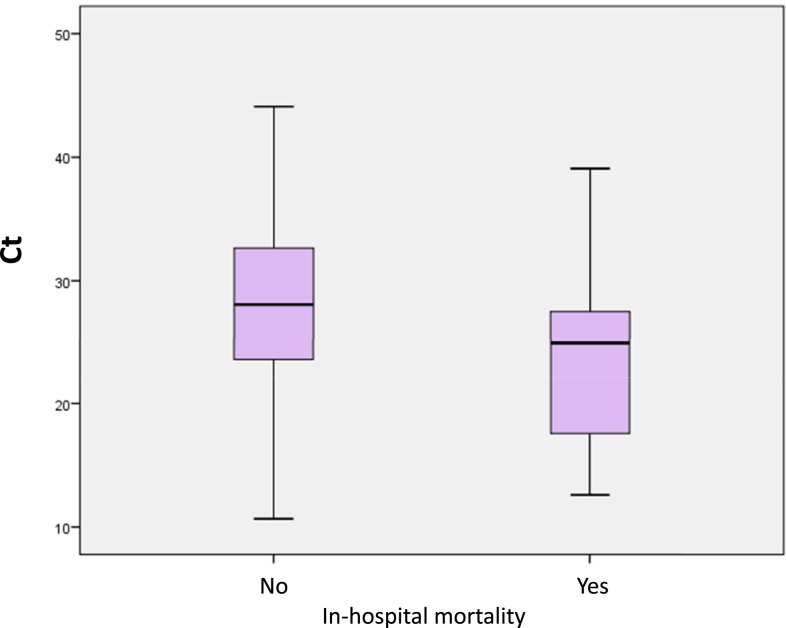
Controversy exists in the literature regarding the possible prognostic implications of the nasopharyngeal SARS-CoV-2 viral load. We carried out a retrospective observational study of 169 patients, 96 (58.9%) of whom had a high viral load and the remaining had a low viral load. Compared with patients with a low viral load, patients with a high viral load did not exhibit differences regarding preexisting cardiovascular risk factors or comorbidities. There were no differences in symptoms, vital signs, or laboratory tests in either group, except for the maximum cardiac troponin I (cTnI), which was higher in the group with a higher viral load (24 [interquartile range 9.5-58.5] versus 8.5 [interquartile range 3-22.5] ng/L, P = 0.007). There were no differences in the need for hospital admission, admission to the intensive care unit, or the need for mechanical ventilation in clinical management. In-hospital mortality was greater in patients who had a higher viral load than in those with low viral load (24% versus 10.4%, P = 0.029). High viral loads were associated with in-hospital mortality in the binary logistic regression analysis (odds ratio: 2.701, 95% Charlson Index (CI): 1.084-6.725, P = 0.033). However, in an analysis adjusted for age, gender, CI, and cTnI, viral load was no longer a predictor of mortality. In conclusion, an elevated nasopharyngeal viral load was not a determinant of in-hospital mortality in patients with COVID-19, as much as age, comorbidity, and myocardial damage determined by elevated cTnI are.
关于鼻咽 SARS-CoV-2 病毒载量的可能预后意义,文献中存在争议。我们对 169 例患者进行了回顾性观察性研究,其中 96 例(58.9%)病毒载量高,其余病毒载量低。与病毒载量低的患者相比,病毒载量高的患者在既往心血管危险因素或合并症方面没有差异。两组患者的症状、生命体征或实验室检查均无差异,除病毒载量较高组的最大肌钙蛋白 I(cTnI)较高外(24 [四分位距 9.5-58.5] 与 8.5 [四分位距 3-22.5] ng/L,P = 0.007)。在临床管理中,两组患者在住院、入住重症监护病房或需要机械通气方面均无差异。病毒载量较高的患者住院死亡率高于病毒载量较低的患者(24% 比 10.4%,P = 0.029)。在二项逻辑回归分析中,高病毒载量与住院死亡率相关(比值比:2.701,95%Charlson 指数(CI):1.084-6.725,P = 0.033)。然而,在调整年龄、性别、CI 和 cTnI 后进行分析时,病毒载量不再是死亡率的预测因素。总之,鼻咽病毒载量升高不是 COVID-19 患者住院死亡率的决定因素,就像由升高的 cTnI 决定的年龄、合并症和心肌损伤一样。