Xue Li-Jun, Han Ju-Qiang, Zhou Yuan-Chen, Peng Hong-Ye, Yin Teng-Fei, Li Kai-Min, Yao Shu-Kun
School of Biological Science and Medical Engineering, Beihang University, Beijing 100191, China.
Department of Hepatology, The Seventh Medical Center of PLA General Hospital, Beijing 100700, China.
World J Gastroenterol. 2020 Dec 14;26(46):7299-7311. doi: 10.3748/wjg.v26.i46.7299.
Nonalcoholic fatty liver disease (NAFLD) has become one of the most common chronic liver diseases in the world. In our early clinical data and questionnaire analysis of NAFLD, it was found that the body mass index of some patients did not meet the diagnostic criteria for overweight or obesity. The consumption of high-temperature-processed foods such as fried food, hot pot and barbecue is closely related to the occurrence of nonobese NAFLD. Reducing the intake of this kind of food can reduce disease severity and improve prognosis.
To explore the untargeted metabolomics characteristics of nonobese nonalcoholic fatty liver disease in Sprague-Dawley rats induced by high-temperature-processed feed.
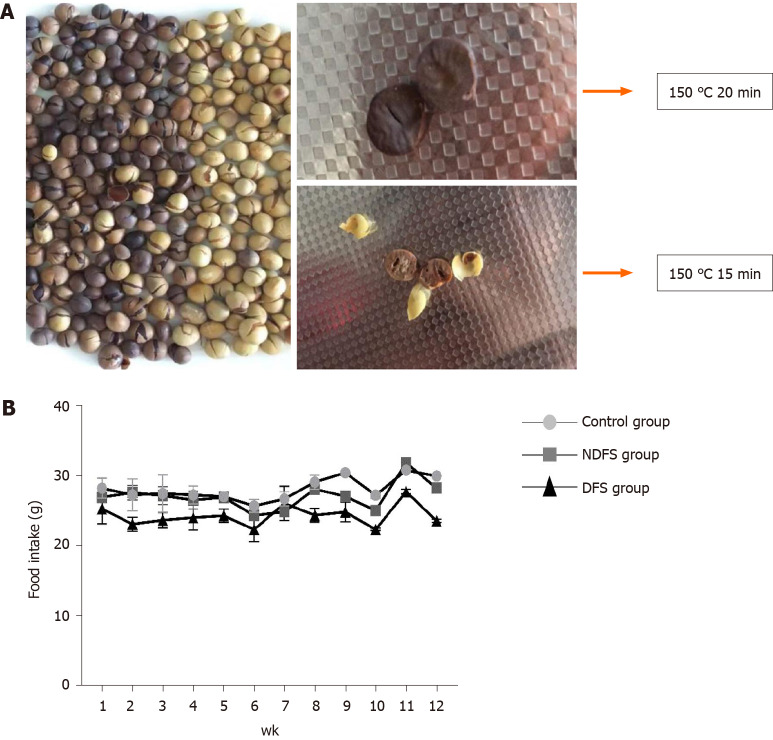
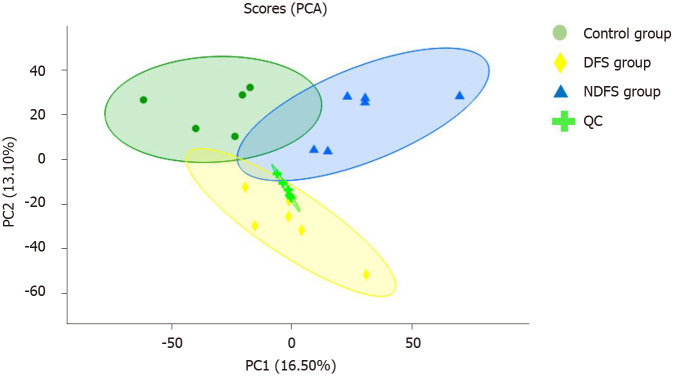
Fifty-four male Sprague-Dawley rats were divided into three groups: The control group received a standard diet; the nonfried soybeans (NDFS) group received 60% NDFS and 40% basic feed and the dry-fried soybeans (DFS) group received 60% DFS and 40% basic feed. Six rats were sacrificed at week 4, 8, and 12 in each group. The food intake, body weight, Lee's index, liver index, serological index and hepatic histopathology were assessed. Untargeted metabolomics characteristics were used to analyze the changes in liver metabolites of rats at week 12. Correlations between metabolites and pathology scores between the DFS and control groups and between the DFS and NDFS groups were analyzed. We selected some of the metabolites, both within the pathway and outside of the pathway, to explain preliminarily the difference in liver pathology in the three groups of rats.
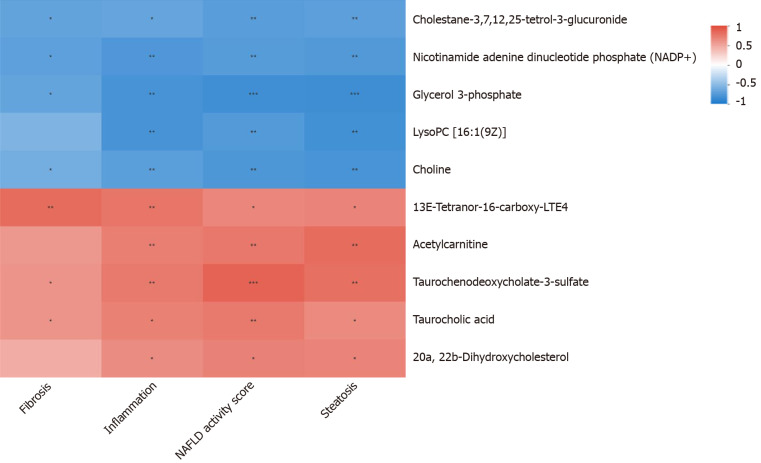
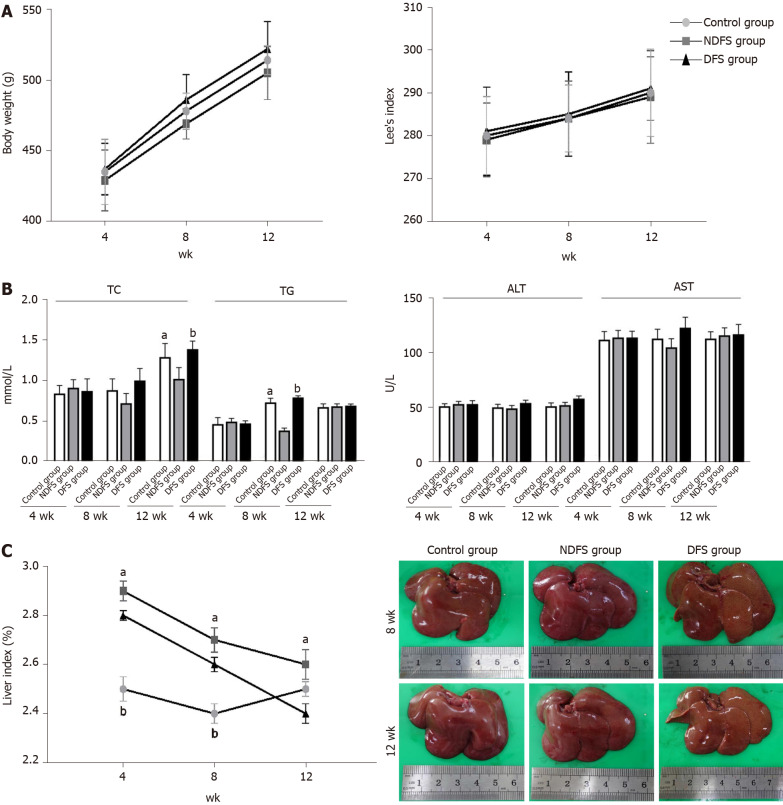
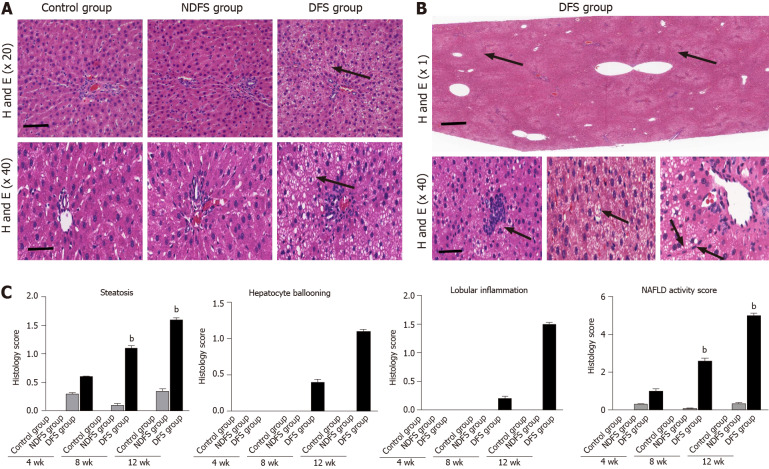
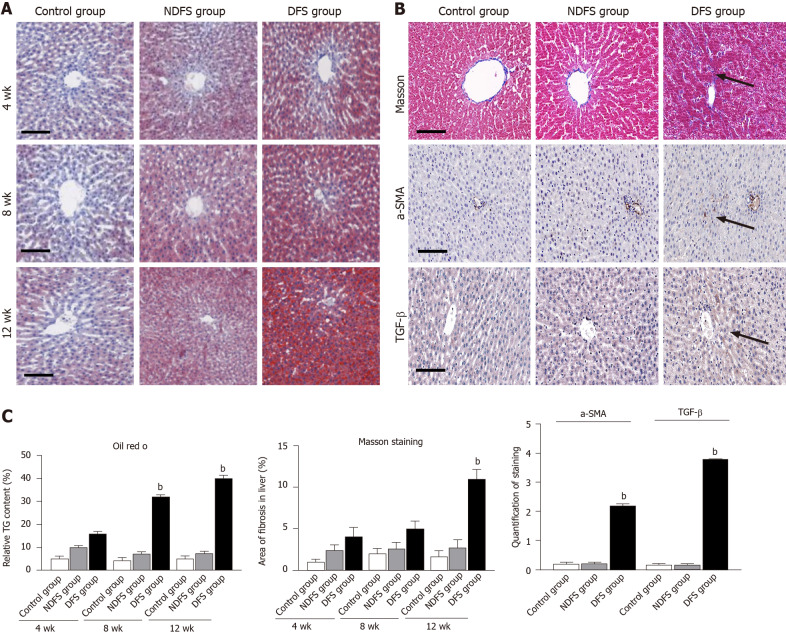
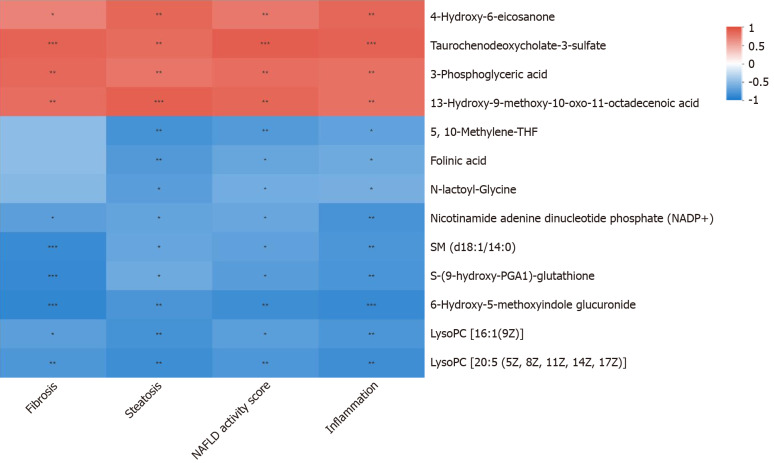
There were no statistically significant differences in the food intake, body weight, Lee's index or serological index between the DFS group and the control group ( > 0.05). At week 8 and week 12, the steatosis scores in the DFS group were significantly higher than those in the other two groups ( < 0.05). At week 12, the liver index of the DFS group was the lowest (NDFS group DFS group, < 0.05). The fibrosis score in the DFS group was significantly higher than those in the other two groups ( < 0.05). The correlation analysis of the liver pathology score and differential metabolites in the DFS and NDFS groups showed that there were 10 strongly correlated substances: Five positively correlated substances and five negatively correlated substances. The positively correlated substances included taurochenodeoxycholate-3-sulfate, acetylcarnitine, 20a,22b-dihydroxycholesterol, 13E-tetranor-16-carboxy-LTE4 and taurocholic acid. The negatively correlated substances included choline, cholesterane-3,7,12,25-tetrol-3-glucuronide, nicotinamide adenine dinucleotide phosphate, lysoPC [16:1 (9Z)] and glycerol 3-phosphate. The correlation analysis of the liver pathology score and differential metabolites in the DFS and control groups showed that there were 13 strongly correlated substances: Four positively correlated substances and 9 negatively correlated substances. The positively correlated substances included 4-hydroxy-6-eicosanone, 3-phosphoglyceric acid, 13-hydroxy-9-methoxy-10-oxo-11-octadecenoic acid and taurochenodeoxycholate-3-sulfate. The negatively correlated substances included lysoPC [16:1(9Z)], S-(9-hydroxy-PGA1)-glutathione, lysoPC [20:5 (5Z, 8Z, 11Z, 14Z, 17Z)], SM (d18:1/14:0), nicotinamide adenine dinucleotide phosphate, 5,10-methylene-THF, folinic acid, N-lactoyl-glycine and 6-hydroxy-5-methoxyindole glucuronide.
We successfully induced liver damage in rats by using a specially prepared high-temperature-processed feed and explored the untargeted metabolomics characteristics.
非酒精性脂肪性肝病(NAFLD)已成为全球最常见的慢性肝病之一。在我们早期对NAFLD的临床数据和问卷调查分析中,发现部分患者的体重指数未达到超重或肥胖的诊断标准。油炸食品、火锅和烧烤等高加工食品的摄入与非肥胖型NAFLD的发生密切相关。减少这类食物的摄入可降低疾病严重程度并改善预后。
探索高温加工饲料诱导的Sprague-Dawley大鼠非肥胖非酒精性脂肪性肝病的非靶向代谢组学特征。
将54只雄性Sprague-Dawley大鼠分为三组:对照组给予标准饮食;非油炸大豆(NDFS)组给予60% NDFS和40%基础饲料,干炸大豆(DFS)组给予60% DFS和40%基础饲料。每组在第4、8和12周处死6只大鼠。评估食物摄入量、体重、李氏指数、肝脏指数、血清学指标和肝脏组织病理学。采用非靶向代谢组学特征分析第12周大鼠肝脏代谢物的变化。分析DFS组与对照组、DFS组与NDFS组之间代谢物与病理评分的相关性。我们选择了一些代谢物,包括途径内和途径外的,以初步解释三组大鼠肝脏病理学的差异。
DFS组与对照组在食物摄入量、体重、李氏指数或血清学指标上无统计学显著差异(P>0.05)。在第8周和第12周,DFS组的脂肪变性评分显著高于其他两组(P<0.05)。在第12周,DFS组的肝脏指数最低(NDFS组>DFS组,P<0.05)。DFS组的纤维化评分显著高于其他两组(P<0.05)。DFS组与NDFS组肝脏病理评分与差异代谢物的相关性分析显示,有10种强相关物质:5种正相关物质和5种负相关物质。正相关物质包括牛磺鹅去氧胆酸-3-硫酸盐、乙酰肉碱、20α,22β-二羟基胆固醇、13E-四降-16-羧基-LTE4和牛磺胆酸。负相关物质包括胆碱、胆甾烷-3,7,12,25-四醇-3-葡萄糖醛酸苷、烟酰胺腺嘌呤二核苷酸磷酸、溶血磷脂酰胆碱[16:1(9Z)]和甘油3-磷酸。DFS组与对照组肝脏病理评分与差异代谢物的相关性分析显示,有13种强相关物质:4种正相关物质和9种负相关物质。正相关物质包括4-羟基-6-二十碳烯酮、3-磷酸甘油酸、13-羟基-9-甲氧基-10-氧代-11-十八碳烯酸和牛磺鹅去氧胆酸-3-硫酸盐。负相关物质包括溶血磷脂酰胆碱[16:1(9Z)]、S-(9-羟基-PGA1)-谷胱甘肽、溶血磷脂酰胆碱[20:5(5Z,8Z,11Z,14Z,17Z)]、鞘磷脂(d18:1/14:0)、烟酰胺腺嘌呤二核苷酸磷酸、5,10-亚甲基-四氢叶酸、亚叶酸、N-乳酰甘氨酸和6-羟基-5-甲氧基吲哚葡萄糖醛酸苷。
我们通过使用特制的高温加工饲料成功诱导了大鼠肝脏损伤,并探索了非靶向代谢组学特征。