Martino Giovanni, McKay J Lucas, Factor Stewart A, Ting Lena H
W.H. Coulter Department of Biomedical Engineering, Georgia Institute of Technology, Emory University, Atlanta, GA, United States.
Department of Biomedical Informatics, Emory University, Atlanta, GA, United States.
Front Hum Neurosci. 2020 Dec 9;14:602595. doi: 10.3389/fnhum.2020.602595. eCollection 2020.
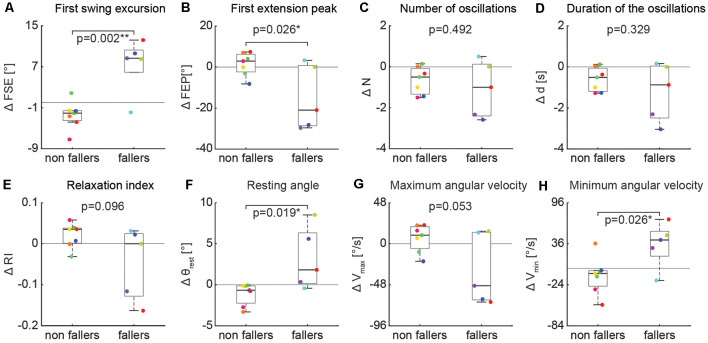
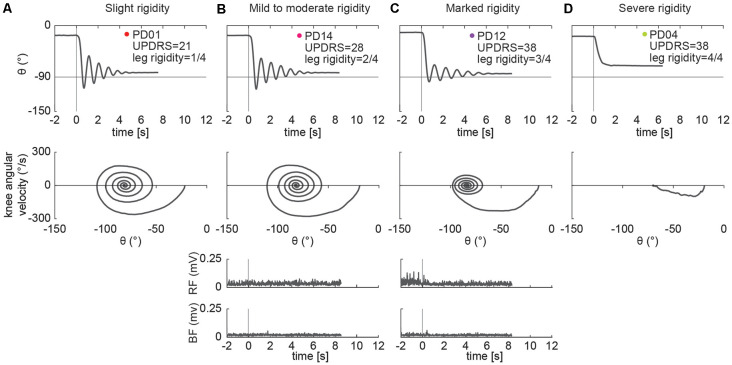
Leg rigidity is associated with frequent falls in people with Parkinson's disease (PD), suggesting a potential role in functional balance and gait impairments. Changes in the neural state due to secondary tasks, e.g., activation maneuvers, can exacerbate (or "activate") rigidity, possibly increasing the risk of falls. However, the subjective interpretation and coarse classification of the standard clinical rigidity scale has prohibited the systematic, objective assessment of resting and activated leg rigidity. The pendulum test is an objective diagnostic method that we hypothesized would be sensitive enough to characterize resting and activated leg rigidity. We recorded kinematic data and electromyographic signals from rectus femoris and biceps femoris during the pendulum test in 15 individuals with PD, spanning a range of leg rigidity severity. From the recorded data of leg swing kinematics, we measured biomechanical outcomes including first swing excursion, first extension peak, number and duration of the oscillations, resting angle, relaxation index, maximum and minimum angular velocity. We examined associations between biomechanical outcomes and clinical leg rigidity score. We evaluated the effect of increasing rigidity through activation maneuvers on biomechanical outcomes. Finally, we assessed whether either biomechanical outcomes or changes in outcomes with activation were associated with a fall history. Our results suggest that the biomechanical assessment of the pendulum test can objectively quantify parkinsonian leg rigidity. We found that the presence of high rigidity during clinical exam significantly impacted biomechanical outcomes, i.e., first extension peak, number of oscillations, relaxation index, and maximum angular velocity. No differences in the effect of activation maneuvers between groups with clinically assessed low rigidity were observed, suggesting that activated rigidity may be independent of resting rigidity and should be scored as independent variables. Moreover, we found that fall history was more common among people whose rigidity was increased with a secondary task, as measured by biomechanical outcomes. We conclude that different mechanisms contributing to resting and activated rigidity may play an important yet unexplored functional role in balance impairments. The pendulum test may contribute to a better understanding of fundamental mechanisms underlying motor symptoms in PD, evaluating the efficacy of treatments, and predicting the risk of falls.
腿部僵硬与帕金森病(PD)患者频繁跌倒有关,这表明其在功能平衡和步态障碍中可能发挥作用。由于诸如激活动作等次要任务导致的神经状态变化会加剧(或“激活”)僵硬,可能增加跌倒风险。然而,标准临床僵硬量表的主观解读和粗略分类阻碍了对静息和激活状态下腿部僵硬的系统、客观评估。摆锤试验是一种客观诊断方法,我们推测它对表征静息和激活状态下的腿部僵硬足够敏感。我们记录了15名PD患者在摆锤试验期间股直肌和股二头肌的运动学数据和肌电图信号,这些患者的腿部僵硬严重程度各不相同。从记录的腿部摆动运动学数据中,我们测量了生物力学结果,包括首次摆动幅度、首次伸展峰值、摆动次数和持续时间、静息角度、松弛指数、最大和最小角速度。我们研究了生物力学结果与临床腿部僵硬评分之间的关联。我们评估了通过激活动作增加僵硬对生物力学结果的影响。最后,我们评估了生物力学结果或激活时结果的变化是否与跌倒史相关。我们的结果表明,摆锤试验的生物力学评估可以客观地量化帕金森病腿部僵硬。我们发现临床检查中高僵硬的存在显著影响生物力学结果,即首次伸展峰值、摆动次数、松弛指数和最大角速度。在临床评估为低僵硬的组之间,未观察到激活动作效果的差异,这表明激活僵硬可能独立于静息僵硬,应作为独立变量进行评分。此外,我们发现,根据生物力学结果衡量,在因次要任务而僵硬增加的人群中,跌倒史更为常见。我们得出结论,导致静息和激活僵硬的不同机制可能在平衡障碍中发挥重要但尚未探索的功能作用。摆锤试验可能有助于更好地理解PD运动症状的基本机制、评估治疗效果以及预测跌倒风险。