Gesser-Edelsburg Anat, Hijazi Rana
School of Public Health and the Health and Risk Communication Research Center, University of Haifa, Haifa 3498838, Israel.
Risk Manag Healthc Policy. 2020 Dec 14;13:2985-3002. doi: 10.2147/RMHP.S280952. eCollection 2020.
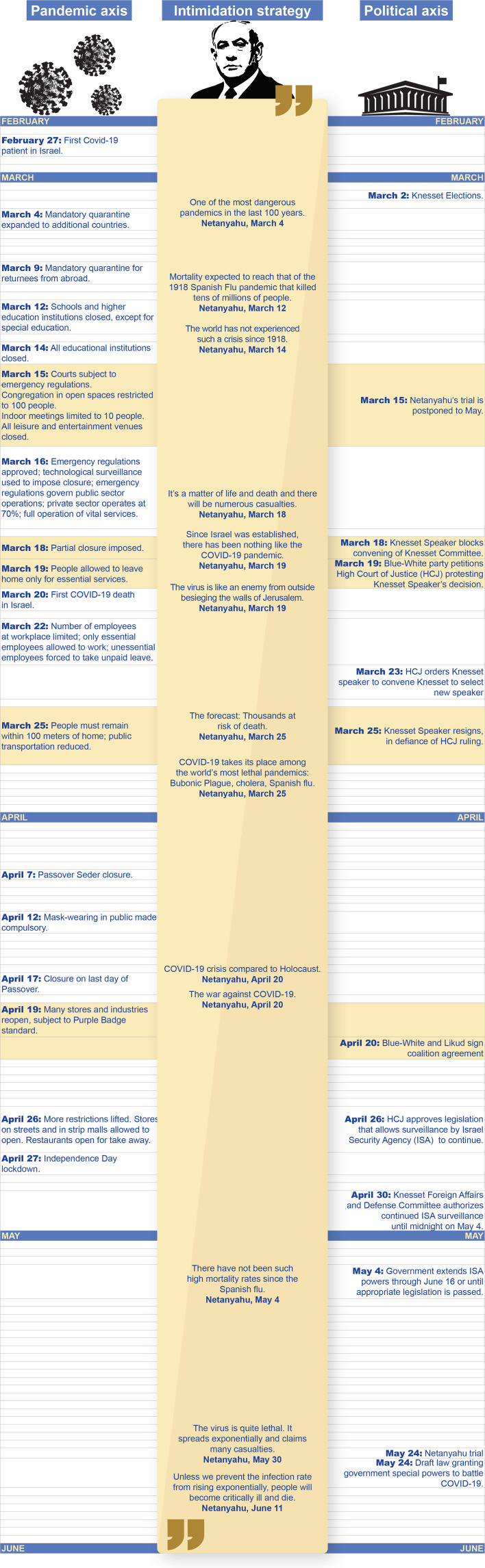
The coronavirus brought the world's leaders to the center of the media stage, where they not only managed the COVID-19 pandemic but also communicated it to the public. The means they used to communicate the global pandemic reveal their strategies and the narratives they chose to create in their nation's social consciousness. In Israel, the crisis broke out after three election cycles, such that the government in charge of the crisis was an interim government under the leadership of Prime Minister Benjamin Netanyahu, who was operating under three criminal indictments. This study sought to examine the ways in which Prime Minister Netanyahu and two senior Israel Ministry of Health officials-Director General Moshe Bar Siman Tov and Prof. Sigal Sadetsky, Head of Public Health Services-communicated information about the health crisis in Israel during what has been termed the first wave and the beginning of the second wave.
The research adopted qualitative methods (discourse, content and thematic analysis) to analyze the communication strategies and compare them to health and risk communication. Triangulated data collection from different data sources was used to increase the credibility and validity of the results. The research sample comprised the following sources from March 3 through June 21, 2020: transcripts of 19 press conferences and 12 press interviews, 95 emergency regulations signed by Prime Minister Netanyahu, and 52 articles in major Israeli newspapers.
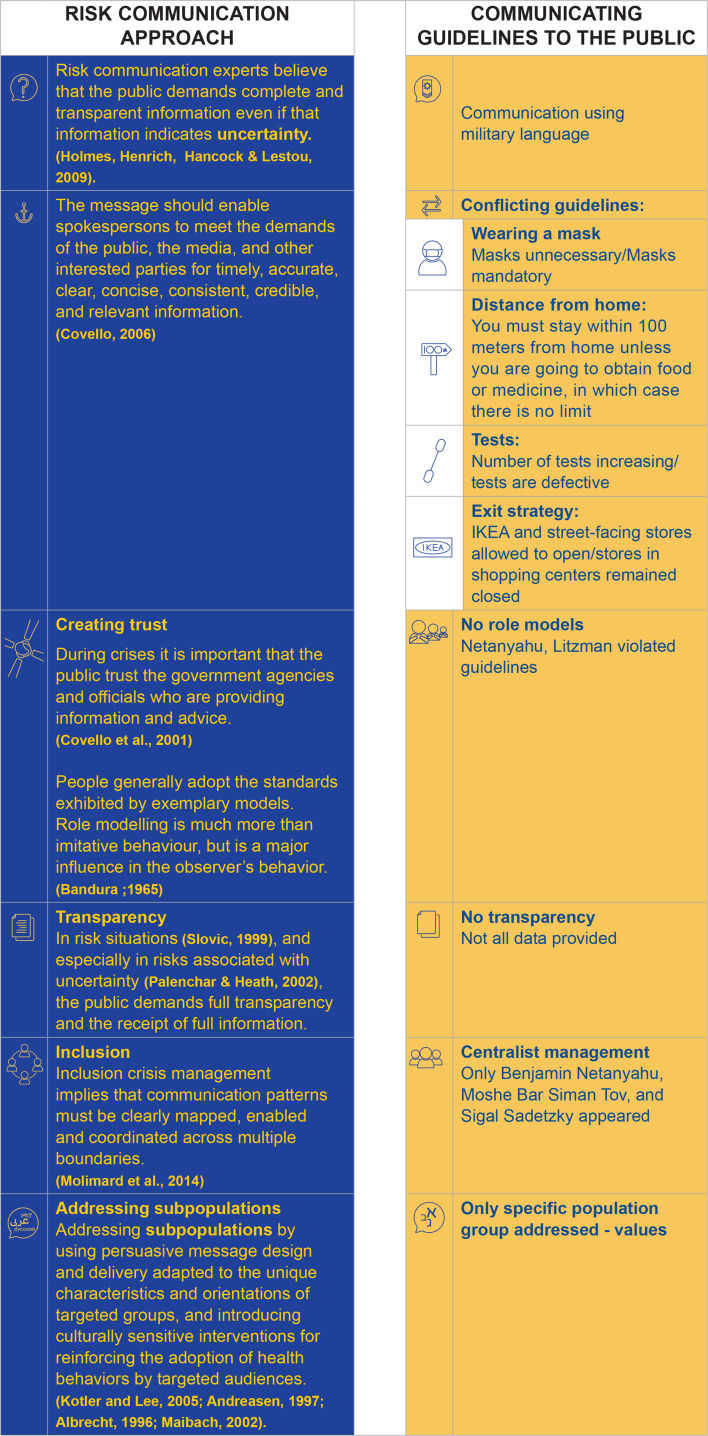
Netanyahu and the Health Ministry Director General used an apocalyptic narrative to communicate COVID-19 to the public. The main strategies used in constructing this narrative were intimidation, lack of information transparency, giving the public conflicting instructions contrary to the health and risk communicating approach, and using a health crisis to promote political intentions and actions.
Communicating health crises to the public, particularly ongoing crises like COVID-19, requires that leaders implement the health and risk communication approach and create a cooperative narrative that does not rely on a strategy of intimidation, but rather on empathy and on fact-based and transparent information.
新冠病毒使世界各国领导人成为媒体关注的焦点,他们不仅要应对新冠疫情,还要向公众传达相关信息。他们用于传达全球疫情的方式揭示了其策略以及他们在本国社会意识中选择塑造的叙事方式。在以色列,危机爆发于三轮选举之后,因此负责应对危机的政府是由内塔尼亚胡总理领导的临时政府,而内塔尼亚胡当时正面临三项刑事指控。本研究旨在考察内塔尼亚胡总理以及以色列卫生部两名高级官员——总干事摩西·巴尔·西曼·托夫和公共卫生服务负责人西加尔·萨德茨基教授——在所谓的第一波疫情以及第二波疫情初期,是如何传达以色列健康危机相关信息的。
本研究采用定性方法(话语、内容和主题分析)来分析传播策略,并将其与健康和风险沟通进行比较。通过从不同数据源收集的数据进行三角互证,以提高结果的可信度和有效性。研究样本包括2020年3月3日至6月21日的以下来源:19场新闻发布会和12次新闻采访的文字记录、内塔尼亚胡总理签署的95项紧急法规,以及以色列主要报纸上的52篇文章。
内塔尼亚胡和卫生部总干事采用了一种末日叙事来向公众传达新冠疫情信息。构建这种叙事所采用的主要策略包括恐吓、缺乏信息透明度、向公众发出与健康和风险沟通方法相悖的相互矛盾的指示,以及利用健康危机来推动政治意图和行动。
向公众传达健康危机,尤其是像新冠疫情这样持续的危机,要求领导人采用健康和风险沟通方法,并创造一种合作性的叙事,这种叙事不依赖于恐吓策略,而是基于同理心以及基于事实和透明的信息。