Roth John Scott, Anthone Gary J, Selzer Don J, Poulose Benjamin K, Pierce Richard A, Bittner James G, Hope William W, Dunn Raymond M, Martindale Robert G, Goldblatt Matthew I, Earle David B, Romanelli John R, Mancini Gregory J, Greenberg Jacob A, Linn John G, Parra-Davila Eduardo, Sandler Bryan J, Deeken Corey R, Verbarg Jasenka, Salluzzo Jennifer L, Voeller Guy R
Department of Surgery, University of Kentucky Medical Center, Lexington, KY, USA.
Department of Surgery, Methodist Health System, Omaha, NE, USA.
Ann Med Surg (Lond). 2020 Dec 15;61:1-7. doi: 10.1016/j.amsu.2020.12.002. eCollection 2021 Jan.
This study represents a prospective, multicenter, open-label study to assess the safety, performance, and outcomes of poly-4-hydroxybutyrate (P4HB, Phasix™) mesh for primary ventral, primary incisional, or multiply-recurrent hernia in subjects at risk for complications. This study reports 3-year clinical outcomes.
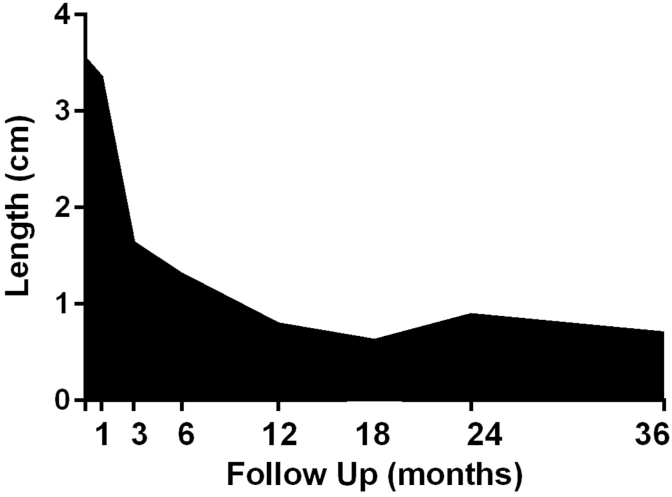
P4HB mesh was implanted in 121 patients via retrorectus or onlay technique. Physical exam and/or quality of life surveys were completed at 1, 3, 6,12, 18, 24, and 36 months, with 5-year (60-month) follow-up ongoing.
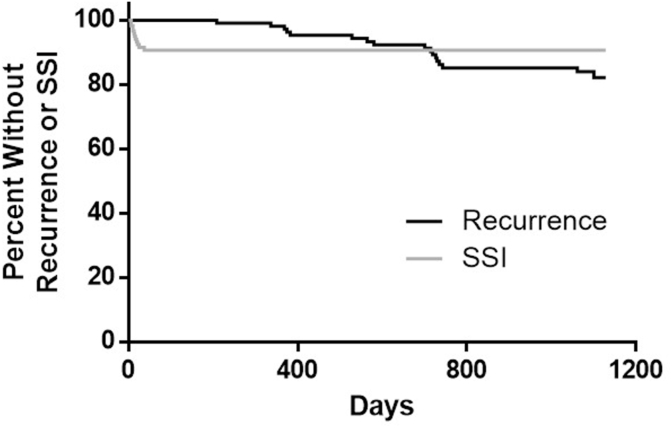
A total of n = 121 patients were implanted with P4HB mesh (n = 75 (62%) female) with a mean age of 54.7 ± 12.0 years and mean BMI of 32.2 ± 4.5 kg/m (±standard deviation). Comorbidities included: obesity (78.5%), active smokers (23.1%), COPD (28.1%), diabetes mellitus (33.1%), immunosuppression (8.3%), coronary artery disease (21.5%), chronic corticosteroid use (5.0%), hypo-albuminemia (2.5%), advanced age (5.0%), and renal insufficiency (0.8%). Hernias were repaired via retrorectus (n = 45, 37.2% with myofascial release (MR) or n = 43, 35.5% without MR), onlay (n = 8, 6.6% with MR or n = 24, 19.8% without MR), or not reported (n = 1, 0.8%). 82 patients (67.8%) completed 36-month follow-up. 17 patients (17.9% ± 0.4%) experienced hernia recurrence at 3 years, with n = 9 in the retrorectus group and n = 8 in the onlay group. SSI (n = 11) occurred in 9.3% ± 0.03% of patients.
Long-term outcomes following ventral hernia repair with P4HB mesh demonstrate low recurrence rates at 3-year (36-month) postoperative time frame with no patients developing late mesh complications or requiring mesh removal. 5-year (60-month) follow-up is ongoing.
本研究是一项前瞻性、多中心、开放标签研究,旨在评估聚4-羟基丁酸酯(P4HB,Phasix™)补片用于有并发症风险的受试者的原发性腹侧疝、原发性切口疝或多次复发性疝的安全性、性能和结局。本研究报告了3年的临床结局。
通过腹直肌后或覆盖技术将P4HB补片植入121例患者体内。在1、3、6、12、18、24和36个月时完成体格检查和/或生活质量调查,目前正在进行5年(60个月)的随访。
共有n = 121例患者植入了P4HB补片(n = 75例(62%)为女性),平均年龄为54.7 ± 12.0岁,平均体重指数为32.2 ± 4.5 kg/m²(±标准差)。合并症包括:肥胖(78.5%)、现吸烟者(23.1%)、慢性阻塞性肺疾病(28.1%)、糖尿病(33.1%)、免疫抑制(8.3%)、冠状动脉疾病(21.5%)、长期使用糖皮质激素(5.0%)、低白蛋白血症(2.5%)、高龄(5.0%)和肾功能不全(0.8%)。通过腹直肌后(n = 45例,37.2%行肌筋膜松解术(MR)或n = 43例,35.5%未行MR)、覆盖(n = 8例,6.6%行MR或n = 24例,19.8%未行MR)或未报告(n = 1例,0.8%)的方式修复疝。82例患者(67.8%)完成了36个月的随访。17例患者(17.9% ± 0.4%)在3年时出现疝复发,其中腹直肌后组9例,覆盖组8例。11例患者(9.3% ± 0.03%)发生手术部位感染。
使用P4HB补片修复腹侧疝后的长期结局显示,在术后3年(36个月)时复发率较低,没有患者出现晚期补片并发症或需要取出补片。目前正在进行5年(60个月)的随访。