Agovi Afiba Manza-A, Anikpo Ifedioranma, Cvitanovich Matthew J, Craten Kevin J, Asuelime Eve O, Ojha Rohit P
Center for Outcomes Research, JPS Health Network, Fort Worth, TX, United States.
Department of Medical Education, TCU and UNTHSC School of Medicine, Fort Worth, TX, United States.
Prev Med Rep. 2020 Nov 28;20:101266. doi: 10.1016/j.pmedr.2020.101266. eCollection 2020 Dec.
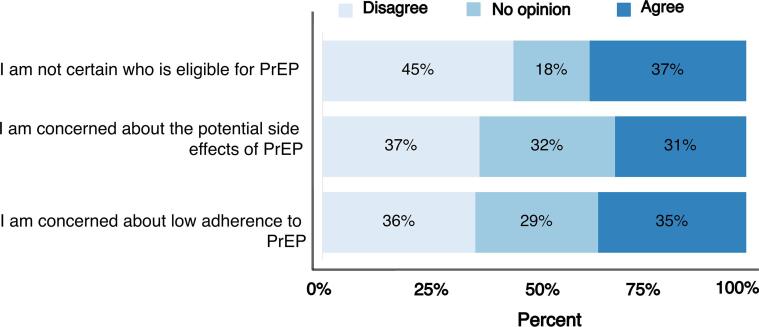
Safety-net health systems are a primary source of care for socioeconomically disadvantaged individuals who may be eligible for HIV pre-exposure prophylaxis (PrEP) and are priority groups under the Ending the HIV Epidemic (EHE) initiative. Nevertheless, little evidence is available about barriers to PrEP implementation in safety-net settings. We aimed to assess the association between PrEP knowledge and prescribing practices, and to ascertain unmet knowledge needs to implement PrEP. In 2019, we surveyed primary care providers (PCPs) in a safety-net health system that serves an EHE priority jurisdiction located in North Texas. Our questionnaire ascertained self-reported prescribing practices, knowledge, and training needs related to PrEP. We used penalized logistic regression to estimate odds ratio (OR) and 95% posterior limits (PL) for the association between provider self-rated knowledge of PrEP and PrEP prescribing. Our study population comprised 62 primary care providers, of whom 61% were female, 60% were non-Hispanic White, 76% were physicians (76%), 57% had ≥ 10 years of practice experience, 45% reported low self-rated PrEP knowledge, and 35% prescribed PrEP in the past year. Providers with low PrEP knowledge had 69% lower odds of prescribing PrEP within the past year (OR = 0.31, 95% PL: 0.12, 0.82). Eligibility for PrEP, side effects and adherence concerns were key unmet knowledge needs. Our findings suggest that low provider PrEP knowledge may be a barrier to PrEP prescribing among safety-net PCPs. Our results provide insight about specific educational needs of PCPs in a safety-net health system, which are amenable to educational intervention.
安全网医疗系统是社会经济弱势群体医疗服务的主要来源,这些人可能符合HIV暴露前预防(PrEP)的条件,并且是“终结HIV流行”(EHE)倡议下的优先群体。然而,关于在安全网环境中实施PrEP的障碍,几乎没有证据。我们旨在评估PrEP知识与处方实践之间的关联,并确定实施PrEP未满足的知识需求。2019年,我们对位于北德克萨斯州的一个安全网医疗系统中的初级保健提供者(PCP)进行了调查,该系统服务于一个EHE优先管辖地区。我们的问卷确定了与PrEP相关的自我报告的处方实践、知识和培训需求。我们使用惩罚逻辑回归来估计提供者自我评估的PrEP知识与PrEP处方之间关联的优势比(OR)和95%后验区间(PL)。我们的研究人群包括62名初级保健提供者,其中61%为女性,60%为非西班牙裔白人,76%为医生,57%有≥10年的执业经验,45%报告自我评估的PrEP知识较低,35%在过去一年中开具过PrEP处方。PrEP知识较低的提供者在过去一年中开具PrEP处方的可能性低69%(OR = 0.31,95% PL:0.12,0.82)。PrEP的资格、副作用和依从性问题是关键的未满足知识需求。我们的研究结果表明,提供者PrEP知识较低可能是安全网PCP中PrEP处方的一个障碍。我们的结果提供了关于安全网医疗系统中PCP特定教育需求的见解,这些需求适合进行教育干预。