Mantegazza Renato, Vanoli Fiammetta, Frangiamore Rita, Cavalcante Paola
Neurology IV - Neuroimmunology and Neuromuscular Diseases Unit, Fondazione IRCCS Istituto Neurologico Carlo Besta, Milan, Italy.
Immunotargets Ther. 2020 Dec 15;9:317-331. doi: 10.2147/ITT.S261414. eCollection 2020.
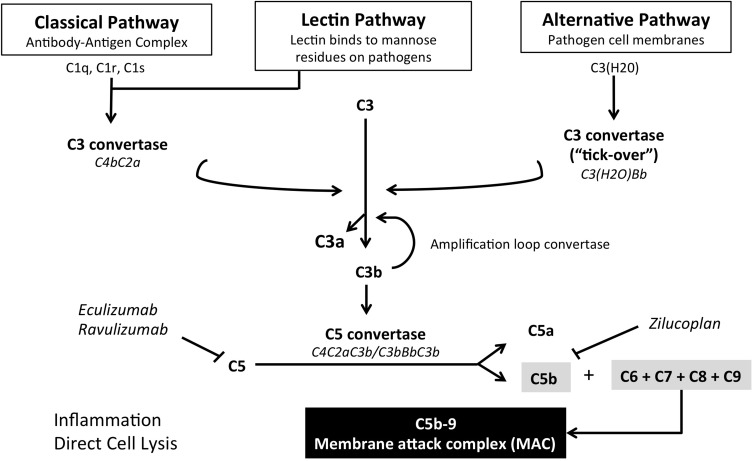
Generalized myasthenia gravis (gMG) is a rare autoimmune disorder affecting the neuromuscular junction (NMJ). Approximately 80-90% of patients display antibodies directed against the nicotinic acetylcholine receptor (AChR). A major drive of AChR antibody-positive MG pathology is represented by complement activation. The role of the complement cascade has been largely demonstrated in patients and in MG animal models. Complement activation at the NMJ leads to focal lysis of the post-synaptic membrane, disruption of the characteristic folds, and reduction of AChR. Given that the complement system works as an activation cascade, there are many potential targets that can be considered for therapeutic intervention. Preclinical studies have confirmed the efficacy of complement inhibition in ameliorating MG symptoms. Eculizumab, an antibody directed towards C5, has recently been approved for the treatment of AChR antibody-positive gMG. Other complement inhibitors, targeting C5 as well, are currently under phase III study. Complement inhibitors, however, may present prohibitive costs. Therefore, the identification of a subset of patients more or less prone to respond to such therapies would be beneficial. For such purpose, there is a critical need to identify possible biomarkers predictive of therapeutic response, a field not yet sufficiently explored in MG. This review aims to give an overview of the complement cascade involvement in MG, the evolution of complement-inhibiting therapies and possible biomarkers useful to tailor and monitor complement-directed therapies.
全身型重症肌无力(gMG)是一种罕见的自身免疫性疾病,会影响神经肌肉接头(NMJ)。大约80-90%的患者体内存在针对烟碱型乙酰胆碱受体(AChR)的抗体。AChR抗体阳性的重症肌无力病理的一个主要驱动因素是补体激活。补体级联反应的作用在患者和重症肌无力动物模型中已得到充分证明。神经肌肉接头处的补体激活会导致突触后膜的局灶性溶解、特征性褶皱的破坏以及AChR的减少。鉴于补体系统作为一个激活级联发挥作用,有许多潜在的靶点可用于治疗干预。临床前研究已证实补体抑制在改善重症肌无力症状方面的疗效。依库珠单抗是一种针对C5的抗体,最近已被批准用于治疗AChR抗体阳性的gMG。其他同样靶向C5的补体抑制剂目前正处于III期研究阶段。然而,补体抑制剂可能成本过高。因此,确定对这类治疗或多或少有反应倾向的患者亚组将是有益的。为此,迫切需要确定可能预测治疗反应的生物标志物,这一领域在重症肌无力中尚未得到充分探索。本综述旨在概述补体级联反应在重症肌无力中的参与情况、补体抑制疗法的发展以及有助于定制和监测补体导向疗法的可能生物标志物。