Meulenbroeks Ralph
Freudenthal Institute of Science and Mathematics Education, Utrecht University, the Netherlands.
Heliyon. 2020 Dec 13;6(12):e05728. doi: 10.1016/j.heliyon.2020.e05728. eCollection 2020 Dec.
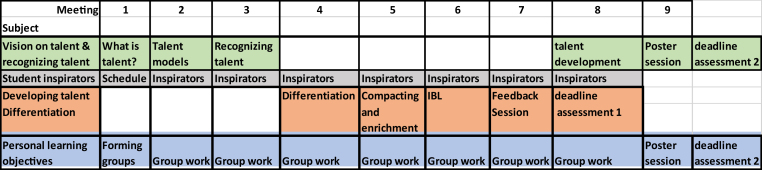
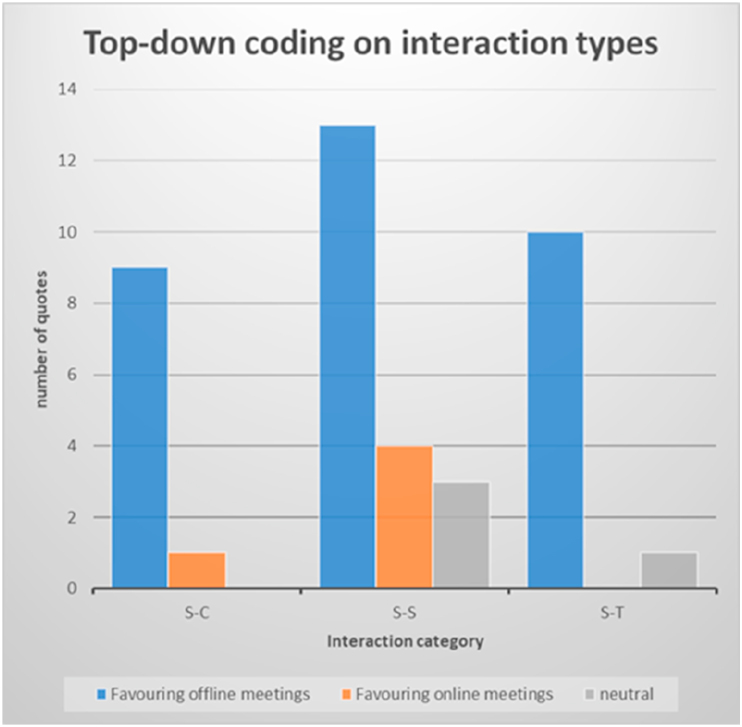
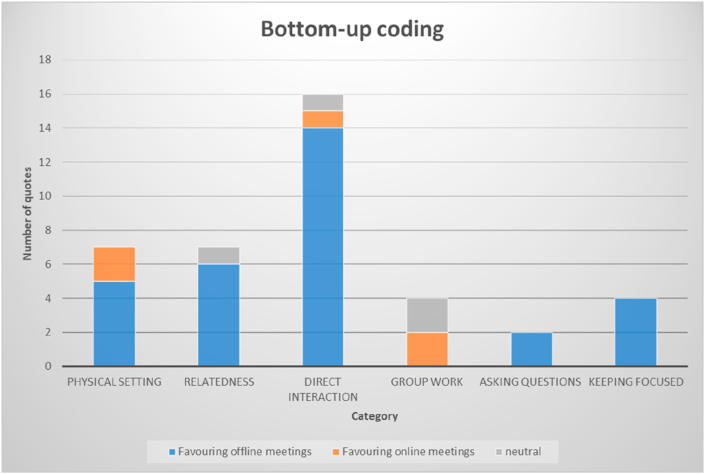
This study investigates the way students experience synchronous online and offline meetings in university education, using a qualitative approach. The context is a course in teacher training that was forced to go fully online during the Covid-19 pandemic while the course was almost halfway to completion. After completion of the course, a semi-structured interview on the experiences during the online and offline synchronous meetings was conducted with six randomly selected students out of a total of 24. The interview was transcribed, coded, and second coding was performed. The results reveal that students generally prefer offline meetings because of higher levels of all types of student interactions (student-student, student-content, and student-teacher), and the higher level of relatedness. However, students do appreciate the possibility to perform small group work outside of class in an online environment. The results support the application of blended learning. Implications are discussed.
本研究采用定性研究方法,调查了学生在大学教育中体验同步在线和线下会议的方式。研究背景是一门教师培训课程,在新冠疫情期间该课程被迫完全转为线上教学,而此时课程已完成近一半。课程结束后,从24名学生中随机挑选了6名学生,就线上和线下同步会议期间的体验进行了半结构化访谈。访谈内容进行了转录、编码,并进行了二次编码。结果显示,由于各类学生互动(学生与学生、学生与内容、学生与教师)水平较高,以及关联度较高,学生总体上更喜欢线下会议。然而,学生确实认可在在线环境中于课外进行小组合作的可能性。研究结果支持混合式学习的应用。文中还讨论了相关启示。