Department of Biochemistry, Faculty of Medicine, Northern Border University, Arar, Saudi Arabia.
Department of Medical Biochemistry and Molecular Biology, Faculty of Medicine, Suez Canal University, Ismailia, Egypt.
Biosci Rep. 2021 Jan 29;41(1). doi: 10.1042/BSR20202584.
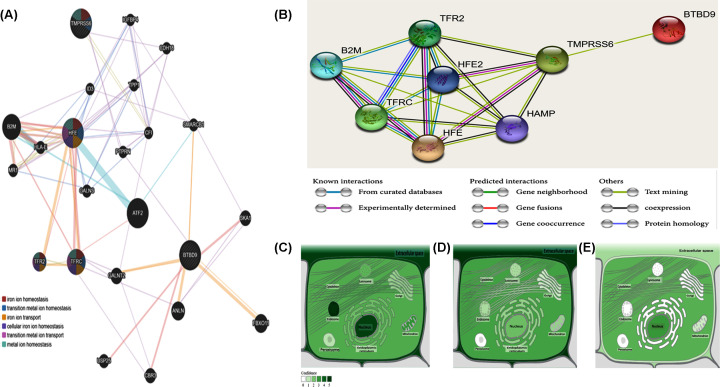
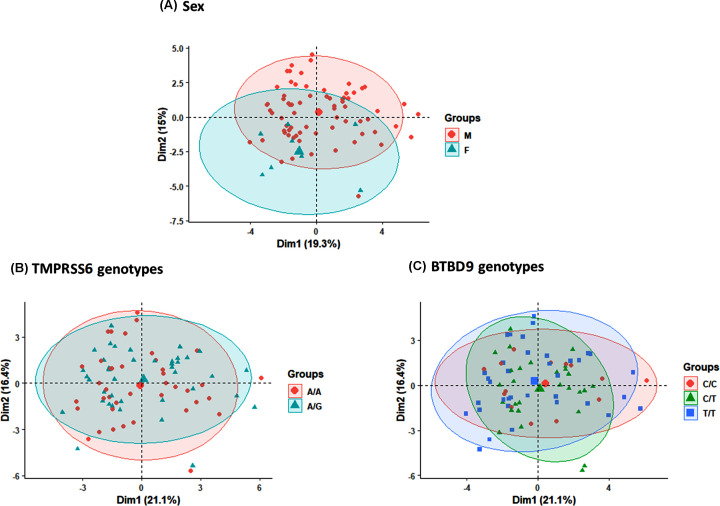
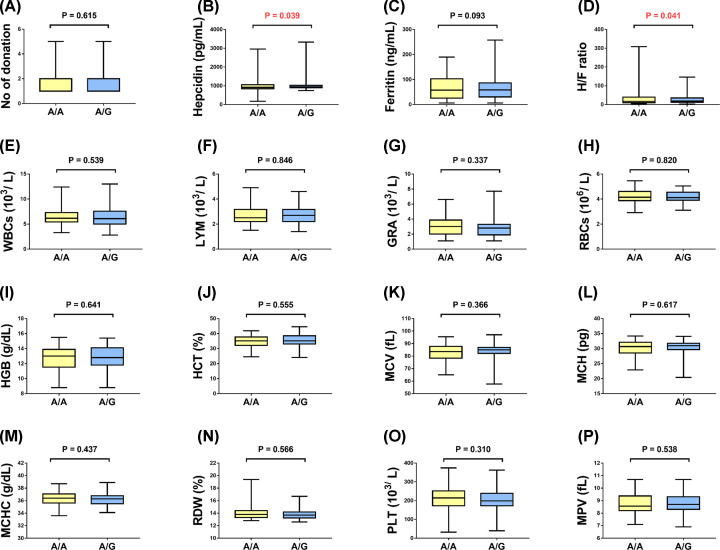
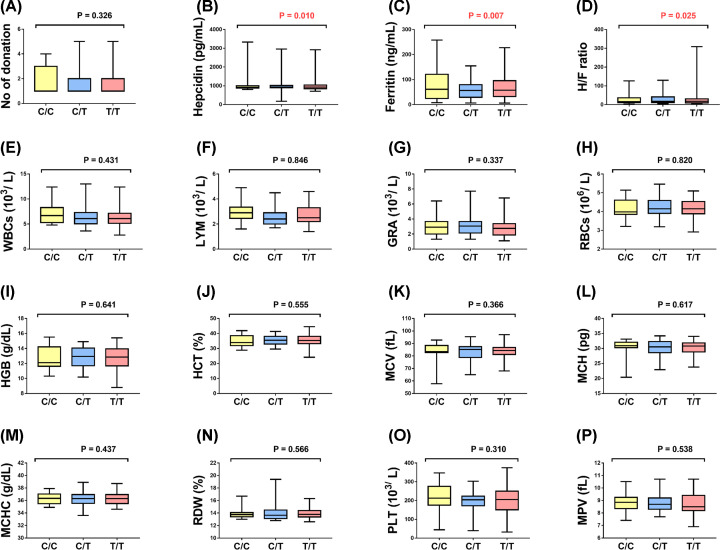
Genetic variants associated with iron homeostasis have been identified, but their association with iron-related indices and variables among different ethnic populations remains controversial. We aimed to explore the genotype frequency and allelic distribution of three iron-metabolism related variants in homeostatic iron regulator gene (HFE; rs1800562 G/A), transmembrane protease, Serine-6 gene (TMPRSS6; rs855791 A/G), and BTB domain-containing protein-9 gene (BTBD9; rs9357271 C/T) among a sample of the Middle Eastern blood donors and to detect the association of these variants on blood indices, and serum hepcidin/ferritin levels. Real-Time TaqMan genotyping assay for the specified variants was applied for 197 unrelated blood donors. Complete blood picture and serum hepcidin/ferritin levels were assessed. All participants were carriers of rs1800562G/G genotype for HFE. The frequency of A/A and A/G genotypes of TMPRSS6 rs855791 variant was 55% and 45%, and for C/C, C/T, and T/T of BTBD9 rs9357271, were 15%, 43%, and 42%, respectively. Minor allele frequencies of rs855791G and rs9357271*C were 0.23 and 0.37. The GGC genotype combination (for HFE/TMPRSS6/BTBD9, respectively) was more frequent in male participants. Higher serum hepcidin and hepcidin/ferritin ratio were observed in TMPRSS6 (A/G) carriers. While subjects with BTBD9 C/T and TT genotypes had lower serum ferritin values and higher levels of hepcidin and hepcidin/ferritin ratio compared with C/C genotype. No significant associations were found with any other blood parameters. In conclusion, TMPRSS6 rs855791 (A/G) and BTBD9 rs9357271 (C/T) variants were prevalent in the present blood donor population and may influence the serum hepcidin and/or ferritin levels.
与铁稳态相关的遗传变异已经被确定,但它们与不同种族人群中铁相关指标和变量的关联仍然存在争议。我们旨在探讨中东献血者样本中稳态铁调节基因(HFE;rs1800562 G/A)、跨膜蛋白酶丝氨酸 6 基因(TMPRSS6;rs855791 A/G)和 BTB 结构域蛋白 9 基因(BTBD9;rs9357271 C/T)三个铁代谢相关变异的基因型频率和等位基因分布,并检测这些变异对血液指标和血清铁调素/铁蛋白水平的影响。应用实时 TaqMan 基因分型检测法对 197 名无关献血者进行了指定变异的检测。评估了全血细胞计数和血清铁调素/铁蛋白水平。所有参与者均为 HFE rs1800562G/G 基因型的携带者。TMPRSS6 rs855791 变异的 A/A 和 A/G 基因型频率分别为 55%和 45%,BTBD9 rs9357271 的 C/C、C/T 和 T/T 基因型频率分别为 15%、43%和 42%。rs855791G 和 rs9357271*C 的次要等位基因频率分别为 0.23 和 0.37。在男性参与者中,HFE/TMPRSS6/BTBD9 的 GGC 基因型组合更为常见。TMPRSS6(A/G)携带者的血清铁调素和铁调素/铁蛋白比值较高。而 BTBD9 C/T 和 TT 基因型的受试者与 C/C 基因型相比,血清铁蛋白值较低,铁调素和铁调素/铁蛋白比值较高。与其他血液参数无显著相关性。总之,本研究人群中 TMPRSS6 rs855791(A/G)和 BTBD9 rs9357271(C/T)变异较为常见,可能影响血清铁调素和/或铁蛋白水平。