Department of Medicine, Section of Nephrology, Baylor College of Medicine, Selzman Institute for Kidney Health, Houston, TX, USA.
Health Policy, Quality & Informatics Program, Michael E. DeBakey VA Medical Center Health Services Research & Development Center for Innovations, Houston, TX, USA.
Nephrol Dial Transplant. 2021 Sep 27;36(10):1893-1899. doi: 10.1093/ndt/gfaa300.
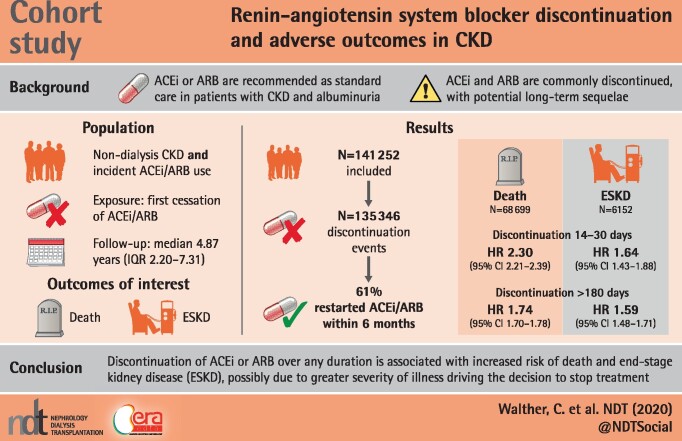
Treatment with renin-angiotensin system inhibitors (RASIs), angiotensin-converting enzyme inhibitors (ACEIs) and angiotensin II receptor blockers (ARBs) is the standard of care for those with chronic kidney disease (CKD) and albuminuria. However, ACEI/ARB treatment is often discontinued for various reasons. We investigated the association of ACEI/ARB discontinuation with outcomes among US veterans with non-dialysis-dependent CKD.
We performed a retrospective cohort study of patients in the Veterans Affairs healthcare system with non-dialysis-dependent CKD who subsequently were started on ACEI/ARB therapy (new user design). Discontinuation events were defined as a gap in ACEI/ARB therapy of ≥14 days and were classified further based on duration (14-30, 31-60, 61-90, 91-180 and >180 days). This was treated as a time-varying risk factor in adjusted Cox proportional hazards models for the outcomes of death and incident end-stage kidney disease (ESKD), which also adjusted for relevant confounders.
We identified 141 252 people with CKD and incident ACEI/ARB use who met the inclusion criteria; these were followed for a mean 4.87 years. There were 135 356 discontinuation events, 68 699 deaths and 6152 incident ESKD events. Discontinuation of ACEI/ARB was associated with a higher risk of death [hazard ratio (HR) 2.3, 2.0, 1.99, 1.92 and 1.74 for those discontinued for 14-30, 31-60, 61-90, 91-180 and >180 days, respectively]. Similar associations were noted between ACEI and ARB discontinuation and ESKD (HR 1.64, 1.47, 1.54, 1.65 and 1.59 for those discontinued for 14-30, 31-60, 61-90, 91-180 and >180 days, respectively).
In a cohort of predominantly male veterans with CKD Stages 3 and 4, ACEI/ARB discontinuation was independently associated with an increased risk of subsequent death and ESKD. This may be due to the severity of illness factors that drive the decision to discontinue therapy. Further investigations to determine the causes of discontinuations and to provide an evidence base for discontinuation decisions are needed.
血管紧张素转化酶抑制剂(ACEI)和血管紧张素 II 受体阻滞剂(ARB)的肾素-血管紧张素系统抑制剂(RASI)治疗是慢性肾脏病(CKD)和白蛋白尿患者的标准治疗方法。然而,由于各种原因,ACEI/ARB 的治疗经常被中断。我们研究了 ACEI/ARB 停药与美国退伍军人非透析依赖性 CKD 患者结局之间的关系。
我们对退伍军人事务部医疗保健系统中接受非透析依赖性 CKD 治疗并随后开始接受 ACEI/ARB 治疗的患者进行了回顾性队列研究(新用户设计)。停药事件定义为 ACEI/ARB 治疗中断≥14 天,并根据持续时间进一步分类(14-30、31-60、61-90、91-180 和>180 天)。在调整后的 Cox 比例风险模型中,将其作为死亡和终末期肾病(ESKD)事件的时变风险因素,该模型还调整了相关混杂因素。
我们确定了 141252 名患有 CKD 并发生 ACEI/ARB 治疗的患者符合纳入标准;这些患者的平均随访时间为 4.87 年。共有 135356 次停药事件、68699 例死亡和 6152 例新发 ESKD 事件。ACEI/ARB 停药与死亡风险增加相关[停药 14-30、31-60、61-90、91-180 和>180 天的风险比(HR)分别为 2.3、2.0、1.99、1.92 和 1.74]。ACEI 和 ARB 停药与 ESKD 之间也存在类似的关联(停药 14-30、31-60、61-90、91-180 和>180 天的 HR 分别为 1.64、1.47、1.54、1.65 和 1.59)。
在一个主要由男性退伍军人组成的 CKD 3 期和 4 期队列中,ACEI/ARB 停药与随后死亡和 ESKD 的风险增加独立相关。这可能是由于导致停药决定的疾病严重程度因素所致。需要进一步调查以确定停药的原因,并为停药决策提供证据基础。