Department of Medical Imaging/Radiology, Radboud university medical center, Nijmegen, The Netherlands.
Department of Geriatrics, Radboud university medical center, Nijmegen, The Netherlands.
J Physiol. 2021 Mar;599(5):1533-1550. doi: 10.1113/JP280771. Epub 2021 Jan 13.
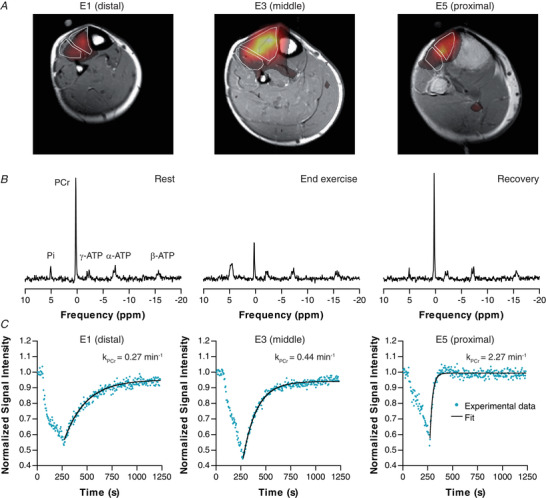
The post-exercise recovery of phosphocreatine, a measure of the oxidative capacity of muscles, as assessed by P MR spectroscopy, shows a striking increase from distal to proximal along the human tibialis anterior muscle. To investigate why this muscle exhibits a greater oxidative capacity proximally, we tested whether the spatial variation in phosphocreatine recovery rate is related to oxygen supply, muscle fibre type or type of exercise. We revealed that oxygen supply also increases from distal to proximal along the tibialis anterior, and that it strongly correlated with phosphocreatine recovery. Carnosine level, a surrogate measure for muscle fibre type was not different between proximal and distal, and type of exercise did not affect the gradient in phosphocreatine recovery rate. Taken together, the findings of this study suggest that the post-exercise spatial gradients in oxygen supply and phosphocreatine recovery are driven by a higher intrinsic mitochondrial oxidative capacity proximally.
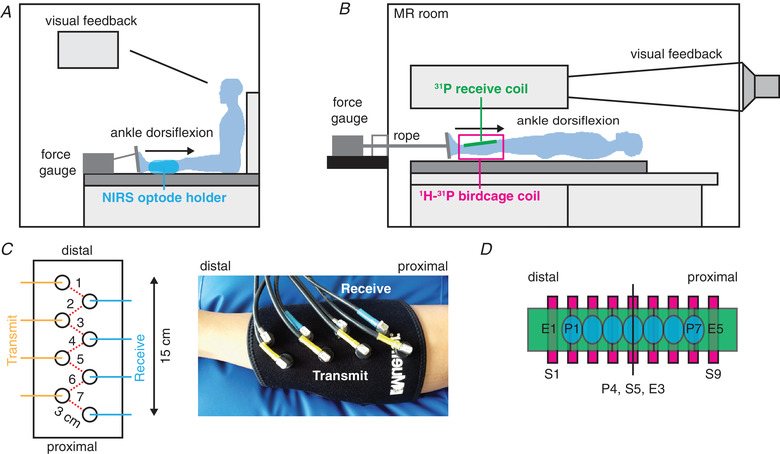
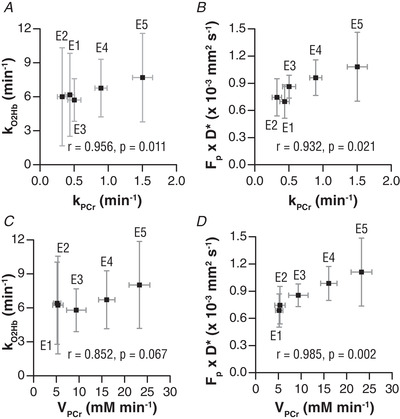
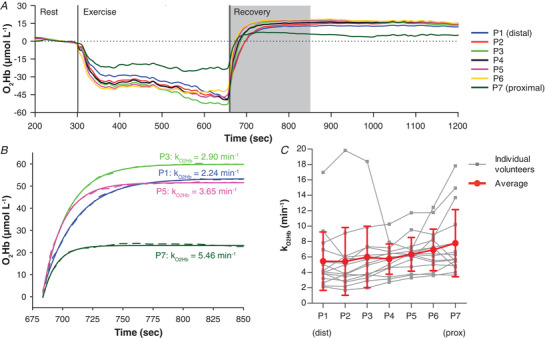
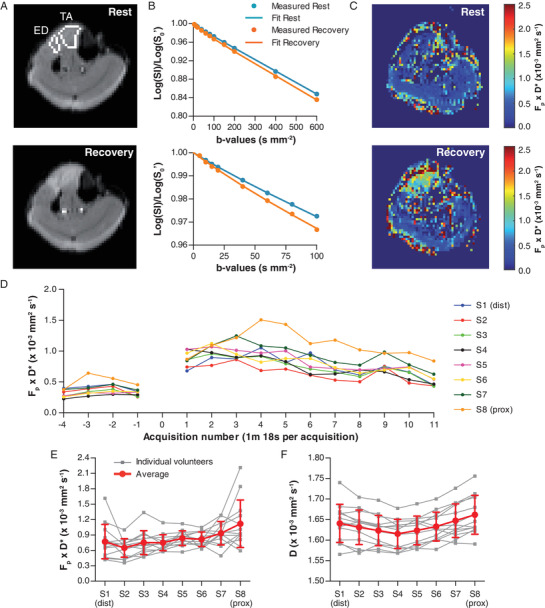
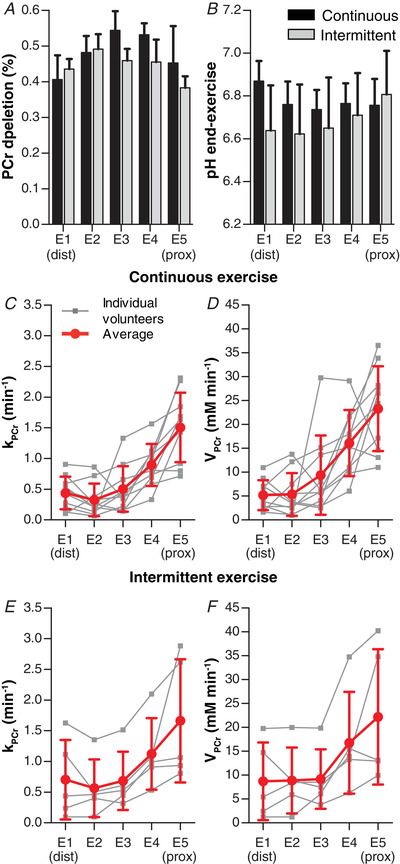
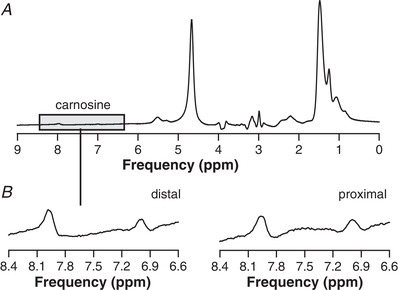
Phosphorus magnetic resonance spectroscopy ( P MRS) of human tibialis anterior (TA) revealed a strong proximo-distal gradient in the post-exercise phosphocreatine (PCr) recovery rate constant (k ), a measure of muscle oxidative capacity. The aim of this study was to investigate whether this k gradient is related to O supply, resting phosphorylation potential, muscle fibre type, or type of exercise. Fifteen male volunteers performed continuous isometric ankle dorsiflexion at 30% maximum force until exhaustion. At multiple locations along the TA, we measured the oxidative PCr resynthesis rate (V = k × PCr depletion) by P MRS, the oxyhaemoglobin recovery rate constant (k ) by near infrared spectroscopy, and muscle perfusion with MR intravoxel incoherent motion imaging. The k , k , V and muscle perfusion depended on measurement location (P < 0.001, P < 0.001, P = 0.032 and P = 0.003, respectively), all being greater proximally. The k and muscle perfusion correlated with k (r = 0.956 and r = 0.852, respectively) and V (r = 0.932 and r = 0.985, respectively), the latter reflecting metabolic O consumption. Resting phosphorylation potential (PCr/inorganic phosphate) was also higher proximally (P < 0.001). The surrogate for fibre type, carnosine content measured by H MRS, did not differ between distal and proximal TA (P = 0.884). Performing intermittent exercise to avoid exercise ischaemia, still led to larger k proximally than distally (P = 0.013). In conclusion, the spatial k gradient is strongly associated with the spatial variation in O supply. It cannot be explained by exercise-induced ischaemia nor by fibre type. Our findings suggest it is driven by a higher proximal intrinsic mitochondrial oxidative capacity, apparently to support contractile performance of the TA.
通过磷磁共振波谱(P 磁共振波谱)测量磷酸肌酸(PCr)的恢复情况,可评估肌肉的氧化能力,结果显示,人类胫骨前肌从远端到近端呈现出惊人的增加。为了探究为什么这块肌肉在近端表现出更大的氧化能力,我们测试了 PCr 恢复率的空间变化是否与氧气供应、肌纤维类型或运动类型有关。我们发现,氧气供应也沿着胫骨前肌从远端到近端增加,并且与 PCr 的恢复强烈相关。作为肌纤维类型的替代测量指标的肌肽水平在近端和远端之间没有差异,运动类型也不会影响 PCr 恢复率的梯度。总之,这项研究的结果表明,运动后氧气供应和 PCr 恢复的空间梯度是由近端更高的内在线粒体氧化能力驱动的。
对人类胫骨前肌(TA)的磷磁共振波谱(P 磁共振波谱)分析显示,PCr 恢复率常数(k )的运动后空间梯度很强,k 是肌肉氧化能力的一个衡量标准。本研究的目的是探讨这个 k 梯度是否与氧供应、静息磷酸化势能、肌纤维类型或运动类型有关。15 名男性志愿者以 30%最大力量进行连续的等长踝关节背屈运动,直至力竭。在 TA 的多个位置,我们通过 P 磁共振波谱测量了氧化型 PCr 再合成率(V = k×PCr 耗竭),通过近红外光谱测量了氧合血红蛋白恢复率常数(k ),通过磁共振体素内不相干运动成像测量了肌肉灌注。k 、k 、V 和肌肉灌注取决于测量位置(P < 0.001,P < 0.001,P = 0.032 和 P = 0.003,分别),近端都更高。k 和肌肉灌注与 k (r = 0.956 和 r = 0.852,分别)和 V (r = 0.932 和 r = 0.985,分别)相关,后者反映了代谢性 O 消耗。静息磷酸化势能(PCr/无机磷酸盐)也在近端更高(P < 0.001)。通过 1 H 磁共振波谱测量的纤维类型的替代指标,肌肽含量在远端和近端的 TA 之间没有差异(P = 0.884)。进行间歇性运动以避免运动性缺血,仍导致近端 k 值大于远端(P = 0.013)。总之,k 的空间梯度与 O 供应的空间变化密切相关。它不能用运动引起的缺血或纤维类型来解释。我们的发现表明,它是由近端更高的内在线粒体氧化能力驱动的,显然是为了支持 TA 的收缩性能。