Center for AIDS Research, Kumamoto University, Kumamoto, Japan.
Division of International Collaboration Research, Joint Research Center for Human Retrovirus Infection, Kumamoto University, Tokyo, Japan.
PLoS Pathog. 2020 Dec 28;16(12):e1009177. doi: 10.1371/journal.ppat.1009177. eCollection 2020 Dec.
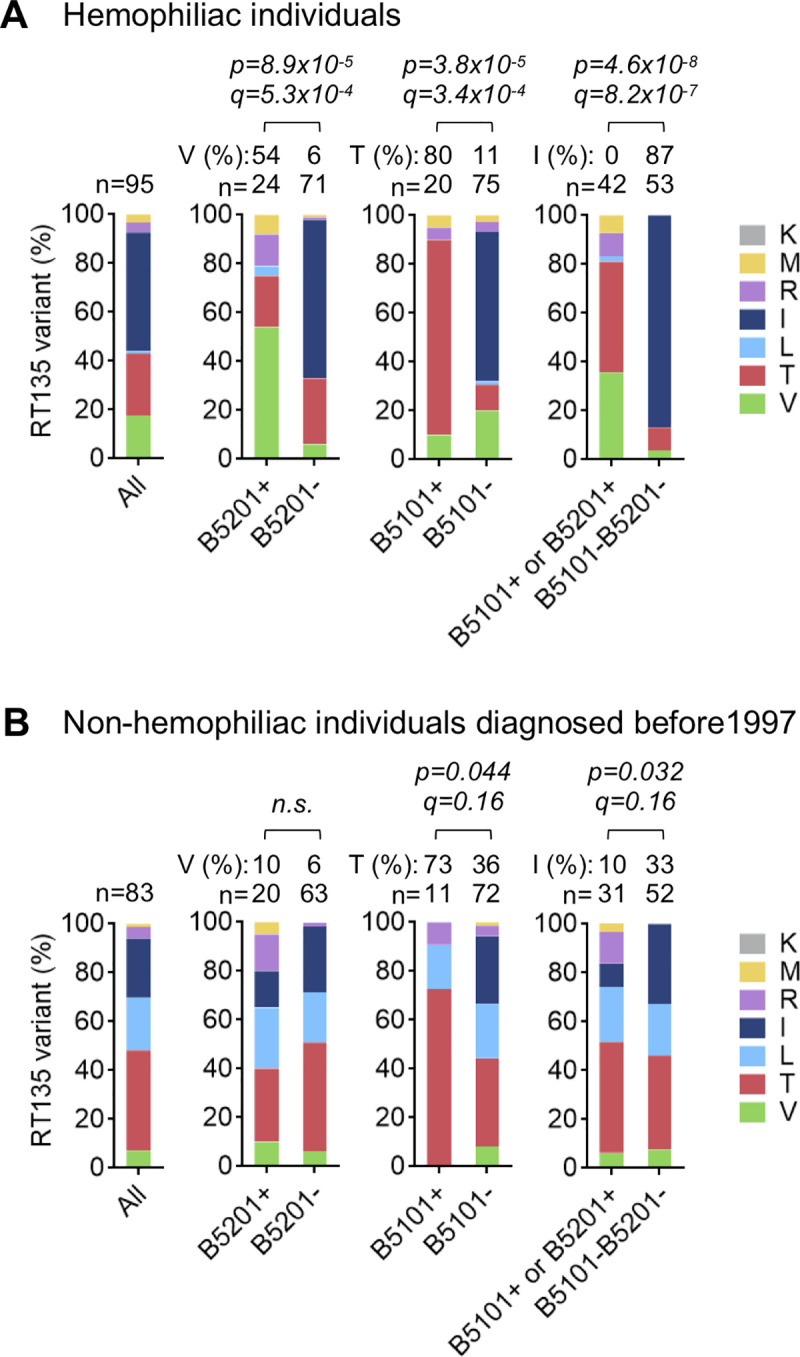
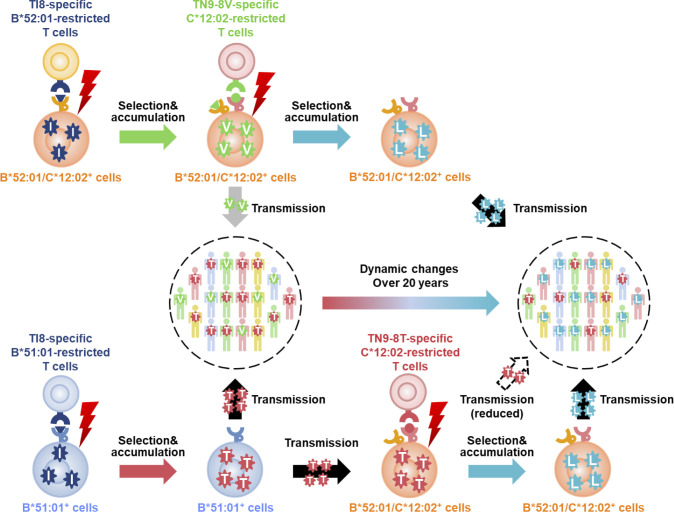
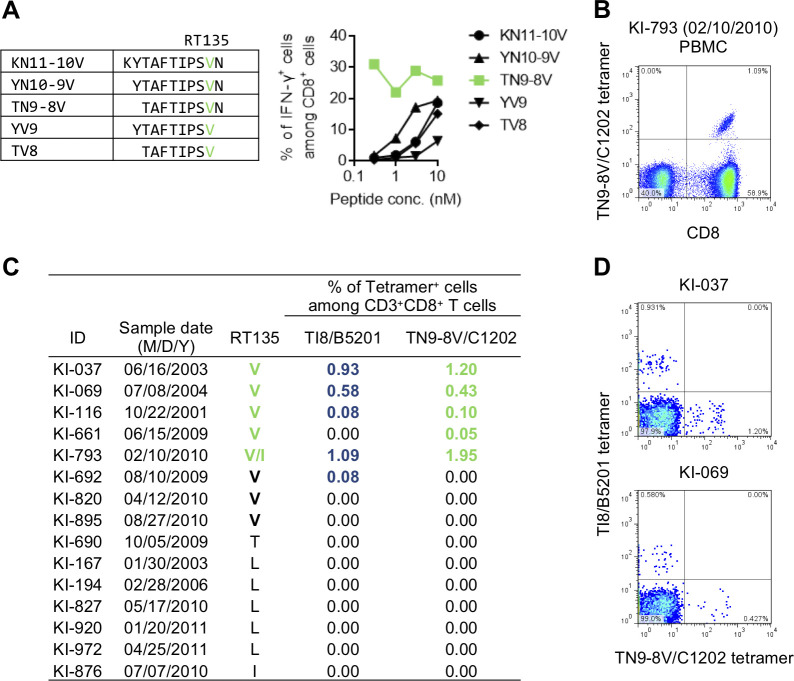
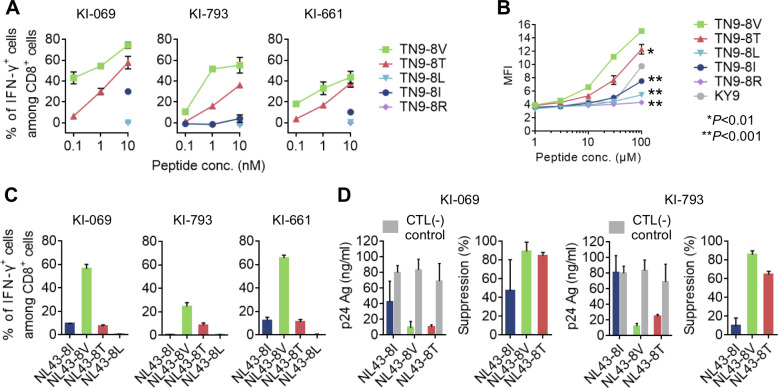
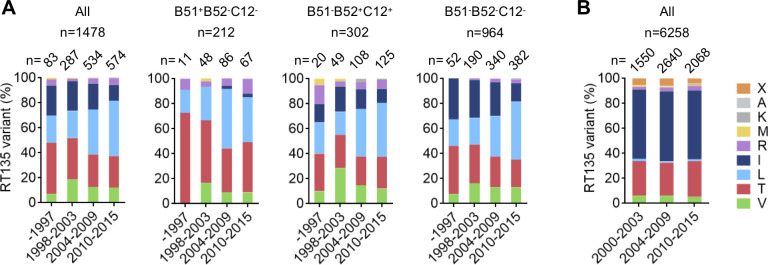
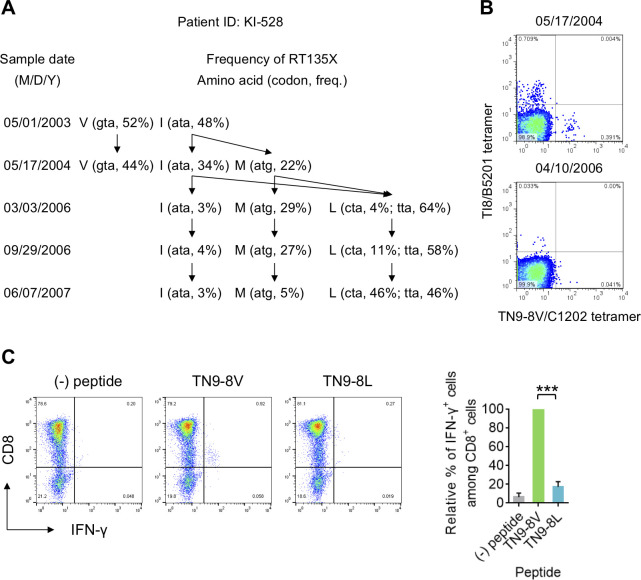
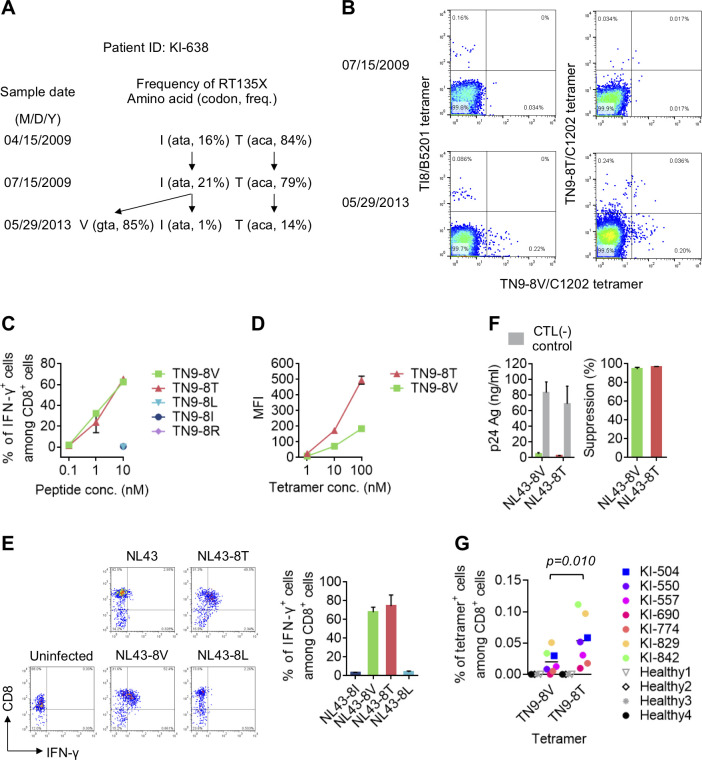
HIV-1 strains harboring immune escape mutations can persist in circulation, but the impact of selection by multiple HLA alleles on population HIV-1 dynamics remains unclear. In Japan, HIV-1 Reverse Transcriptase codon 135 (RT135) is under strong immune pressure by HLA-B51:01-restricted and HLA-B52:01-restricted T cells that target a key epitope in this region (TI8; spanning RT codons 128-135). Major population-level shifts have occurred at HIV-1 RT135 during the Japanese epidemic, which first affected hemophiliacs (via imported contaminated blood products) and subsequently non-hemophiliacs (via domestic transmission). Specifically, threonine accumulated at RT135 (RT135T) in hemophiliac and non-hemophiliac HLA-B51:01+ individuals diagnosed before 1997, but since then RT135T has markedly declined while RT135L has increased among non-hemophiliac individuals. We demonstrated that RT135V selection by HLA-B52:01-restricted TI8-specific T-cells led to the creation of a new HLA-C12:02-restricted epitope TN9-8V. We further showed that TN9-8V-specific HLA-C12:02-restricted T cells selected RT135L while TN9-8T-specific HLA-C12:02-restricted T cells suppressed replication of the RT135T variant. Thus, population-level accumulation of the RT135L mutation over time in Japan can be explained by initial targeting of the TI8 epitope by HLA-B52:01-restricted T-cells, followed by targeting of the resulting escape mutant by HLA-C12:02-restricted T-cells. We further demonstrate that this phenomenon is particular to Japan, where the HLA-B52:01-C*12:02 haplotype is common: RT135L did not accumulate over a 15-year longitudinal analysis of HIV sequences in British Columbia, Canada, where this haplotype is rare. Together, our observations reveal that T-cell responses to sequentially emerging viral escape mutants can shape long-term HIV-1 population dynamics in a host population-specific manner.
HIV-1 株系中携带免疫逃逸突变的病毒可以在循环中持续存在,但多个 HLA 等位基因对人群 HIV-1 动力学的选择影响仍不清楚。在日本,HIV-1 逆转录酶密码子 135(RT135)受到 HLA-B51:01 限制性和 HLA-B52:01 限制性 T 细胞的强烈免疫压力,这些 T 细胞靶向该区域的关键表位(TI8;跨越 RT 密码子 128-135)。在日本的 HIV-1 流行期间,HIV-1 RT135 发生了主要的人群水平变化,首先影响血友病患者(通过进口污染的血液制品),随后影响非血友病患者(通过国内传播)。具体来说,在 1997 年之前诊断的血友病和非血友病 HLA-B51:01+个体中,RT135 积累了苏氨酸(RT135T),但此后 RT135T 显著下降,而非血友病患者的 RT135L 增加。我们证明了 HLA-B52:01 限制性 TI8 特异性 T 细胞对 RT135V 的选择导致了一个新的 HLA-C12:02 限制性表位 TN9-8V 的产生。我们进一步表明,TN9-8V 特异性 HLA-C12:02 限制性 T 细胞选择 RT135L,而 TN9-8T 特异性 HLA-C12:02 限制性 T 细胞抑制 RT135T 变异体的复制。因此,随着时间的推移,日本人群中 RT135L 突变的积累可以通过 HLA-B52:01 限制性 T 细胞最初靶向 TI8 表位来解释,随后是 HLA-C12:02 限制性 T 细胞靶向由此产生的逃逸突变体。我们进一步证明,这种现象是日本特有的,在那里 HLA-B52:01-C*12:02 单倍型很常见:在加拿大不列颠哥伦比亚省的一项长达 15 年的 HIV 序列纵向分析中,RT135L 并没有积累,而在那里这种单倍型很少见。总之,我们的观察结果表明,针对连续出现的病毒逃逸突变体的 T 细胞反应可以以宿主群体特异性的方式塑造 HIV-1 种群的长期动力学。