Department of Cardiology School of Medicine The First Affiliated HospitalZhejiang University Hangzhou Zhejiang China.
Institute for Stroke and Dementia Research (ISD) University HospitalLudwig-Maximilians-University LMU Munich Germany.
J Am Heart Assoc. 2021 Jan 5;10(1):e017986. doi: 10.1161/JAHA.120.017986. Epub 2020 Dec 29.
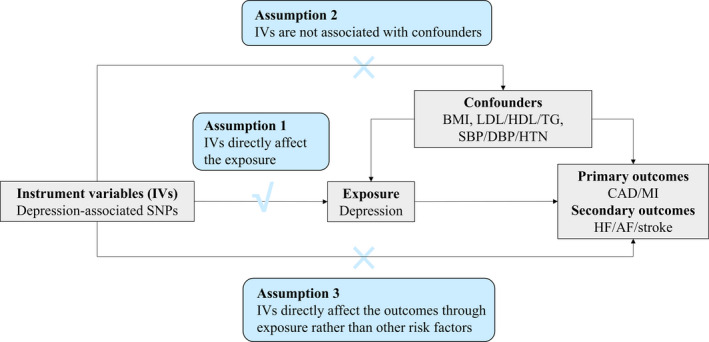
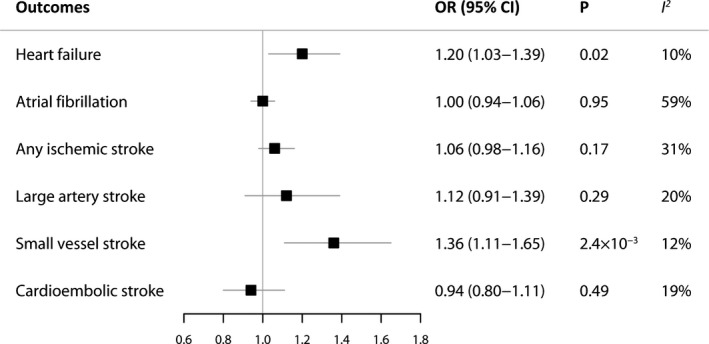
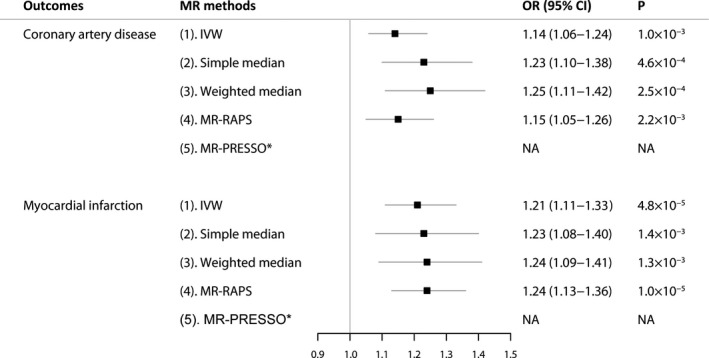
Background Observational studies have indicated that depression is associated with coronary artery disease (CAD) and myocardial infarction. Nevertheless, causal associations between depression and cardiovascular diseases remain controversial. Hence, we conducted a Mendelian randomization and mediation analysis to evaluate the associations of depression-related genetic variants with CAD and myocardial infarction. Methods and Results Summary statistics from genome-wide association studies of depression (807 553 individuals), and CAD (60 801 cases, including 43 676 with myocardial infarction, and 123 504 controls) were used. We pooled Mendelian randomization estimates using a fixed-effects inverse-variance weighted meta-analysis and multivariable Mendelian randomization. The mediation effects of potential cardiovascular risk factors on depression-CAD and myocardial infarction risk were investigated by using mediation analysis. We also explored the relationship of genetic liability to depression with heart failure, atrial fibrillation, and ischemic stroke. Genetic liability to depression was associated with higher CAD (odds ratio [OR], 1.14; 95% CI, 1.06-1.24; =1.0×10) and myocardial infarction (OR, 1.21; 95% CI, 1.11-1.33; =4.8×10) risks. Results were consistent in all sensitivity analyses. Type 2 diabetes mellitus and smoking demonstrated significant mediation effects. Furthermore, our Mendelian randomization analyses revealed that the genetic liability to depression was associated with higher risks of heart failure and small vessel stroke. Conclusions Genetic liability to depression is associated with higher CAD and myocardial infarction risks, partly mediated by type 2 diabetes mellitus and smoking. The potential preventive value of depression treatment on cardiovascular diseases should be investigated in the future.
观察性研究表明,抑郁与冠状动脉疾病(CAD)和心肌梗死有关。然而,抑郁与心血管疾病之间的因果关系仍存在争议。因此,我们进行了一项孟德尔随机化和中介分析,以评估与抑郁相关的遗传变异与 CAD 和心肌梗死的关联。
总结了抑郁(807553 人)和 CAD(60801 例病例,包括 43676 例心肌梗死和 123504 例对照)的全基因组关联研究的汇总统计数据。我们使用固定效应逆方差加权荟萃分析和多变量孟德尔随机化来汇总孟德尔随机化估计值。通过中介分析研究了潜在心血管风险因素对抑郁与 CAD 和心肌梗死风险的中介作用。我们还探讨了遗传易感性与抑郁症与心力衰竭、心房颤动和缺血性中风之间的关系。
抑郁的遗传易感性与 CAD(优势比 [OR],1.14;95%置信区间 [CI],1.06-1.24;=1.0×10)和心肌梗死(OR,1.21;95%CI,1.11-1.33;=4.8×10)风险的升高有关。所有敏感性分析结果均一致。2 型糖尿病和吸烟显示出显著的中介作用。此外,我们的孟德尔随机化分析表明,抑郁的遗传易感性与心力衰竭和小血管中风的风险增加有关。
抑郁的遗传易感性与 CAD 和心肌梗死风险的增加有关,部分通过 2 型糖尿病和吸烟介导。未来应调查抑郁症治疗对心血管疾病的潜在预防价值。