Minakawa Noboru, Kongere James O, Sonye George O, Lutiali Peter A, Awuor Beatrice, Kawada Hitoshi, Isozumi Rie, Futami Kyoko
Institute of Tropical Medicine (NEKKEN), Nagasaki University, 1-12-4 Sakamoto, Nagasaki, 852-8523, Japan.
Kenya Medical Research Institute, Nairobi, Kenya.
Trop Med Health. 2020 Dec 7;48(1):98. doi: 10.1186/s41182-020-00276-x.
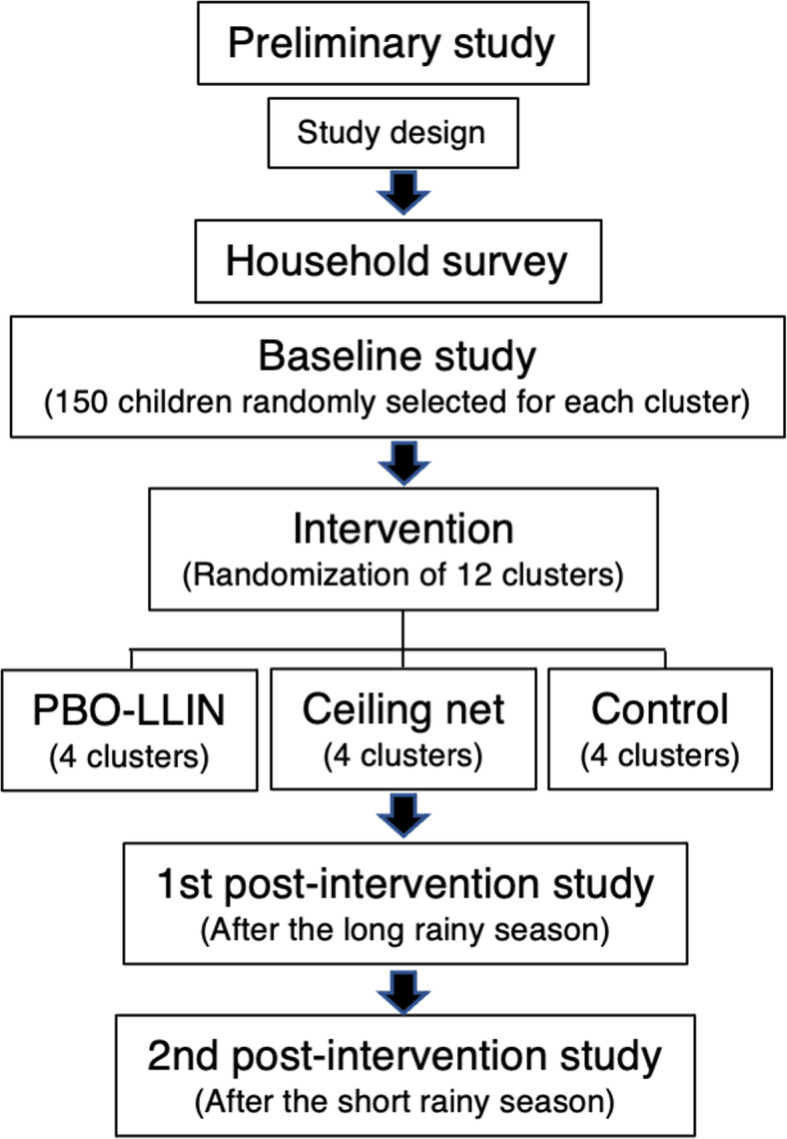
Although long-lasting insecticidal nets (LLINs) are the most effective tool for preventing malaria parasite transmission, the nets have some limitations. For example, the increase of LLIN use has induced the rapid expansion of mosquito insecticide resistance. More than two persons often share one net, which increases the infection risk. To overcome these problems, two new mosquito nets were developed, one incorporating piperonyl butoxide and another covering ceilings and open eaves. We designed a cluster randomized controlled trial (cRCT) to evaluate these nets based on the information provided in the present preliminary study.
Nearly 75% of the anopheline population in the study area in western Kenya was Anopheles gambiae s. l., and the remaining was Anopheles funestus s. l. More female anophelines were recorded in the western part of the study area. The number of anophelines increased with rainfall. We planned to have 80% power to detect a 50% reduction in female anophelines between the control group and each intervention group. The between-cluster coefficient of variance was 0.192. As the number of clusters was limited to 4 due to the size of the study area, the estimated cluster size was 7 spray catches with an alpha of 0.05. Of 1619 children tested, 626 (48%) were Plasmodium falciparum positive using a rapid diagnostic test (RDT). The prevalence was higher in the northwestern part of the study area. The number of children who slept under bed nets was 929 (71%). The P. falciparum RDT-positive prevalence (RDTpfPR) of net users was 45%, and that of non-users was 55% (OR 0.73; 95% CI 0.56, 0.95). Using 45% RDTpfPR of net users, we expected each intervention to reduce prevalence by 50%. The intracluster correlation coefficient was 0.053. With 80% power and an alpha of 0.05, the estimated cluster size was 116 children. Based on the distribution of children, we modified the boundaries of the clusters and established 300-m buffer zones along the boundaries to minimize a spillover effect.
The cRCT study design is feasible. As the number of clusters is limited, we will apply a two-stage procedure with the baseline data to evaluate each intervention.
尽管长效驱虫蚊帐(LLINs)是预防疟原虫传播最有效的工具,但这些蚊帐存在一些局限性。例如,LLINs使用的增加导致了蚊虫抗药性的迅速扩大。通常不止两人共用一顶蚊帐,这增加了感染风险。为克服这些问题,研发了两种新型蚊帐,一种含有胡椒基丁醚,另一种覆盖天花板和开放式屋檐。我们根据本初步研究提供的信息设计了一项整群随机对照试验(cRCT)来评估这些蚊帐。
肯尼亚西部研究区域近75%的按蚊种群为冈比亚按蚊复合组,其余为富氏按蚊复合组。研究区域西部记录到的雌蚊更多。按蚊数量随降雨量增加。我们计划有80%的把握度来检测对照组与各干预组之间雌蚊数量减少50%的情况。整群间方差系数为0.192。由于研究区域面积的原因,整群数量限制为4个,估计整群大小为7次喷雾捕捉,α水平为0.05。在1619名接受检测的儿童中,使用快速诊断检测(RDT)有626名(48%)恶性疟原虫呈阳性。患病率在研究区域西北部较高。睡在蚊帐下的儿童有929名(71%)。使用蚊帐者的恶性疟原虫RDT阳性患病率(RDTpfPR)为45%,未使用蚊帐者为55%(比值比0.73;95%置信区间0.56,0.95)。利用使用蚊帐者45%的RDTpfPR,我们预计每种干预措施可使患病率降低50%。组内相关系数为0.053。把握度为80%且α水平为0.05时,估计整群大小为116名儿童。根据儿童分布情况,我们修改了整群边界,并沿边界设立了300米的缓冲区,以尽量减少溢出效应。
cRCT研究设计可行。由于整群数量有限,我们将采用两阶段程序并结合基线数据来评估每种干预措施。