Department of Psychology, University of Québec at Trois-Rivières, Trois-Rivières, Québec, Canada.
Department of Psychoeducation and Psychology, University of Québec in Outaouais, Gatineau, Québec, Canada.
PLoS One. 2020 Dec 29;15(12):e0243083. doi: 10.1371/journal.pone.0243083. eCollection 2020.
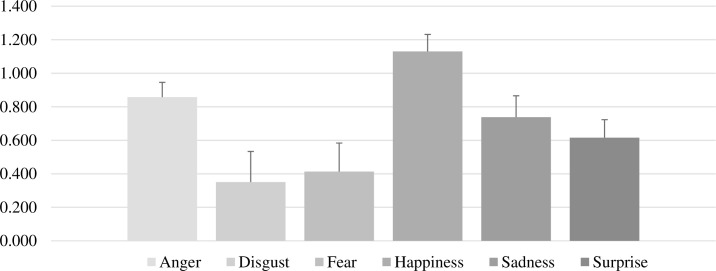
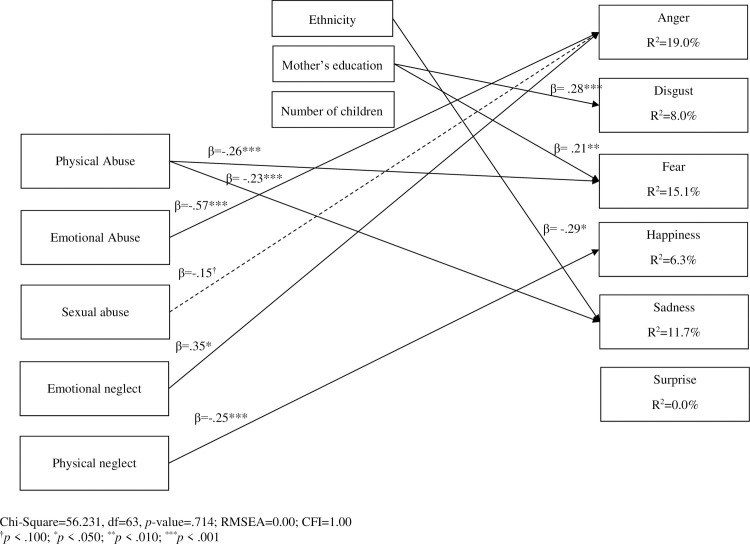
Several studies have shown that child maltreatment is associated with both positive and negative effects on the recognition of facial emotions. Research has provided little evidence of a relation between maltreatment during childhood and young adults' ability to recognize facial displays of emotion in children, an essential skill for a sensitive parental response. In this study, we examined the consequences of different forms of maltreatment experienced in childhood on emotion recognition during parenthood. Participants included sixty-three mothers of children aged 2 to 5 years. Retrospective self-reports of childhood maltreatment were assessed using the short form of the Childhood Trauma Questionnaire (CTQ). Emotion recognition was measured using a morphed facial emotion identification task of all six basic emotions (anger, disgust, fear, happiness, sadness, and surprise). A Path Analysis via Structural Equation Model revealed that a history of physical abuse is related to a decreased ability to recognize both fear and sadness in children, whereas emotional abuse and sexual abuse are related to a decreased ability to recognize anger in children. In addition, emotional neglect is associated with an increased ability to recognize anger, whereas physical neglect is associated with less accuracy in recognizing happiness in children's facial emotional expressions. These findings have important clinical implications and expand current understanding of the consequences of childhood maltreatment on parents' ability to detect children's needs.
已有多项研究表明,儿童虐待既会对识别面部情绪产生积极影响,也会产生消极影响。研究几乎没有提供证据表明,儿童时期的虐待与年轻成年人识别儿童面部情绪表达的能力有关,而这种能力是对孩子做出敏感反应的关键技能。在这项研究中,我们探讨了童年时期经历的不同形式的虐待对为人父母时情绪识别的影响。参与者包括 63 名 2 至 5 岁儿童的母亲。使用儿童期创伤问卷(CTQ)的简短形式评估了童年期虐待的回溯性自我报告。使用所有六种基本情绪(愤怒、厌恶、恐惧、快乐、悲伤和惊讶)的变形面部情绪识别任务来衡量情绪识别能力。通过结构方程模型的路径分析表明,身体虐待史与识别儿童恐惧和悲伤的能力下降有关,而情感虐待和性虐待与识别儿童愤怒的能力下降有关。此外,情感忽视与识别愤怒的能力增强有关,而身体忽视与识别儿童面部情绪表达中快乐的准确性降低有关。这些发现具有重要的临床意义,并扩展了对儿童虐待对父母识别孩子需求能力的影响的现有理解。