Pivovarova Aleksandra I, Thongprayoon Charat, Hansrivijit Panupong, Kaewput Wisit, Qureshi Fawad, Boonpheng Boonphiphop, Bathini Tarun, Mao Michael A, Vallabhajosyula Saraschandra, Cheungpasitporn Wisit
Division of Nephrology, Department of Internal Medicine, University of Mississippi Medical Center, Jackson, MS 39216, USA.
Division of Nephrology and Hypertension, Department of Medicine, Mayo Clinic, Rochester, MN 55905, USA.
Diseases. 2020 Dec 24;9(1):3. doi: 10.3390/diseases9010003.
This study aimed to evaluate thrombotic microangiopathy's (TMA) incidence, risk factors, and impact on outcomes and resource use in hospitalized patients with systemic lupus erythematosus (SLE).
We used the National Inpatient Sample to construct a cohort of hospitalized patients with SLE from 2003-2014. We compared clinical characteristics, in-hospital treatments, outcomes, and resource use between SLE patients with and without TMA.
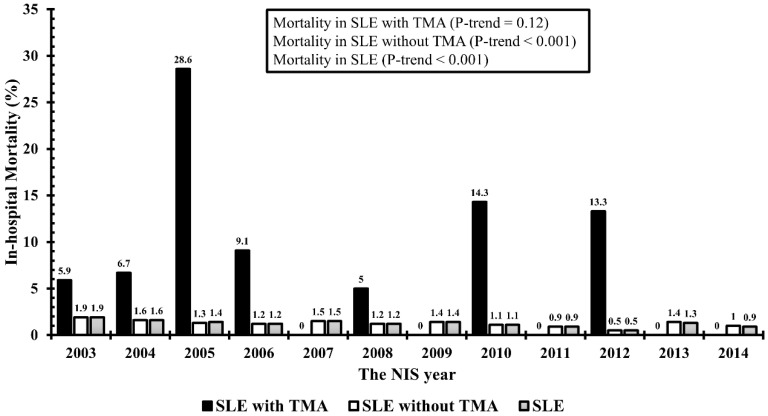
Of 35,745 hospital admissions for SLE, TMA concurrently presented or developed in 188 (0.5%) admissions. Multivariable analysis showed that age ≥ 40 years and Hispanics were significantly associated with decreased risk of TMA, whereas Asian/Pacific Islanders and history of chronic kidney disease were significantly associated with increased risk of TMA. TMA patients required more kidney biopsy, plasmapheresis, mechanical ventilation, and renal replacement therapy. TMA was significantly associated with increased risk of in-hospital mortality and acute conditions including hemoptysis, glomerulonephritis, encephalitis/myelitis/encephalopathy, hemolytic anemia, pneumonia, urinary tract infection, sepsis, ischemic stroke, seizure, and acute kidney injury. The length of hospital stays and hospitalization cost was also significantly higher in SLE with TMA patients.
TMA infrequently occurred in less than 1% of patients admitted for SLE, but it was significantly associated with higher morbidity, mortality, and resource use.
本研究旨在评估血栓性微血管病(TMA)在住院系统性红斑狼疮(SLE)患者中的发病率、危险因素及其对预后和资源利用的影响。
我们利用全国住院患者样本构建了一个2003年至2014年住院SLE患者队列。我们比较了有和没有TMA的SLE患者的临床特征、住院治疗、预后和资源利用情况。
在35745例SLE住院病例中,188例(0.5%)住院期间并发或发生了TMA。多变量分析显示,年龄≥40岁和西班牙裔与TMA风险降低显著相关,而亚太岛民和慢性肾病病史与TMA风险增加显著相关。TMA患者需要更多的肾活检、血浆置换、机械通气和肾脏替代治疗。TMA与住院死亡率增加以及包括咯血、肾小球肾炎、脑炎/脊髓炎/脑病、溶血性贫血、肺炎、尿路感染、败血症、缺血性中风、癫痫发作和急性肾损伤在内的急性病症显著相关。有TMA的SLE患者的住院时间和住院费用也显著更高。
TMA在SLE住院患者中发生率不到1%,但与更高的发病率、死亡率和资源利用显著相关。