Tsochatzis Emmanouil, Lopes Joao Alberto, Gika Helen, Theodoridis Georgios
Department of Food Science, Centre of Innovative Food Research (iFood), Aarhus University, Agro Food Park 48, 8200 Aarhus N, Denmark.
European Commission, Joint Research Centre (JRC), 2440 Geel, Belgium.
Polymers (Basel). 2020 Dec 23;13(1):17. doi: 10.3390/polym13010017.
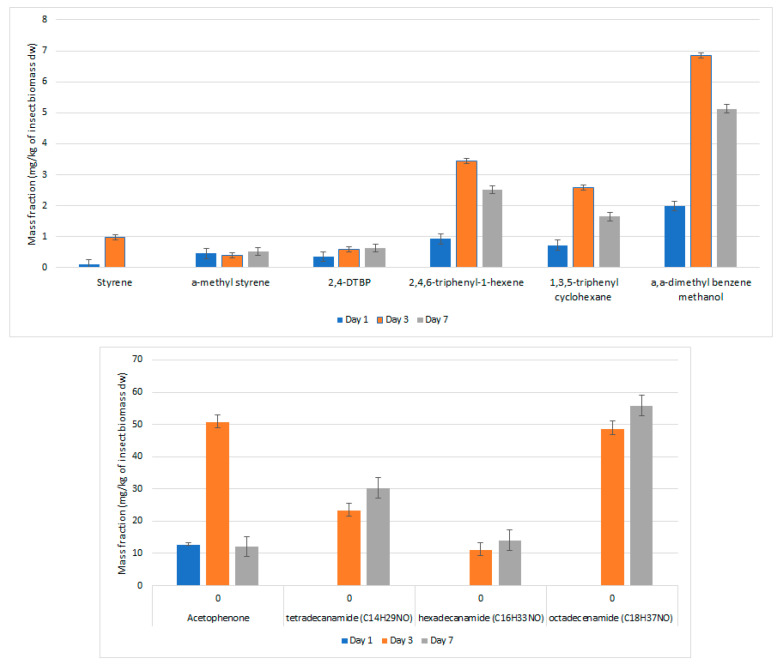
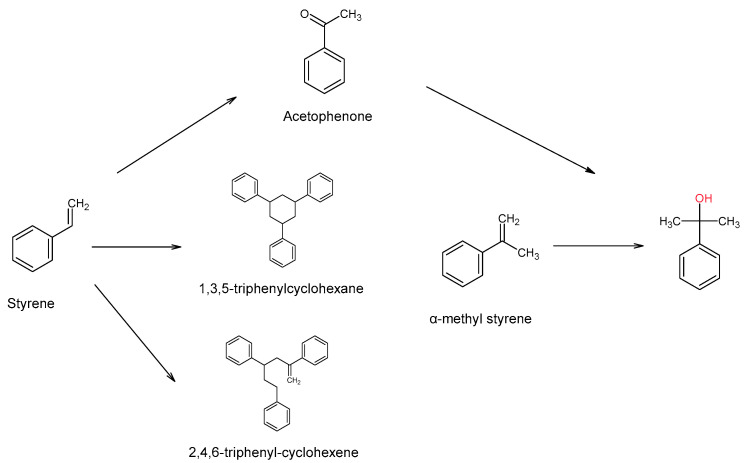
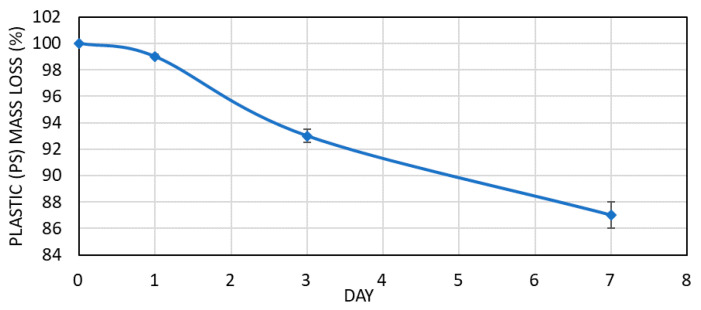
A GC-MS method has been applied to screen and evaluate the generation of chemical compounds during the biodegradation of polystyrene (PS) with larvae. Several resulting compounds have been identified, including trimers 2,4,6-triphenyl-1-hexene and 1,3,5-triphenylcyclohexane, the volatiles acetophenone and cumyl alcohol, and 2,4-di-tert butylphenol, a non-intentionally added substance (NIAS) present in the plastic material. The PS monomers styrene and α-methyl styrene were also identified in the extracts. Bioactive molecules present in the biomass of the studied insects were identified, such as the free fatty acids myristic, palmitic, and oleic acid. Undecanoic acid was also found, but in lower mass fractions. Finally, biochemically formatted amides resulting from their respective fatty acids were identified, namely tetradecanamide, hexadecanamide and oleamide. The formation of all these substances seems to suggest enzymatic and biochemical activity occurring during the biodegradation of PS, and their amounts varied throughout the experience. The overall degradation rate of PS resulted in a 13% rate, which highlights the potential of biorecycling using these insects.
已应用气相色谱-质谱联用(GC-MS)方法来筛选和评估用幼虫对聚苯乙烯(PS)进行生物降解过程中产生的化合物。已鉴定出几种生成的化合物,包括三聚体2,4,6-三苯基-1-己烯和1,3,5-三苯基环己烷、挥发性物质苯乙酮和枯基醇,以及塑料材料中存在的一种非有意添加物质(NIAS)2,4-二叔丁基苯酚。在提取物中还鉴定出了PS单体苯乙烯和α-甲基苯乙烯。已鉴定出所研究昆虫生物量中存在的生物活性分子,如游离脂肪酸肉豆蔻酸、棕榈酸和油酸。还发现了十一烷酸,但质量分数较低。最后,鉴定出了由各自脂肪酸形成的生化形式的酰胺,即十四烷酰胺、十六烷酰胺和油酰胺。所有这些物质的形成似乎表明在PS生物降解过程中发生了酶促和生化活性,并且它们的量在整个实验过程中有所变化。PS的总体降解率为13%,这突出了使用这些昆虫进行生物回收的潜力。