European Commission, Joint Research Centre (JRC), Retieseweg 111, 2440, Geel, Belgium.
European Commission, Joint Research Centre (JRC), Via E. Fermi 2749, 21027, Ispra, Italy.
Anal Bioanal Chem. 2020 Sep;412(22):5419-5434. doi: 10.1007/s00216-020-02758-7. Epub 2020 Jun 24.
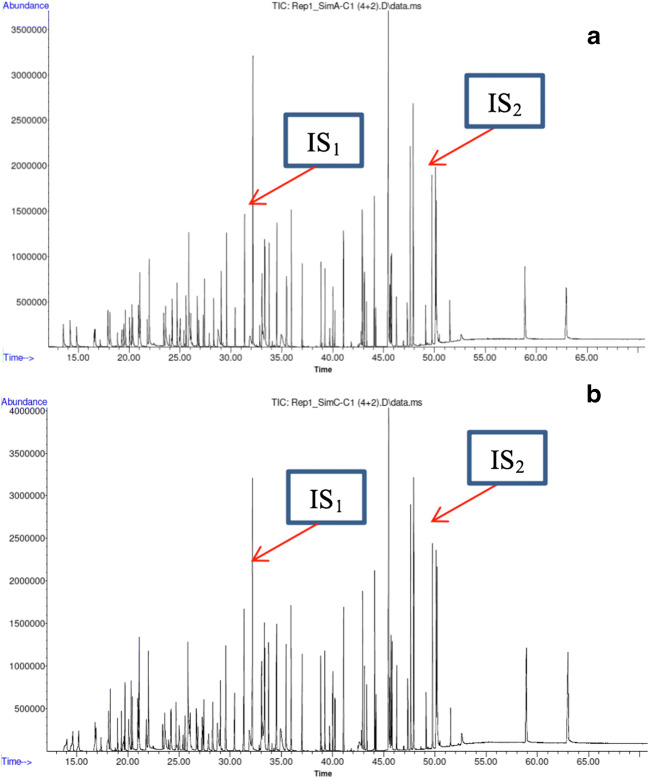
Chemical substances shall not migrate from food contact materials (FCM) at levels that are potentially harmful for the consumers. Each of the current analytical methods applied to verify the migration of substances from FCM covers only one or few substances. There is a very limited number of publications on the development of analytical methods allowing the simultaneous determination of several classes of FCM substances, and almost none of them reported methods entirely dedicated to the ones in the positive list of Commission Regulation (EU) No. 10/2011 for plastic FCMs. Therefore, a simple, sensitive and reliable multi-analyte method was developed for the analysis of FCM substances in food simulants. It employs an optimised liquid-liquid extraction with dichloromethane as extraction solvent in the presence of 10% m/v NaCl, followed by quantitative analysis with gas chromatography coupled to mass spectrometry (GC-MS). A combination of total ion chromatograms (TICs) and extracted ion chromatograms (EICs) was used. The optimisation and validation of the method have been carried out according to current international guidelines. Adequate sensitivity was demonstrated in the selected concentration ranges for most of the analytes, with limits of quantification (LOQs) at least three times lower than the legislative limit, when existing. The results showed that the method is sufficiently accurate for the majority of substances, with recoveries between 70 and 115% and relative standard deviations (RSDs) smaller than 20% at three concentration levels. The method was applied to the analysis of some FCM multilayers. The method allows, for the first time, the simultaneous quantification of 84 FCM substances in two of the official food simulants (A and C) at levels of a few ng g. Graphical abstract.
化学物质不应从食品接触材料(FCM)中迁移到对消费者有潜在危害的水平。目前应用于验证物质从 FCM 迁移的分析方法,每种方法仅涵盖一种或几种物质。关于允许同时测定几类 FCM 物质的分析方法的开发,仅有极少数出版物,而且几乎没有一篇报道完全针对欧盟委员会法规 (EU) No. 10/2011 号中塑料 FCM 的阳性清单中所列出的物质的方法。因此,开发了一种简单、灵敏和可靠的多分析物方法,用于测定食品模拟物中的 FCM 物质。它采用优化的液 - 液萃取法,以二氯甲烷作为萃取溶剂,并在 10% m/v NaCl 存在下进行萃取,然后用气相色谱 - 质谱联用 (GC-MS) 进行定量分析。采用总离子色谱图 (TIC) 和提取离子色谱图 (EIC) 的组合。根据当前国际指南对方法进行了优化和验证。大多数分析物在选定的浓度范围内均表现出足够的灵敏度,在存在时,定量限 (LOQ) 至少比立法限量低三倍。结果表明,该方法对大多数物质足够准确,回收率在 70%至 115%之间,三个浓度水平下的相对标准偏差 (RSD) 小于 20%。该方法应用于一些 FCM 多层材料的分析。该方法首次允许在两种官方食品模拟物(A 和 C)中同时定量测定 84 种 FCM 物质,浓度水平为几纳克/克。