LaBove Gabrielle A, Evans Gregory Rd, Biggerstaff Brian, Richland Brandon K, Lee Seung Ah, Banyard Derek A, Khoshab Nima
Department of Plastic Surgery, University of California, 200 S. Manchester Ave, Suite 650, Irvine, CA 92868, USA.
JPRAS Open. 2020 Nov 30;27:90-98. doi: 10.1016/j.jpra.2020.11.010. eCollection 2021 Mar.
We evaluate outcomes of our single center using vertical rectus abdominis myocutaneous (VRAM) flaps for reconstruction after abdominoperineal resection (APR). Our goal was to analyze factors that may affect perineal wound healing, a problematic complication with APR reconstructions due to location and high frequency of neoadjuvant chemoradiation.
This single-center, retrospective study analyzed all VRAM flap perineal reconstruction patients after APR defect over a 10-year period (from July 2008 to June 2018). Outcome measures focused on factors that may affect perineal wound healing complication rates: cancer stage (I/II vs III/IV), neoadjuvant chemoradiation, surgeon's years in practice (<5 years vs >5 years), and pelvic closed suction drain use.
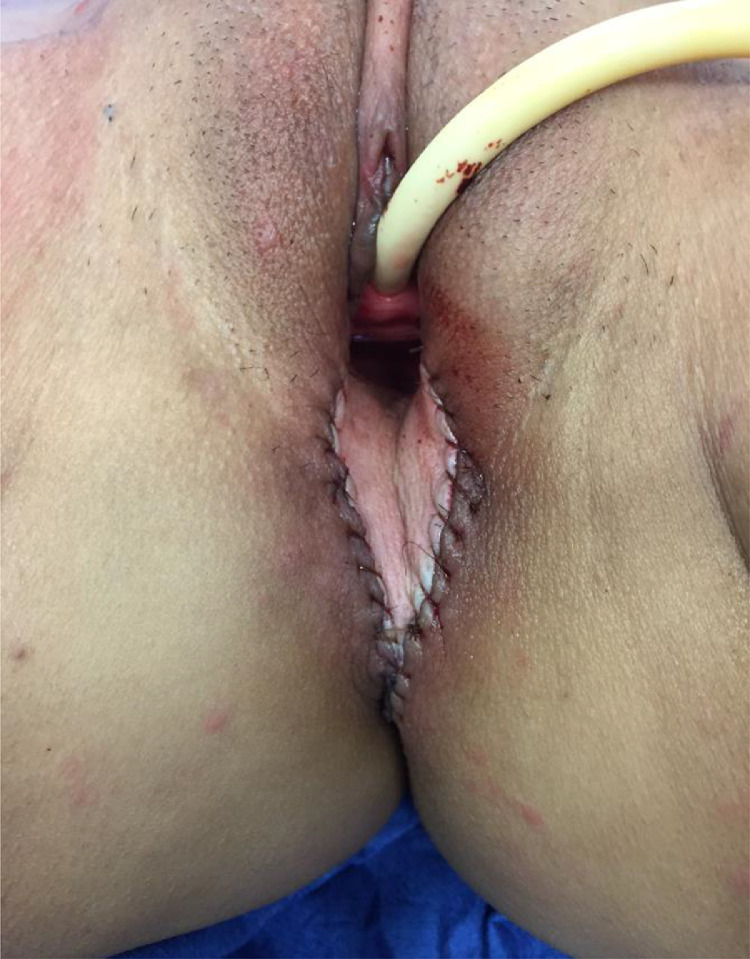
Twenty-eight patients met inclusion criteria. The overall major perineal wound complication rate was 14.3% (4 patients). Lack of perioperative closed suction pelvic drain use was associated with a significantly higher rate of major perineal wound complications (28.6% vs 0% and = 0.031). All four major wound complications occurred in patients who did not have a pelvic drain. The major perineal wound complication rate for patients who underwent neoadjuvant chemoradiation was 22% vs 0% with no neoadjuvant chemoradiation ( = 0.107).
While our cohort represents a relatively small single-center study, our 14.3% rate of major perineal wound complications is consistent with previous studies in the literature. Our findings show that perioperative pelvic closed suction drain use is associated with a lower rate of perineal wound complications. While neoadjuvant chemoradiation trended toward a higher incidence of perineal wound complications, it did not reach statistical significance.
我们评估了在我们单中心使用腹直肌肌皮瓣(VRAM)进行腹会阴联合切除术(APR)后重建的效果。我们的目标是分析可能影响会阴伤口愈合的因素,由于位置和新辅助放化疗的高频率,会阴伤口愈合是APR重建中一个有问题的并发症。
这项单中心回顾性研究分析了10年间(2008年7月至2018年6月)所有接受VRAM瓣会阴重建以修复APR缺损后的患者。结果测量集中于可能影响会阴伤口愈合并发症发生率的因素:癌症分期(I/II期与III/IV期)、新辅助放化疗、外科医生的从业年限(<5年与>5年)以及盆腔闭式引流的使用情况。
28名患者符合纳入标准。会阴主要伤口并发症的总体发生率为14.3%(4例患者)。围手术期未使用盆腔闭式引流与会阴主要伤口并发症的发生率显著较高相关(28.6%对0%,P = 0.031)。所有4例主要伤口并发症均发生在未使用盆腔引流的患者中。接受新辅助放化疗的患者会阴主要伤口并发症发生率为22%,未接受新辅助放化疗的患者为0%(P = 0.107)。
虽然我们的队列代表了一项相对较小的单中心研究,但我们14.3%的会阴主要伤口并发症发生率与文献中先前的研究一致。我们的研究结果表明,围手术期使用盆腔闭式引流与会阴伤口并发症发生率较低相关。虽然新辅助放化疗有使会阴伤口并发症发生率升高的趋势,但未达到统计学意义。