Chandrashekarappa Smitha Malenahalli, Krishna Murali, Krupp Karl, Jaykrishna Poornima, Urs Chaithra V, Goswami Satyapal Puri, Ravi Kavitha, Khan Anisa, Arun Anjali, Dawes Piers, Newall John, Madhivanan Purnima
Community Medicine, JSS Medical College, JSS Academy of Higher Education and Research, Mysuru, Karnataka, India.
Public Health Research Institute of India, Mysuru, Karnataka, India.
BMJ Paediatr Open. 2020 Dec 16;4(1):e000789. doi: 10.1136/bmjpo-2020-000789. eCollection 2020.
It is proven that adverse intrauterine environment results in 'early life programming,' alterations in metabolism and physiological development of the fetus, often termed as 'Developmental Origins of Health and Disease' (DOHaD) resulting in a smaller size at birth, greater non-communicable diseases (NCD) risk factors during childhood and adolescence, and cardiometabolic disorders in adulthood. Nevertheless, very few studies have examined the relationship between DOHaD programming and cognition. This study aims to examine if impaired prenatal growth indicated by birth weight is associated with cognition among adolescents in the Kisalaya cohort, a rural birth cohort in South India, thus providing newer insights into DOHaD programming for adolescent mental health in a low-income and middle-income country setting.
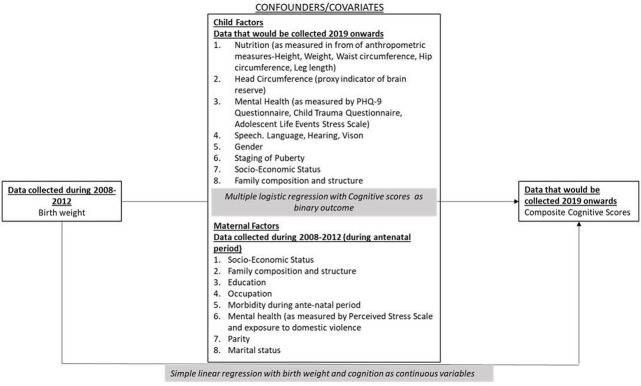
Kisalaya cohort was established in 2008, to provide integrated antenatal care and HIV testing using mobile clinics to improve maternal and child health outcomes. This cohort included pregnant women residing in 144 villages of Mysuru Taluk (rural) who received antenatal care through mobile clinics and delivered their children between 2008 and 2011. Data related to mother-infant dyads for all pregnant women who received care in the Kisalaya programme are available for this study. Presently, children born to women who received care through Kisalaya are adolescents between 10 and 12 years. At this point, information would be collected on sociodemographic data and assessments of mental health, stressful life events, cognition, vision, speech, language, hearing and anthropometric measures would be done and relevant maternal data and child data, available from the cohort would be retracted for analysis. We plan to retrace as many adolescents as possible out of 1544 adolescents who are currently available for study excluding twins, abortions, stillbirths and postdelivery deaths. Analyses will be extended to construct a life course pathway for cognition using structural equation modelling.
已证实不良的子宫内环境会导致“早期生命编程”,即胎儿新陈代谢和生理发育的改变,通常被称为“健康与疾病的发育起源”(DOHaD),这会导致出生时体型较小、儿童期和青少年期患非传染性疾病(NCD)的风险因素增加以及成年期的心脏代谢紊乱。然而,很少有研究探讨DOHaD编程与认知之间的关系。本研究旨在检验在印度南部农村出生队列Kisalaya中,出生体重所表明的产前生长受损是否与青少年的认知有关,从而为低收入和中等收入国家背景下青少年心理健康的DOHaD编程提供新的见解。
Kisalaya队列于2008年建立,旨在通过移动诊所提供综合产前护理和HIV检测,以改善母婴健康结局。该队列包括居住在迈索尔县(农村)144个村庄的孕妇,她们通过移动诊所接受产前护理,并在2008年至2011年期间分娩。本研究可获取在Kisalaya项目中接受护理的所有孕妇的母婴二元数据。目前,通过Kisalaya接受护理的妇女所生的孩子为10至12岁的青少年。此时,将收集社会人口学数据以及心理健康、压力性生活事件、认知、视力、言语、语言、听力和人体测量指标的评估信息,并从队列中获取相关的母亲数据和儿童数据进行分析。我们计划从目前可用于研究的1544名青少年(不包括双胞胎、流产、死产和产后死亡)中尽可能多地追踪青少年。分析将扩展至使用结构方程模型构建认知的生命历程路径。