Department of Biology, Stanford University, Stanford, CA, 94305, USA.
School of Chemical and Biomolecular Engineering, Georgia Institute of Technology, Atlanta, GA, 30332, USA.
New Phytol. 2021 Apr;230(2):867-877. doi: 10.1111/nph.17165. Epub 2021 Feb 14.
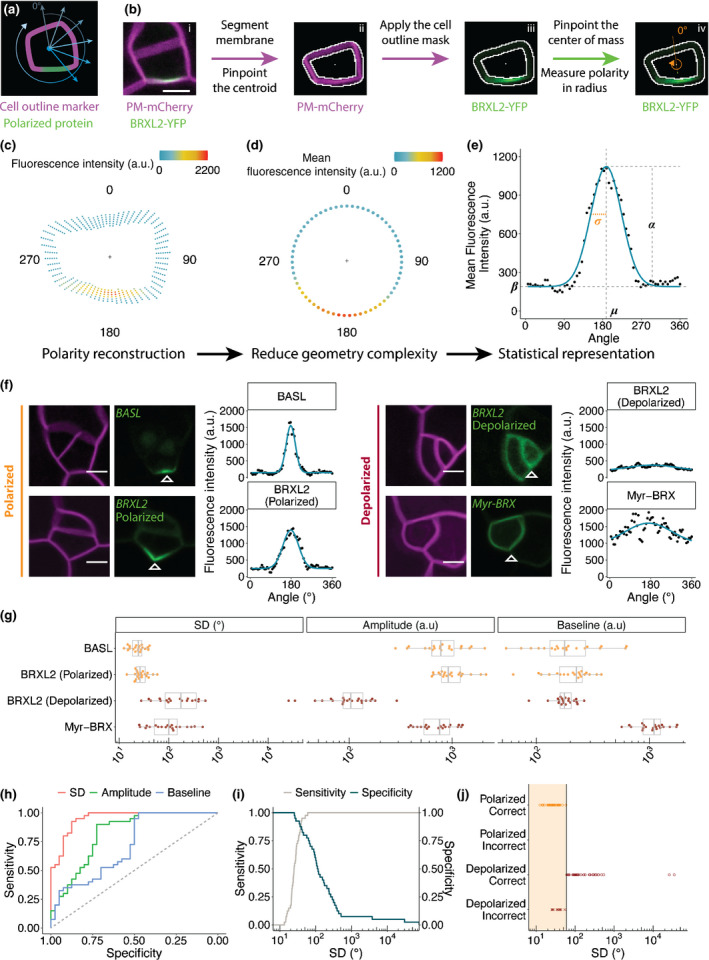
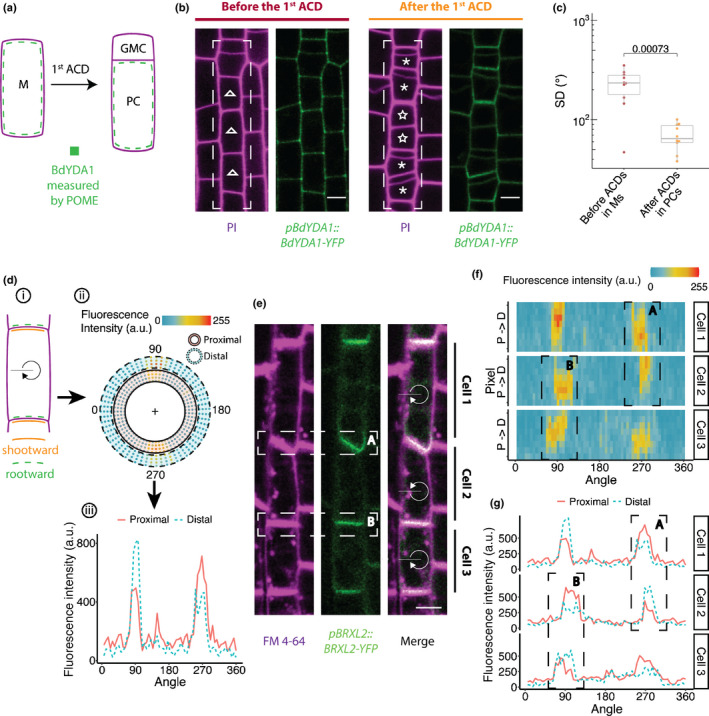
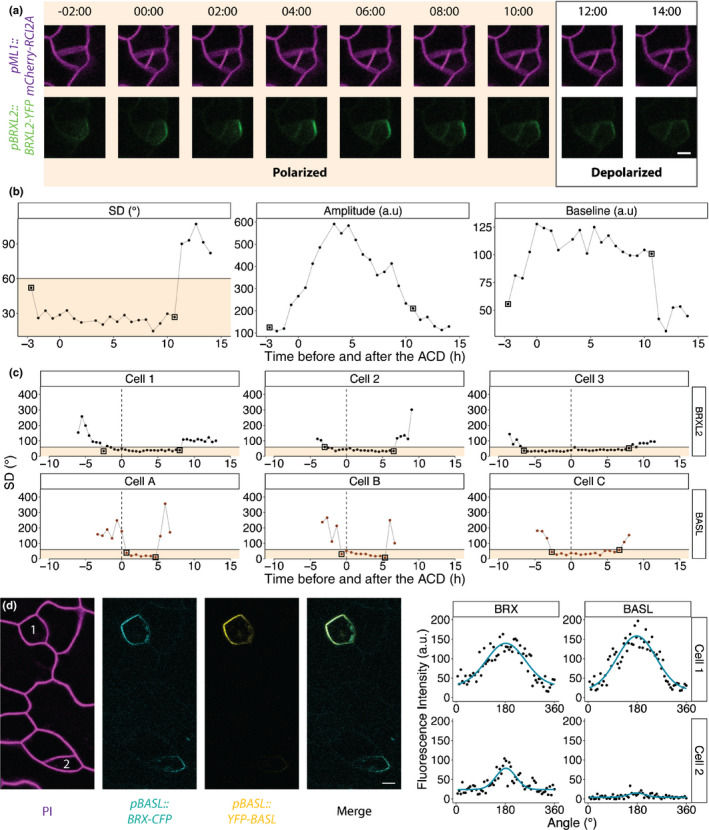
Quantitative information on the spatiotemporal distribution of polarised proteins is central for understanding cell-fate determination, yet collecting sufficient data for statistical analysis is difficult to accomplish with manual measurements. Here we present Polarity Measurement (Pome), a semi-automated pipeline for the quantification of cell polarity and demonstrate its application to a variety of developmental contexts. Pome analysis reveals that, during asymmetric cell divisions in the Arabidopsis thaliana stomatal lineage, polarity proteins BASL and BRXL2 are more asynchronous and less mutually dependent than previously thought. A similar analysis of the linearly arrayed stomatal lineage of Brachypodium distachyon revealed that the MAPKKK BdYDA1 is segregated and polarised following asymmetrical divisions. Our results demonstrate that Pome is a versatile tool, which by itself or combined with tissue-level studies and advanced microscopy techniques can help to uncover new mechanisms of cell polarity.
极化蛋白的时空分布的定量信息对于理解细胞命运决定至关重要,但通过手动测量很难收集到足够的数据进行统计分析。在这里,我们提出了极化测量(Pome),这是一种用于量化细胞极性的半自动分析方法,并展示了它在各种发育环境中的应用。Pome 分析表明,在拟南芥气孔谱系的不对称细胞分裂过程中,极性蛋白 BASL 和 BRXL2 的异步性更强,相互依赖性比之前认为的要低。对拟南芥线性排列的气孔谱系的类似分析表明,MAPKKK BdYDA1 在不对称分裂后被分隔和极化。我们的结果表明,Pome 是一种通用的工具,它本身或与组织水平的研究和先进的显微镜技术相结合,可以帮助揭示细胞极性的新机制。