Heidelberg Collaboratory for Image Processing, Heidelberg University, Heidelberg, Germany.
EMBL, Heidelberg, Germany.
Elife. 2020 Jul 29;9:e57613. doi: 10.7554/eLife.57613.
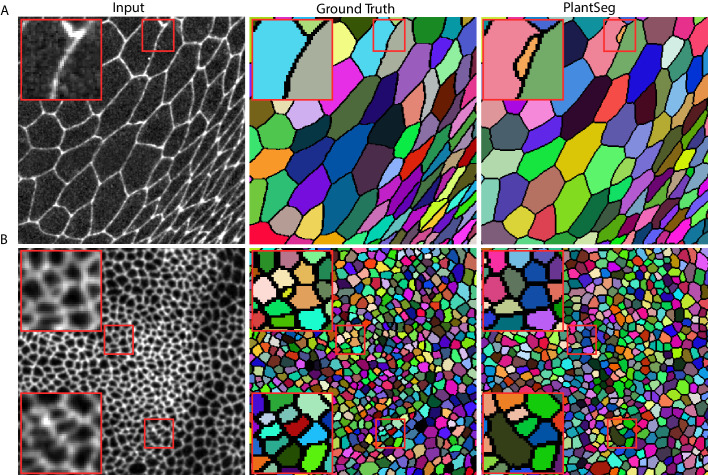
Quantitative analysis of plant and animal morphogenesis requires accurate segmentation of individual cells in volumetric images of growing organs. In the last years, deep learning has provided robust automated algorithms that approach human performance, with applications to bio-image analysis now starting to emerge. Here, we present PlantSeg, a pipeline for volumetric segmentation of plant tissues into cells. PlantSeg employs a convolutional neural network to predict cell boundaries and graph partitioning to segment cells based on the neural network predictions. PlantSeg was trained on fixed and live plant organs imaged with confocal and light sheet microscopes. PlantSeg delivers accurate results and generalizes well across different tissues, scales, acquisition settings even on non plant samples. We present results of PlantSeg applications in diverse developmental contexts. PlantSeg is free and open-source, with both a command line and a user-friendly graphical interface.
植物和动物形态发生的定量分析需要对生长器官的体积图像中的单个细胞进行精确分割。在过去的几年中,深度学习提供了强大的自动化算法,可以达到人类的表现水平,现在生物图像分析的应用也开始出现。在这里,我们提出了 PlantSeg,这是一个将植物组织分割成细胞的体积分割管道。PlantSeg 使用卷积神经网络来预测细胞边界,并使用图划分根据神经网络预测来分割细胞。PlantSeg 是在使用共聚焦和光片显微镜成像的固定和活体植物器官上进行训练的。PlantSeg 提供了准确的结果,并可以很好地推广到不同的组织、尺度、采集设置,甚至是非植物样本。我们展示了 PlantSeg 在不同发育背景下的应用结果。PlantSeg 是免费的开源软件,同时提供命令行和用户友好的图形界面。