
维多珠单抗在GEMINI 2研究中对亚洲国家克罗恩病患者的疗效与安全性
Efficacy and safety of vedolizumab in Crohn's disease in patients from Asian countries in the GEMINI 2 study.
作者信息
Banerjee Rupa, Chuah Sai Wei, Hilmi Ida Normiha, Wu Deng-Chyang, Yang Suk-Kyun, Demuth Dirk, Lindner Dirk, Adsul Shashi
机构信息
Asian Institute of Gastroenterology, Hyderabad, India.
Singapore General Hospital, Singapore.
出版信息
Intest Res. 2021 Jan;19(1):83-94. doi: 10.5217/ir.2019.09160. Epub 2020 Dec 31.
BACKGROUND/AIMS: The efficacy and safety of vedolizumab in moderate-to-severely active Crohn's disease (CD) were demonstrated in the GEMINI 2 study (NCT00783692). This post-hoc exploratory analysis aimed to assess the efficacy and safety of vedolizumab in the subgroup of patients from Asian countries.
METHODS
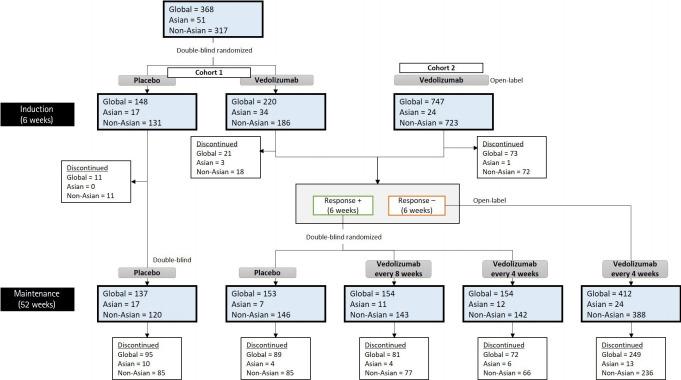
During the induction phase (doses at day 1, 15), clinical remission, enhanced clinical response, and change in C-reactive protein at 6 weeks; during the maintenance phase, clinical remission, enhanced clinical response, glucocorticoid-free remission and durable clinical remission at 52 weeks, were the efficacy outcomes of interest. Efficacy and safety of vedolizumab compared to placebo were assessed in Asian countries (Hong Kong, India, Malaysia, Singapore, South Korea, and Taiwan) using descriptive analyses.
RESULTS
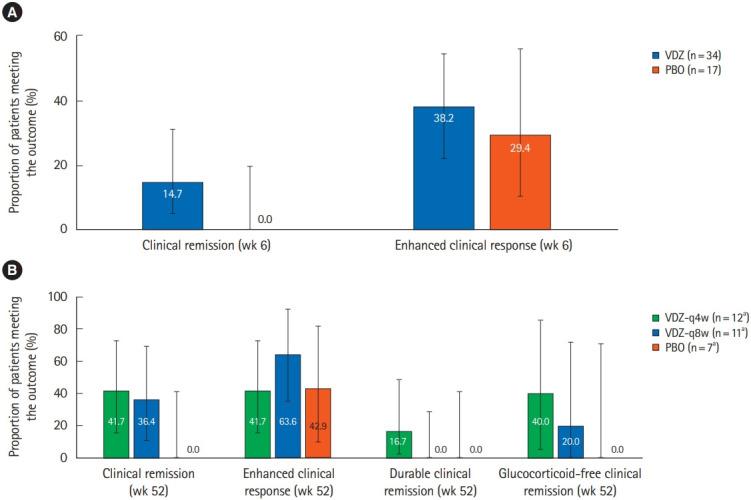
During the induction phase, in Asian countries (n = 51), 14.7% of the vedolizumab-treated patients achieved clinical remission at week 6 compared to none with placebo (difference, 14.7%; 95% confidence interval, 15.8%-43.5%). In non-Asian countries (n = 317), the remission rate at week 6 with vedolizumab was 14.5%. During maintenance, in Asian countries, clinical remission rates at 52 weeks with vedolizumab administered every 4 weeks, vedolizumab administered every 8 weeks and placebo were 41.7%, 36.4%, and 0%, respectively; while enhanced clinical response rates were 41.7%, 63.6%, and 42.9%, respectively. During induction, 39.7% of patients with vedolizumab experienced an adverse event compared to 58.8% of patients with placebo, and vedolizumab was generally well-tolerated.
CONCLUSIONS
This post-hoc analysis demonstrates the treatment effect and safety of vedolizumab in moderateto-severely active CD in patients from Asian countries.
背景/目的:在GEMINI 2研究(NCT00783692)中已证实维多珠单抗治疗中度至重度活动性克罗恩病(CD)的有效性和安全性。这项事后探索性分析旨在评估维多珠单抗在亚洲国家患者亚组中的有效性和安全性。
方法
在诱导期(第1天、第15天给药),观察第6周时的临床缓解、临床反应增强以及C反应蛋白的变化;在维持期,观察第52周时的临床缓解、临床反应增强、无糖皮质激素缓解和持久临床缓解情况,这些是感兴趣的疗效指标。通过描述性分析评估亚洲国家(中国香港、印度、马来西亚、新加坡、韩国和中国台湾)中维多珠单抗与安慰剂相比的有效性和安全性。
结果
在诱导期,亚洲国家(n = 51)中,接受维多珠单抗治疗的患者在第6周时14.7%实现临床缓解,而接受安慰剂治疗的患者无一人实现临床缓解(差异为14.7%;95%置信区间为15.8% - 43.5%)。在非亚洲国家(n = 317)中,接受维多珠单抗治疗的患者第6周缓解率为14.5%。在维持期,亚洲国家中,每4周给药一次的维多珠单抗、每8周给药一次的维多珠单抗和安慰剂在第52周时的临床缓解率分别为41.7%、36.4%和0%;而临床反应增强率分别为41.7%、63.6%和42.9%。在诱导期,接受维多珠单抗治疗的患者中有39.7%发生不良事件,而接受安慰剂治疗的患者中有58.8%发生不良事件,维多珠单抗总体耐受性良好。
结论
这项事后分析证明了维多珠单抗在亚洲国家中度至重度活动性CD患者中的治疗效果和安全性。

 Zotero 插件