
患有脑小血管疾病、局灶性萎缩和慢性中风病灶的个体的皮质厚度估计
Cortical Thickness Estimation in Individuals With Cerebral Small Vessel Disease, Focal Atrophy, and Chronic Stroke Lesions.
作者信息
Ozzoude Miracle, Ramirez Joel, Raamana Pradeep Reddy, Holmes Melissa F, Walker Kirstin, Scott Christopher J M, Gao Fuqiang, Goubran Maged, Kwan Donna, Tartaglia Maria C, Beaton Derek, Saposnik Gustavo, Hassan Ayman, Lawrence-Dewar Jane, Dowlatshahi Dariush, Strother Stephen C, Symons Sean, Bartha Robert, Swartz Richard H, Black Sandra E
机构信息
LC Campbell Cognitive Neurology Research, Hurvitz Brain Sciences Program, Sunnybrook Research Institute, University of Toronto, Toronto, ON, Canada.
Rotman Research Institute, Baycrest Health Sciences, Toronto, ON, Canada.
出版信息
Front Neurosci. 2020 Dec 14;14:598868. doi: 10.3389/fnins.2020.598868. eCollection 2020.
BACKGROUND
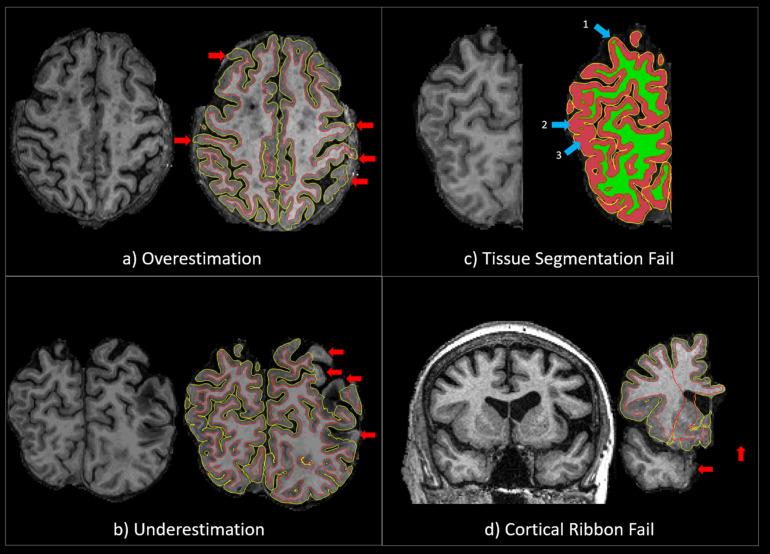
Regional changes to cortical thickness in individuals with neurodegenerative and cerebrovascular diseases (CVD) can be estimated using specialized neuroimaging software. However, the presence of cerebral small vessel disease, focal atrophy, and cortico-subcortical stroke lesions, pose significant challenges that increase the likelihood of misclassification errors and segmentation failures.
PURPOSE
The main goal of this study was to examine a correction procedure developed for enhancing FreeSurfer's (FS's) cortical thickness estimation tool, particularly when applied to the most challenging MRI obtained from participants with chronic stroke and CVD, with varying degrees of neurovascular lesions and brain atrophy.
METHODS
In 155 CVD participants enrolled in the Ontario Neurodegenerative Disease Research Initiative (ONDRI), FS outputs were compared between a fully automated, unmodified procedure and a corrected procedure that accounted for potential sources of error due to atrophy and neurovascular lesions. Quality control (QC) measures were obtained from both procedures. Association between cortical thickness and global cognitive status as assessed by the Montreal Cognitive Assessment (MoCA) score was also investigated from both procedures.
RESULTS
Corrected procedures increased "Acceptable" QC ratings from 18 to 76% for the cortical ribbon and from 38 to 92% for tissue segmentation. Corrected procedures reduced "Fail" ratings from 11 to 0% for the cortical ribbon and 62 to 8% for tissue segmentation. FS-based segmentation of T1-weighted white matter hypointensities were significantly greater in the corrected procedure (5.8 mL vs. 15.9 mL, < 0.001). The unmodified procedure yielded no significant associations with global cognitive status, whereas the corrected procedure yielded positive associations between MoCA total score and clusters of cortical thickness in the left superior parietal ( = 0.018) and left insula ( = 0.04) regions. Further analyses with the corrected cortical thickness results and MoCA subscores showed a positive association between left superior parietal cortical thickness and Attention ( < 0.001).
CONCLUSION
These findings suggest that correction procedures which account for brain atrophy and neurovascular lesions can significantly improve FS's segmentation results and reduce failure rates, thus maximizing power by preventing the loss of our important study participants. Future work will examine relationships between cortical thickness, cerebral small vessel disease, and cognitive dysfunction due to neurodegenerative disease in the ONDRI study.
背景
使用专门的神经影像软件可以估计神经退行性疾病和脑血管疾病(CVD)患者皮质厚度的区域变化。然而,脑小血管疾病、局灶性萎缩和皮质-皮质下中风病变的存在带来了重大挑战,增加了错误分类和分割失败的可能性。
目的
本研究的主要目标是检验一种开发用于增强FreeSurfer(FS)皮质厚度估计工具的校正程序,特别是当应用于从患有慢性中风和CVD的参与者获得的最具挑战性的MRI时,这些参与者具有不同程度的神经血管病变和脑萎缩。
方法
在安大略神经退行性疾病研究倡议(ONDRI)招募的155名CVD参与者中,比较了全自动、未修改程序与校正程序的FS输出,校正程序考虑了由于萎缩和神经血管病变导致的潜在误差来源。从这两种程序中获得了质量控制(QC)指标。还从这两种程序中研究了皮质厚度与通过蒙特利尔认知评估(MoCA)评分评估的整体认知状态之间的关联。
结果
校正程序将皮质带的“可接受”QC评级从18%提高到76%,组织分割的“可接受”QC评级从38%提高到92%。校正程序将皮质带的“失败”评级从11%降低到0%,组织分割的“失败”评级从62%降低到8%。在校正程序中,基于FS的T1加权白质低信号分割明显更大(5.8 mL对15.9 mL,<0.001)。未修改的程序与整体认知状态无显著关联,而校正程序在MoCA总分与左上顶叶(=0.018)和左岛叶(=0.04)区域的皮质厚度簇之间产生了正相关。对校正后的皮质厚度结果和MoCA子分数的进一步分析表明,左上顶叶皮质厚度与注意力之间存在正相关(<0.001)。
结论
这些发现表明,考虑脑萎缩和神经血管病变的校正程序可以显著改善FS的分割结果并降低失败率,从而通过防止重要研究参与者的流失来最大化效能。未来的工作将在ONDRI研究中检验皮质厚度、脑小血管疾病和神经退行性疾病导致的认知功能障碍之间的关系。

 Zotero 插件