Wang Shao-Hua, Wang Kuan, Zhao Ke, Hua Shu-Cheng, Du Juan
Institute of Virology and AIDS Research, The First Hospital of Jilin University, Changchun, China.
Department of Neurotrauma, The First Hospital of Jilin University, Changchun, China.
Front Microbiol. 2020 Dec 14;11:615965. doi: 10.3389/fmicb.2020.615965. eCollection 2020.
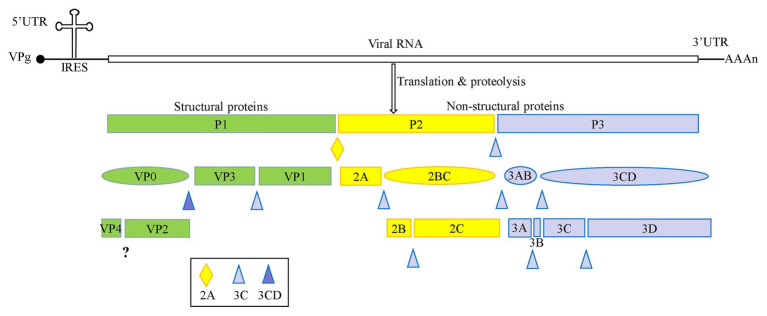
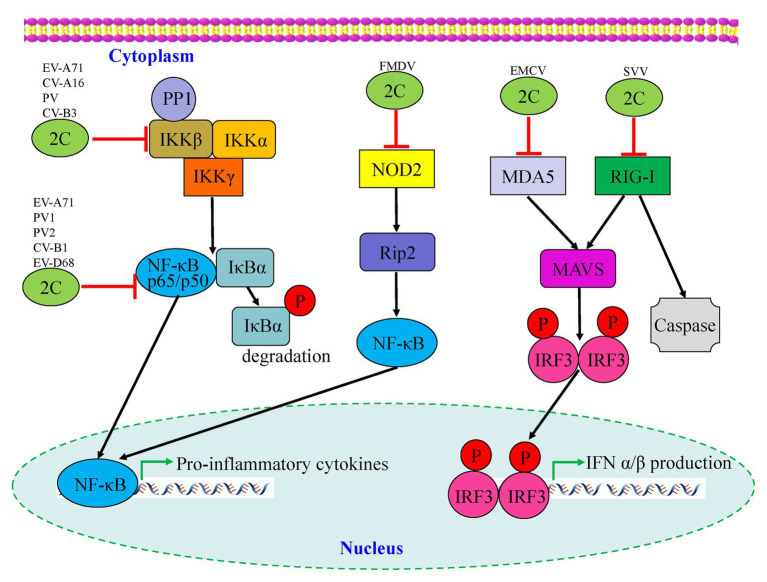
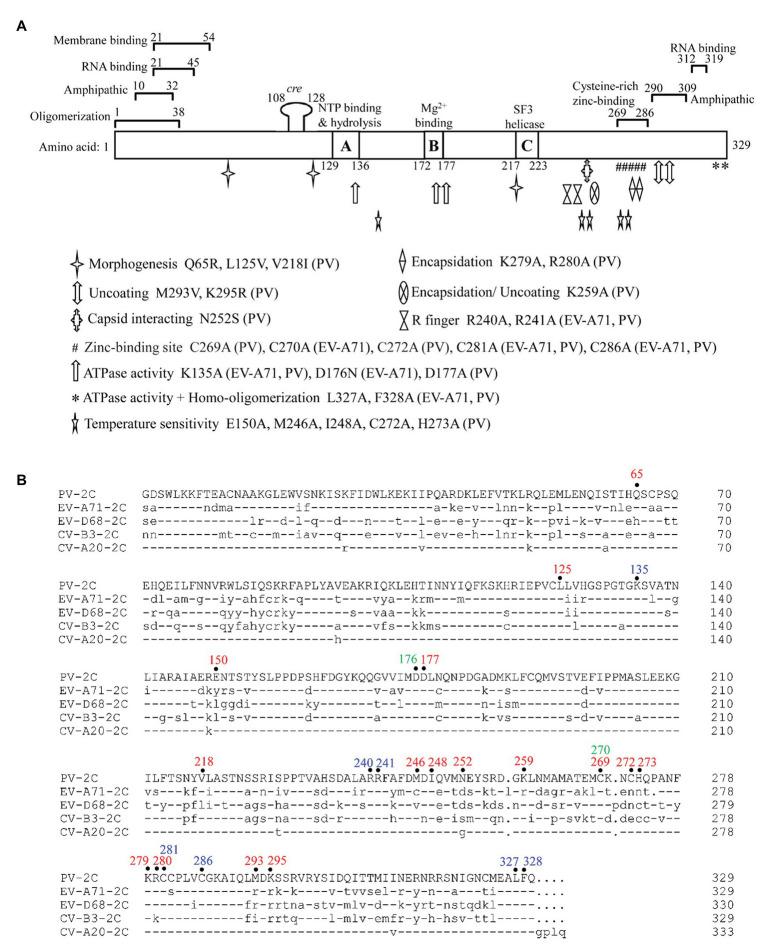
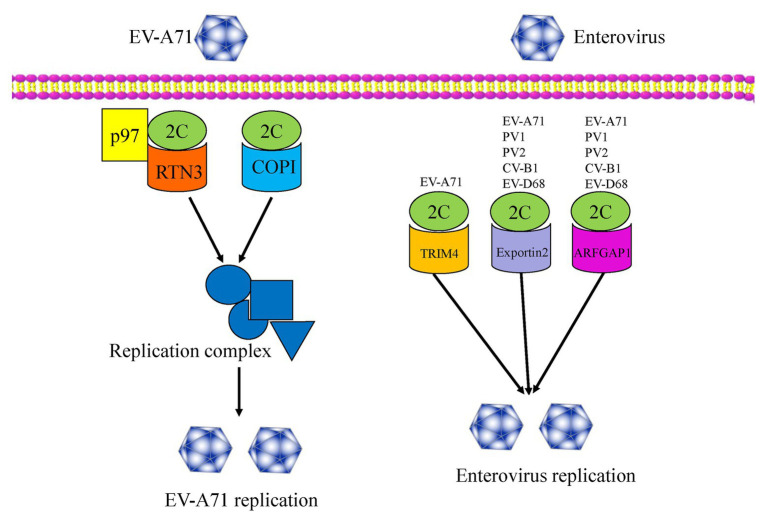
Enteroviruses are a group of RNA viruses belonging to the family . They include human enterovirus groups A, B, C, and D as well as non-human enteroviruses. Enterovirus infections can lead to hand, foot, and mouth disease and herpangina, whose clinical manifestations are often mild, although some strains can result in severe neurological complications such as encephalitis, myocarditis, meningitis, and poliomyelitis. To date, research on enterovirus non-structural proteins has mainly focused on the 2A and 3C proteases and 3D polymerase. However, another non-structural protein, 2C, is the most highly conserved protein, and plays a vital role in the enterovirus life cycle. There are relatively few studies on this protein. Previous studies have demonstrated that enterovirus 2C is involved in virus uncoating, host cell membrane rearrangements, RNA replication, encapsidation, morphogenesis, ATPase, helicase, and chaperoning activities. Despite ongoing research, little is known about the pathogenesis of enterovirus 2C proteins in viral replication or in the host innate immune system. In this review, we discuss and summarize the current understanding of the structure, function, and mechanism of the enterovirus 2C proteins, focusing on the key mutations and motifs involved in viral infection, replication, and immune regulation. We also focus on recent progress in research into the role of 2C proteins in regulating the pattern recognition receptors and type I interferon signaling pathway to facilitate viral replication. Given these functions and mechanisms, the potential application of the 2C proteins as a target for anti-viral drug development is also discussed. Future studies will focus on the determination of more crystal structures of enterovirus 2C proteins, which might provide more potential targets for anti-viral drug development against enterovirus infections.
肠道病毒是一组属于该科的RNA病毒。它们包括人肠道病毒A、B、C和D组以及非人肠道病毒。肠道病毒感染可导致手足口病和疱疹性咽峡炎,其临床表现通常较轻,尽管有些毒株可导致严重的神经并发症,如脑炎、心肌炎、脑膜炎和脊髓灰质炎。迄今为止,对肠道病毒非结构蛋白的研究主要集中在2A和3C蛋白酶以及3D聚合酶上。然而,另一种非结构蛋白2C是最保守的蛋白,在肠道病毒生命周期中起着至关重要的作用。对这种蛋白的研究相对较少。先前的研究表明,肠道病毒2C参与病毒脱壳、宿主细胞膜重排、RNA复制、衣壳化、形态发生、ATP酶、解旋酶和伴侣活性。尽管研究仍在进行,但关于肠道病毒2C蛋白在病毒复制或宿主先天免疫系统中的发病机制知之甚少。在这篇综述中,我们讨论并总结了目前对肠道病毒2C蛋白的结构、功能和机制的理解,重点关注与病毒感染、复制和免疫调节相关的关键突变和基序。我们还关注了2C蛋白在调节模式识别受体和I型干扰素信号通路以促进病毒复制方面的研究进展。鉴于这些功能和机制,还讨论了2C蛋白作为抗病毒药物开发靶点的潜在应用。未来的研究将集中于确定更多肠道病毒2C蛋白的晶体结构,这可能为开发抗肠道病毒感染的抗病毒药物提供更多潜在靶点。