Department of Pharmacy, Faculty of Pharmaceutical Sciences, Tokyo University of Science, Tokyo, Japan.
School of Pharmacy, Institute of Clinical Pharmacy and Pharmaceutical Sciences, College of Medicine, National Cheng Kung University, Tainan, Taiwan.
Clin Transl Sci. 2021 May;14(3):1002-1014. doi: 10.1111/cts.12964. Epub 2021 Jan 27.
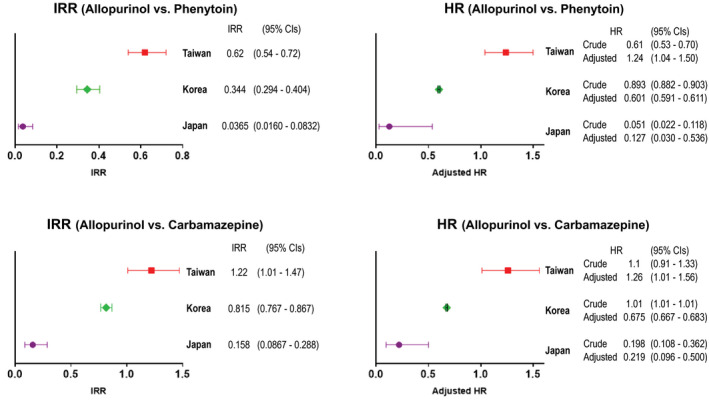
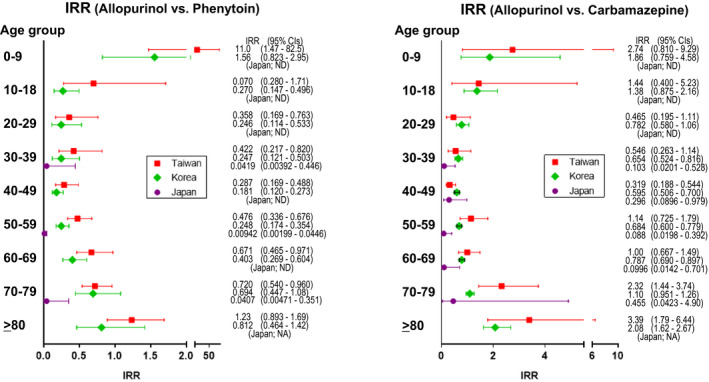
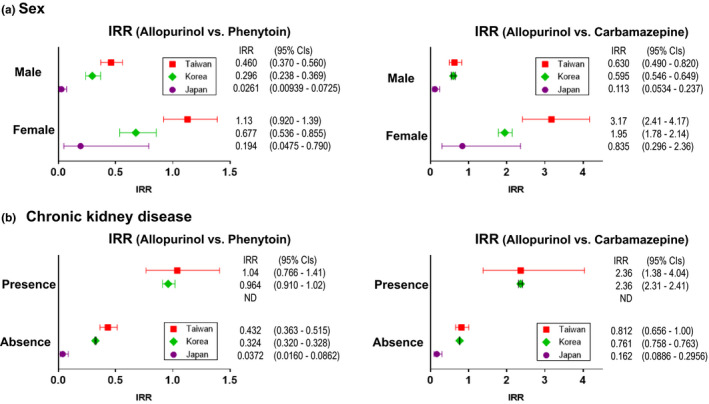
Allopurinol-related severe cutaneous adverse reactions (SCARs) are strongly associated with HLA-B58:01, the allele frequency (AF) of which is largely different among East Asians. However, evidence of population differences in SCAR development and relevance of genetic and/or other risk factors in the real-world remain unelucidated. This study aimed to evaluate population differences in allopurinol-related SCAR incidence related to genetic and/or other risk factors among East Asians in the real-world. A population-based cohort study was conducted using claims databases from Taiwan, Korea, and Japan. New users of allopurinol (311,846; 868,221; and 18,052 in Taiwan, Korea, and Japan, respectively) were followed up to 1 year. As control drugs, phenytoin and carbamazepine were used. The crude incidence rate ratios (IRRs) of SCARs for allopurinol against phenytoin or carbamazepine were the highest in Taiwan (IRR, 0.62 and 1.22; 95% confidence interval [CI], 0.54-0.72 and 1.01-1.47, respectively), followed by Korea (IRR, 0.34 and 0.82; 95% CI, 0.29-0.40 and 0.77-0.87), and the lowest in Japan (IRR, 0.04 and 0.16; 95% CI, 0.02-0.08 and 0.09-0.29). This order was accordant with that of AF ratios (AFRs) reported of HLA-B58:01 against alleles responsible for phenytoin- or carbamazepine-related SCARs. The IRRs were higher in patients with chronic kidney disease, females, and elderly. This study demonstrated population differences in the risk of allopurinol-related SCAR development among East Asians based on genetic and other common risk factors. This finding will help to promote appropriate risk management for allopurinol-related SCARs based on ethnic origins. Study Highlights WHAT IS THE CURRENT KNOWLEDGE ON THIS TOPIC? Allopurinol-related severe cutaneous adverse reactions (SCARs) are strongly associated with HLA-B58:01, the allele frequency of which is largely different among East Asians. However, there is no direct real-world evidence of population differences in SCAR development and the influence of genetic factors and/or other risk factors. WHAT QUESTION DID THIS STUDY ADDRESS? Do population differences in development of allopurinol-related SCARs, depending on genetic factors and/or other risk factors, exist among three East Asians in the real-world? WHAT DOES THIS STUDY ADD TO OUR KNOWLEDGE? The current analysis, based on comparisons of relative risks of SCAR incidence, provides real-world evidence of population differences in allopurinol-related SCAR development risk among East Asians, which was consistent with differences in reported HLA-B58:01 frequencies, as well as identifying chronic kidney disease, female gender, and old age as common risk factors. HOW MIGHT THIS CHANGE CLINICAL PHARMACOLOGY OR TRANSLATIONAL SCIENCE? This study helps to promote appropriate risk management strategies for allopurinol-related SCARs in the real-world considering risk factors based on the patients' ethnicity. Our approach is useful for evaluating population differences in the real-world.
别嘌醇相关性严重皮肤不良反应(SCAR)与 HLA-B58:01 强相关,东亚人群中该等位基因频率差异很大。然而,东亚人群中 SCAR 发展的人群差异以及遗传和/或其他风险因素的相关性证据仍不清楚。本研究旨在评估东亚人群中与遗传和/或其他风险因素相关的别嘌醇相关性 SCAR 发病率的人群差异。本研究采用来自台湾、韩国和日本的索赔数据库进行了一项基于人群的队列研究。分别有 311846、868221 和 18052 名新使用别嘌醇的患者(台湾、韩国和日本)进行了为期 1 年的随访。作为对照药物,使用了苯妥英和卡马西平。别嘌醇与苯妥英或卡马西平相比 SCAR 的粗发病率比值比(IRR)在台湾最高(IRR,0.62 和 1.22;95%置信区间[CI],0.54-0.72 和 1.01-1.47),其次是韩国(IRR,0.34 和 0.82;95%CI,0.29-0.40 和 0.77-0.87),在日本最低(IRR,0.04 和 0.16;95%CI,0.02-0.08 和 0.09-0.29)。这一顺序与 HLA-B58:01 对导致苯妥英或卡马西平相关 SCAR 的等位基因的报告 AFR 一致。在慢性肾脏病、女性和老年人中,IRR 更高。本研究证明了东亚人群中与遗传和其他常见风险因素相关的别嘌醇相关性 SCAR 发展风险的人群差异。这一发现将有助于根据种族起源促进别嘌醇相关性 SCAR 的适当风险管理。