Lai Shih-Wei, Liao Kuan-Fu, Kuo Yu-Hung, Liu Chiu-Shong, Hwang Bing-Fang
Department of Public Health, College of Public Health, China Medical University, Taichung 404, Taiwan.
School of Medicine, College of Medicine, China Medical University, Taichung 404, Taiwan.
J Pers Med. 2022 Apr 27;12(5):697. doi: 10.3390/jpm12050697.
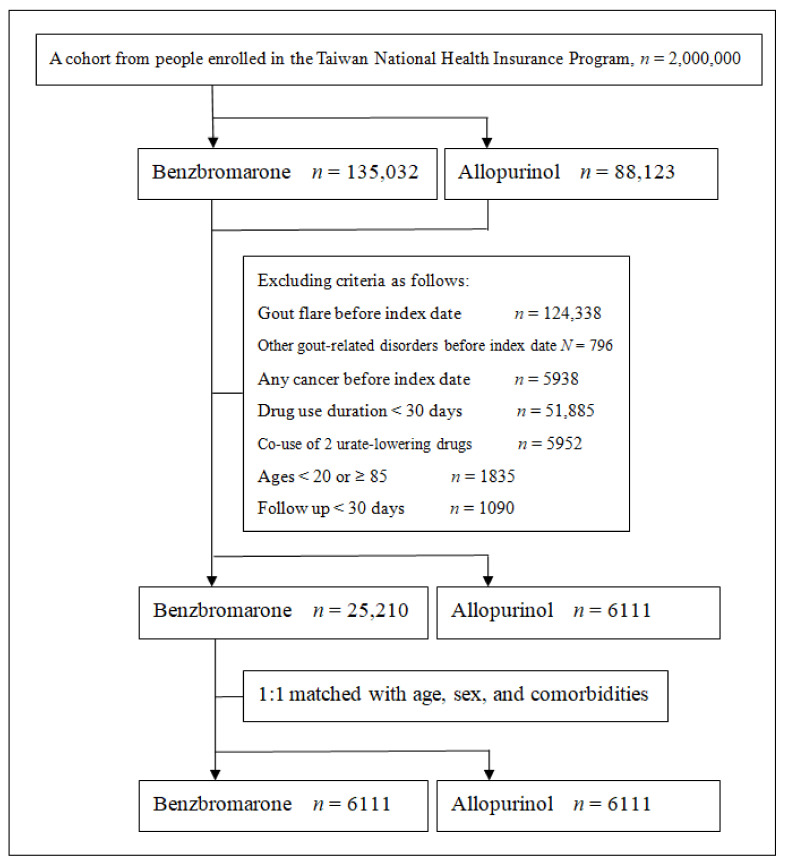
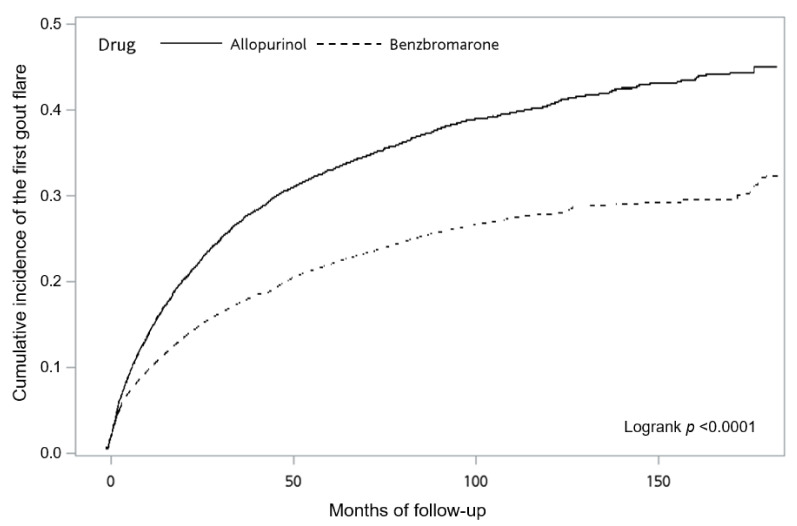
Objectives. Whether uric acid-lowering agent use in asymptomatic hyperuricemia can reduce the development of the first gout flare remains unsettled. The goal of the present research was to test the efficacy of benzbromarone and allopurinol on primary prevention of the first gout flare in persons with asymptomatic hyperuricemia in Taiwan. Methods. One observational cohort study was constructed to examine the 2001−2015 dataset adapted from the National Health Insurance Program of Taiwan containing the claims data of 2 million beneficiaries. Asymptomatic hyperuricemia was considered as individuals on uric acid-lowering therapy who did not have gout flares. Individuals aged 20−84 without gout flares who had the use of benzbromarone alone were assigned into a benzbromarone group. Individuals ages 20−84 without gout flares who had the use of allopurinol alone were assigned into an allopurinol group. The final study included 6111 pairs of 1:1 propensity score-matched individuals from both benzbromarone and allopurinol groups. The end point was assigned as individuals who were newly diagnosed with their first gout flare. The incidence rate of the first gout flare was estimated between the benzbromarone and allopurinol groups. A Cox proportional hazards regression model was applied to explore the hazard ratio and 95% confidence interval of the first gout flare related to benzbromarone use and allopurinol use. Results. The incidence rate of the first gout flare was lower in the benzbromarone group compared with an allopurinol group (3.29 versus 5.46 per 1000 person-months, incidence rate ratio = 0.60 and 95% confidence interval = 0.56−0.64). After adjustment for co-variables, the adjusted hazard ratio of the first gout flare was 0.63 (95% confidence interval = 0.59−0.68, p < 0.001) for the benzbromarone group when compared with the allopurinol group. Conclusion. People with asymptomatic hyperuricemia taking benzbromarone have a lower hazard of developing their first gout flare when compared with those taking allopurinol. Based on the medication safety, the therapeutic effects and the low price, with oral administration once daily, we suggest that benzbromarone should be the first drug of choice if clinicians are treating asymptomatic hyperuricemia.
目的。在无症状高尿酸血症患者中使用降尿酸药物是否能减少首次痛风发作的发生仍未明确。本研究的目的是检验苯溴马隆和别嘌醇在台湾无症状高尿酸血症患者中对首次痛风发作一级预防的疗效。方法。构建一项观察性队列研究,以检查2001 - 2015年从台湾国民健康保险计划改编而来的数据集,其中包含200万受益人的理赔数据。无症状高尿酸血症被定义为接受降尿酸治疗但无痛风发作的个体。年龄在20 - 84岁且无痛风发作且仅使用苯溴马隆的个体被纳入苯溴马隆组。年龄在20 - 84岁且无痛风发作且仅使用别嘌醇的个体被纳入别嘌醇组。最终研究包括来自苯溴马隆组和别嘌醇组的6111对1:1倾向评分匹配个体。终点定义为新诊断为首次痛风发作的个体。估计苯溴马隆组和别嘌醇组首次痛风发作的发病率。应用Cox比例风险回归模型探索与使用苯溴马隆和别嘌醇相关的首次痛风发作的风险比和95%置信区间。结果。与别嘌醇组相比,苯溴马隆组首次痛风发作的发病率更低(每1000人月分别为3.29和5.46,发病率比 = 0.60,95%置信区间 = 0.56 - 0.64)。在对协变量进行调整后,与别嘌醇组相比,苯溴马隆组首次痛风发作的调整后风险比为0.63(95%置信区间 = 0.59 - 0.68,p < 0.001)。结论。与服用别嘌醇的无症状高尿酸血症患者相比,服用苯溴马隆的患者首次痛风发作的风险更低。基于药物安全性、治疗效果和低价格,且每日口服一次,我们建议如果临床医生治疗无症状高尿酸血症,苯溴马隆应作为首选药物。