Department of Urban and Regional Planning, Faculty of Built Environment, Universiti Malaya, Kuala Lumpur 50603, Malaysia.
Department of City and Regional Planning, School of Architecture and Planning, University of Management and Technology, Lahore 54770, Pakistan.
Int J Environ Res Public Health. 2020 Dec 29;18(1):185. doi: 10.3390/ijerph18010185.
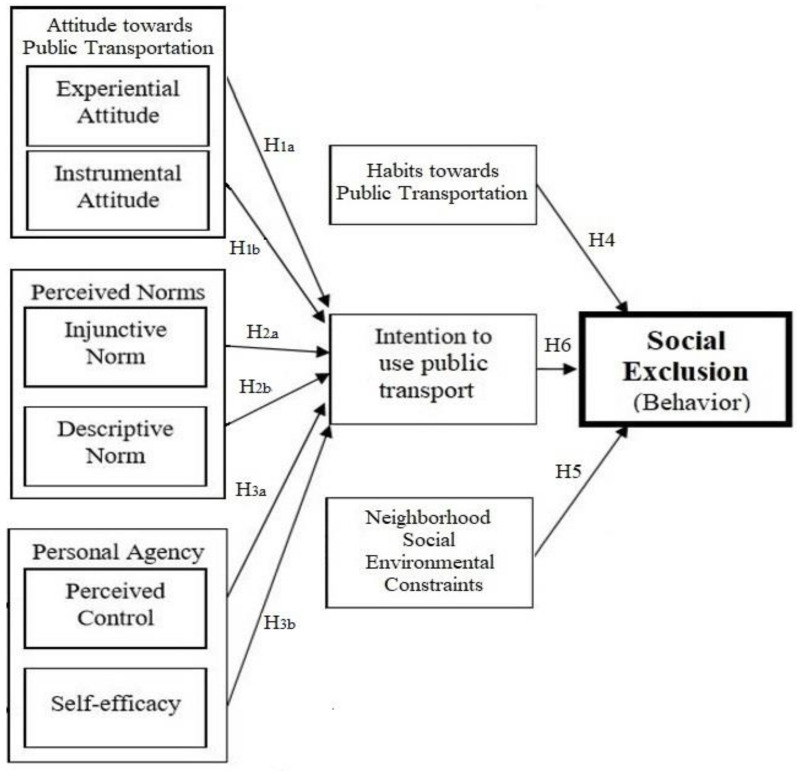
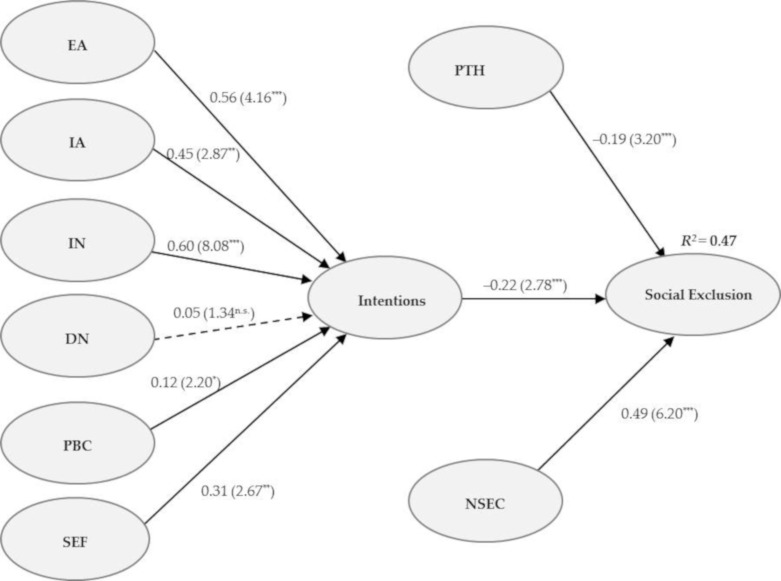
Transport planning and public health have been intertwined historically. The health impact of public transport services, such as social exclusion, is a widely discussed research topic. Social exclusion is a paramount concern for older adults' health in the wake of emerging global challenges. However, there remains a significant research gap on how psychosocial barriers faced by older adults in using public transport services influence the social exclusion behavior. The present research provides empirical evidence and shows the impact of certain psychosocial barriers of public transportation on older adults' social exclusion. A total of 243 Pakistani older adults (aged 60-89 years old) voluntarily participated in this cross-sectional study. The participants provided self-reports on their psychosocial barriers (including perceived norms, attitude, personal ability, habits, neighborhood social constraints, and intention) and the corresponding social exclusion. Partial Least Square Structural Equation Modeling (PLS-SEM) was utilized for the data analysis. The structural path model supported the significant associations between psychosocial barriers and social exclusion. Except for perceived descriptive norms, all other psychosocial barriers predicted older adults' social exclusion. The research portrays the significance of the psychosocial factors to examine social exclusion and offers practical implications for urban and transport planners. The concerned policymakers can use the research findings to develop age-sensitive, socially sustainable, and healthy cities.
交通规划与公共卫生历来紧密交织。公共交通服务对健康的影响,如社会排斥,是一个广泛讨论的研究课题。社会排斥是当前全球挑战下,老年人健康的首要关注点。然而,关于老年人在使用公共交通服务时所面临的心理社会障碍如何影响其社会排斥行为,仍存在显著的研究空白。本研究提供了实证证据,展示了公共交通某些心理社会障碍对老年人社会排斥的影响。共有 243 名巴基斯坦老年人(60-89 岁)自愿参加了这项横断面研究。参与者提供了关于其心理社会障碍(包括感知规范、态度、个人能力、习惯、邻里社会约束和意图)和相应社会排斥的自我报告。偏最小二乘结构方程建模(PLS-SEM)用于数据分析。结构路径模型支持心理社会障碍与社会排斥之间的显著关联。除了感知描述性规范外,所有其他心理社会障碍都预测了老年人的社会排斥。该研究描绘了心理社会因素在考察社会排斥方面的重要性,并为城市和交通规划者提供了实际意义。相关政策制定者可以利用研究结果来制定对老年人敏感、社会可持续和健康的城市。