de Oliveira Débora Moraes, Santos Igor de Andrade, Martins Daniel Oliveira Silva, Gonçalves Yasmim Garcia, Cardoso-Sousa Léia, Sabino-Silva Robinson, Von Poelhsitz Gustavo, Franca Eduardo de Faria, Nicolau-Junior Nilson, Pacca Carolina Colombelli, Merits Andres, Harris Mark, Jardim Ana Carolina Gomes
Institute of Biomedical Science, Federal University of Uberlândia, Uberlândia, Brazil.
Institute of Bioscience, Language and Exact Sciences, São Paulo State University, São José do Rio Preto, Brazil.
Front Microbiol. 2020 Dec 15;11:608924. doi: 10.3389/fmicb.2020.608924. eCollection 2020.
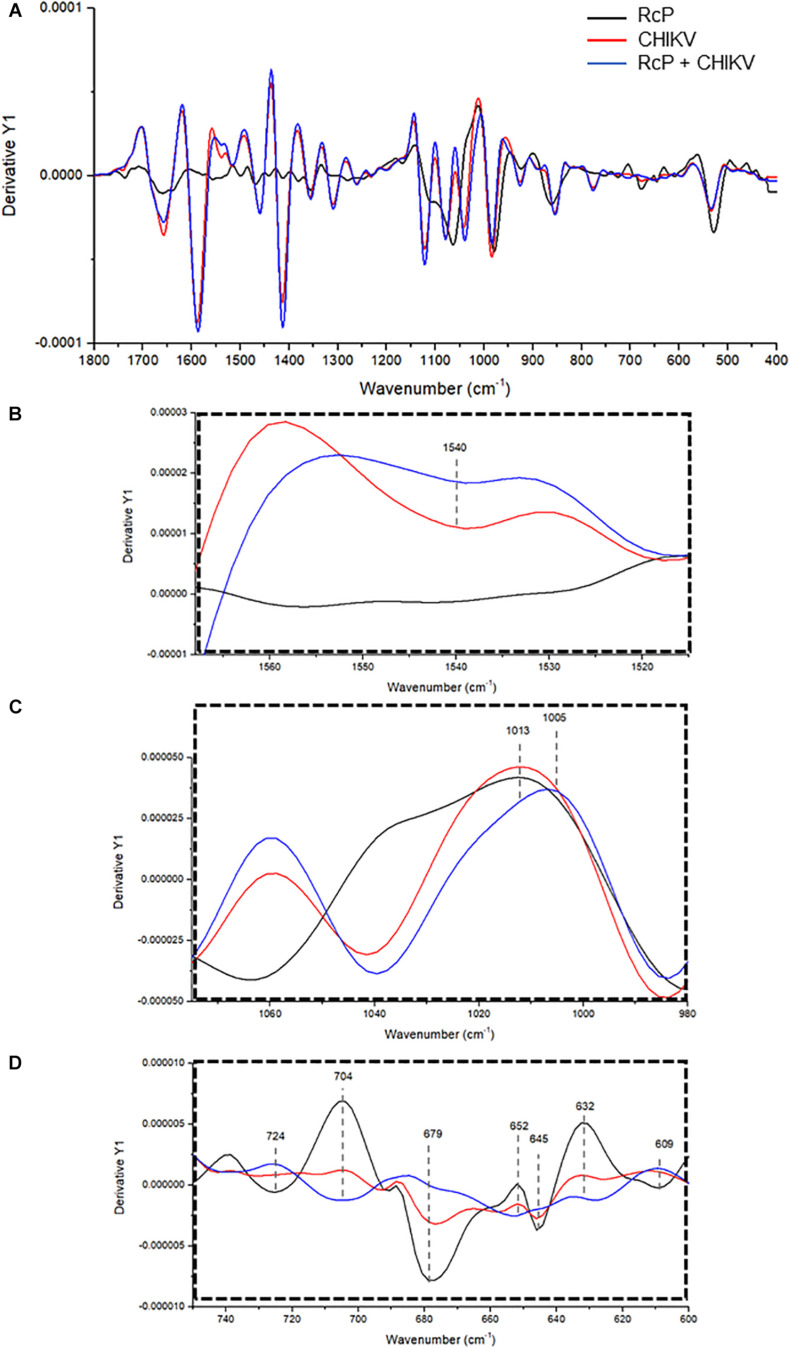
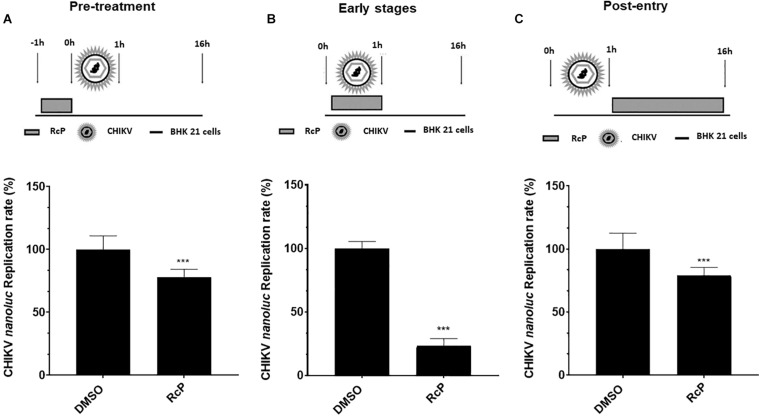
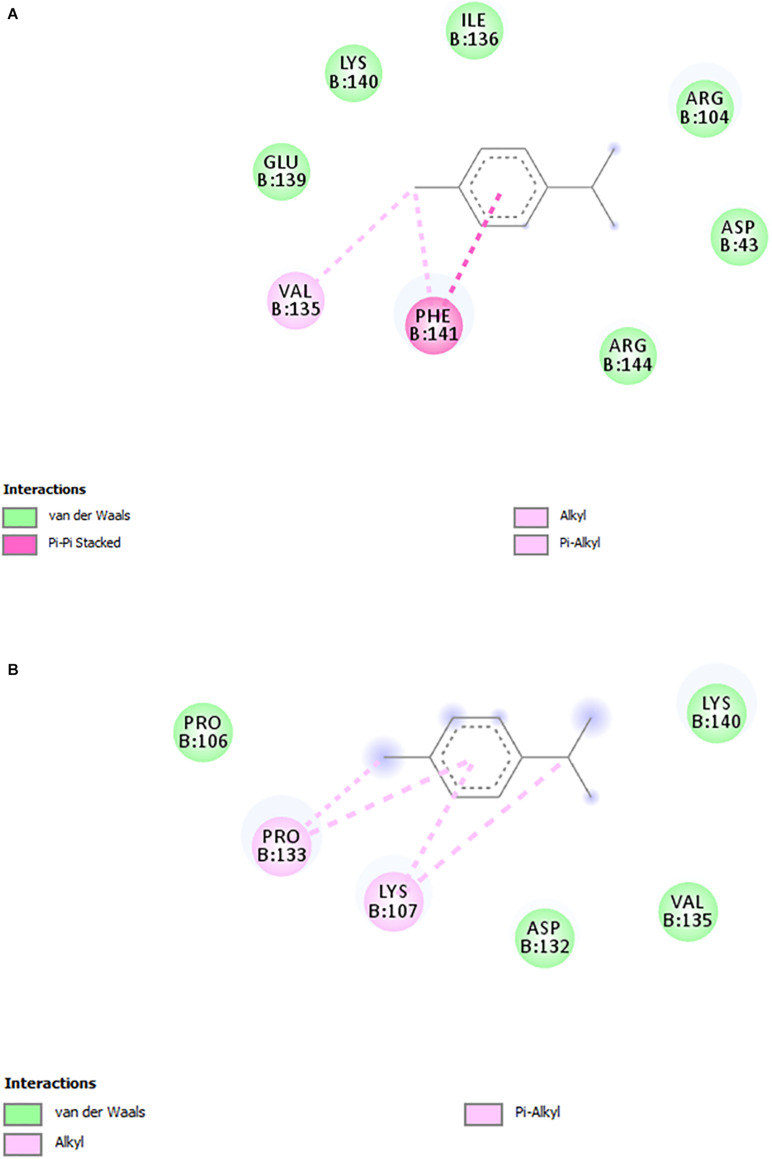
Chikungunya fever is a disease caused by the Chikungunya virus (CHIKV) that is transmitted by the bite of the female of sp. mosquito. The symptoms include fever, muscle aches, skin rash, and severe joint pains. The disease may develop into a chronic condition and joint pain for months or years. Currently, there is no effective antiviral treatment against CHIKV infection. Treatments based on natural compounds have been widely studied, as many drugs were produced by using natural molecules and their derivatives. Alpha-phellandrene (α-Phe) is a naturally occurring organic compound that is a ligand for ruthenium, forming the organometallic complex [RuCl(p-cymene)] (RcP). Organometallic complexes have shown promising as candidate molecules to a new generation of compounds that presented relevant biological properties, however, there is a lack of knowledge concerning the anti-CHIKV activity of these complexes. The present work evaluated the effects of the RcP and its precursors, the hydrate ruthenium(III) chloride salt (RuCl⋅xHO) (Ru) and α-Phe, on CHIKV infection . To this, BHK-21 cells were infected with CHIKV- (CHIKV), a viral construct harboring the reporter gene, at the presence or absence of the compounds for 16 h. Cytotoxicity and impact on infectivity were analyzed. The results demonstrated that RcP exhibited a strong therapeutic potential judged by the selective index > 40. Antiviral effects of RcP on different stages of the CHIKV replicative cycle were investigated; the results showed that it affected early stages of virus infection reducing virus replication by 77% at non-cytotoxic concentrations. Further assays demonstrated the virucidal activity of the compound that completely blocked virus infectivity. molecular docking calculations suggested different binding interactions between aromatic rings of RcP and the loop of amino acids of the E2 envelope CHIKV glycoprotein mainly through hydrophobic interactions. Additionally, infrared spectroscopy spectral analysis indicated interactions of RcP with CHIKV glycoproteins. These data suggest that RcP may act on CHIKV particles, disrupting virus entry to the host cells. Therefore, RcP may represent a strong candidate for the development of anti-CHIKV drugs.
基孔肯雅热是一种由基孔肯雅病毒(CHIKV)引起的疾病,该病毒通过白纹伊蚊雌蚊叮咬传播。症状包括发热、肌肉疼痛、皮疹和严重的关节疼痛。这种疾病可能会发展成慢性疾病,并导致关节疼痛持续数月或数年。目前,尚无针对CHIKV感染的有效抗病毒治疗方法。基于天然化合物的治疗方法已得到广泛研究,因为许多药物是利用天然分子及其衍生物生产的。α-水芹烯(α-Phe)是一种天然存在的有机化合物,是钌的配体,可形成有机金属配合物[RuCl(p-异丙基苯)](RcP)。有机金属配合物已显示出有望成为具有相关生物学特性的新一代化合物的候选分子,然而,关于这些配合物的抗CHIKV活性缺乏了解。本研究评估了RcP及其前体水合氯化钌(III)盐(RuCl⋅xH₂O)(Ru)和α-Phe对CHIKV感染的影响。为此,在有或无这些化合物的情况下,用携带报告基因的病毒构建体CHIKV-感染BHK-21细胞16小时。分析了细胞毒性和对感染性的影响。结果表明,根据选择性指数>40判断,RcP具有很强的治疗潜力。研究了RcP对CHIKV复制周期不同阶段的抗病毒作用;结果表明,在无细胞毒性浓度下,它影响病毒感染的早期阶段,使病毒复制减少77%。进一步的试验证明了该化合物的杀病毒活性,它完全阻断了病毒的感染性。分子对接计算表明,RcP的芳香环与E2包膜CHIKV糖蛋白的氨基酸环之间主要通过疏水相互作用存在不同的结合相互作用。此外,红外光谱分析表明RcP与CHIKV糖蛋白之间存在相互作用。这些数据表明,RcP可能作用于CHIKV颗粒,破坏病毒进入宿主细胞。因此,RcP可能是开发抗CHIKV药物的有力候选物。