Instituto de Aplicaciones de las Tecnologías de la Información y de las Comunicaciones Avanzadas (ITACA), Universitat Politècnica de València, Valencia, Spain.
CNRS, University of Bordeaux, Bordeaux INP, LABRI, UMR5800, Talence, France.
Hum Brain Mapp. 2021 Apr 1;42(5):1287-1303. doi: 10.1002/hbm.25293. Epub 2021 Jan 1.
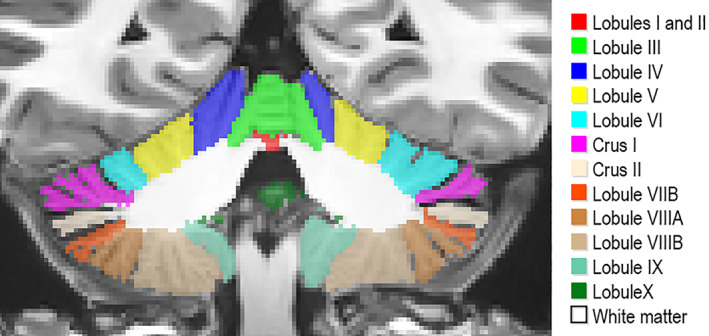
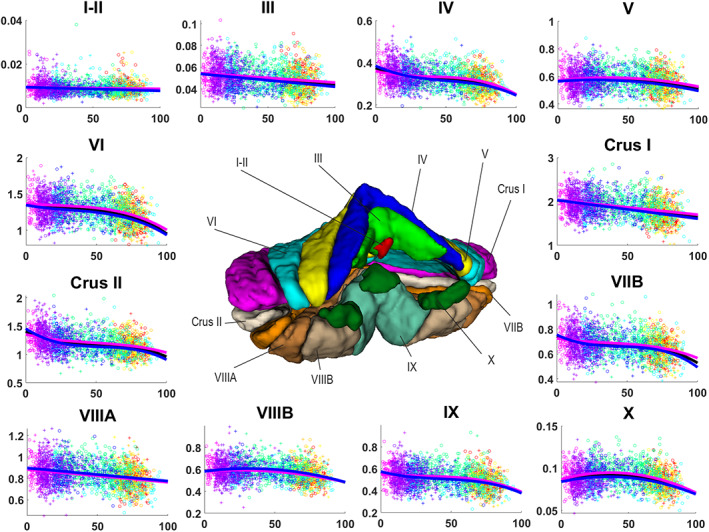
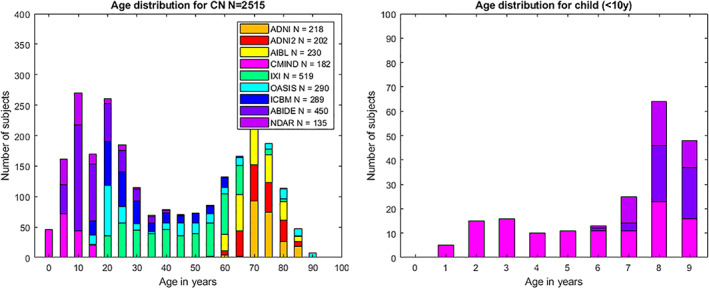
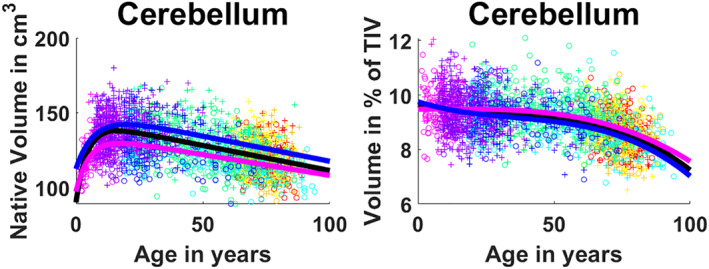
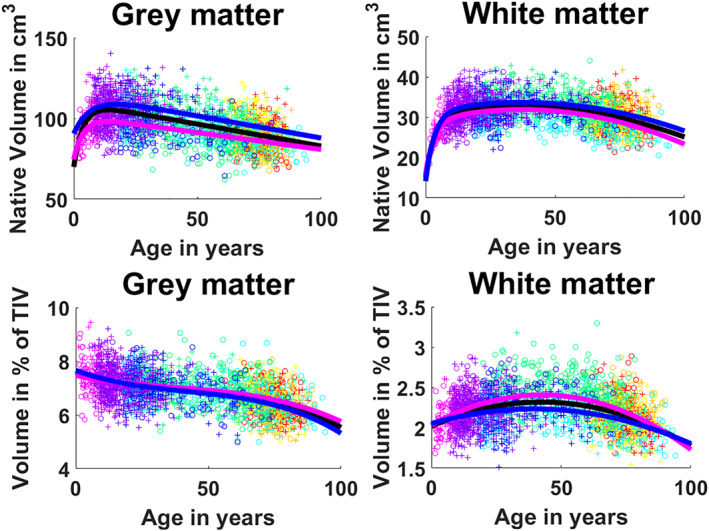
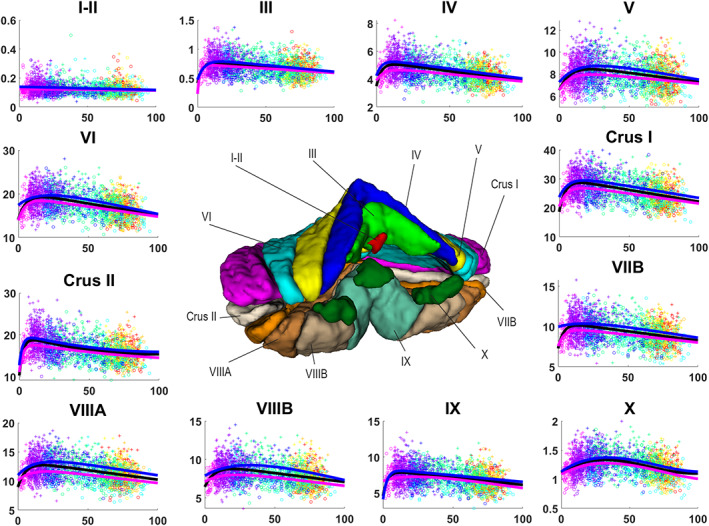
Previous literature about the structural characterization of the human cerebellum is related to the context of a specific pathology or focused in a restricted age range. In fact, studies about the cerebellum maturation across the lifespan are scarce and most of them considered the cerebellum as a whole without investigating each lobule. This lack of study can be explained by the lack of both accurate segmentation methods and data availability. Fortunately, during the last years, several cerebellum segmentation methods have been developed and many databases comprising subjects of different ages have been made publically available. This fact opens an opportunity window to obtain a more extensive analysis of the cerebellum maturation and aging. In this study, we have used a recent state-of-the-art cerebellum segmentation method called CERES and a large data set (N = 2,831 images) from healthy controls covering the entire lifespan to provide a model for 12 cerebellum structures (i.e., lobules I-II, III, IV, VI, Crus I, Crus II, VIIB, VIIIA, VIIIB, IX, and X). We found that lobules have generally an evolution that follows a trajectory composed by a fast growth and a slow degeneration having sometimes a plateau for absolute volumes, and a decreasing tendency (faster in early ages) for normalized volumes. Special consideration is dedicated to Crus II, where slow degeneration appears to stabilize in elder ages for absolute volumes, and to lobule X, which does not present any fast growth during childhood in absolute volumes and shows a slow growth for normalized volumes.
先前关于人类小脑结构特征的文献与特定病理学的背景有关,或集中于特定年龄范围。事实上,关于整个生命周期中小脑成熟的研究很少,而且大多数研究都将小脑作为一个整体进行考虑,而没有对每个小脑叶进行研究。这种缺乏研究的情况可以归因于缺乏精确的分割方法和数据可用性。幸运的是,在过去几年中,已经开发出了几种小脑分割方法,并且许多包含不同年龄受试者的数据库已经公开可用。这一事实为更广泛地分析小脑的成熟和老化提供了机会窗口。在本研究中,我们使用了一种最近的先进小脑分割方法,即 CERES,以及来自健康对照组的涵盖整个生命周期的大量数据集(N=2831 张图像),为 12 个小脑结构(即,叶 I-II、III、IV、VI、Crus I、Crus II、VIIB、VIIIA、VIIIB、IX 和 X)提供了模型。我们发现,小脑叶的一般演变遵循由快速生长和缓慢退化组成的轨迹,对于绝对体积有时存在一个平台,而对于归一化体积则呈现下降趋势(在早期更快)。特别关注 Crus II,其绝对体积的缓慢退化在老年时似乎趋于稳定,以及 lobule X,其在绝对体积的儿童期没有任何快速生长,而对于归一化体积则呈现缓慢生长。