McGovern Institute for Brain Research, Massachusetts Institute of Technology, Cambridge, United States.
Laboratory for Neuroanatomy and Cerebellar Neurobiology, Department of Neurology, Massachusetts General Hospital, Harvard Medical School, Boston, United States.
Elife. 2018 Aug 14;7:e36652. doi: 10.7554/eLife.36652.
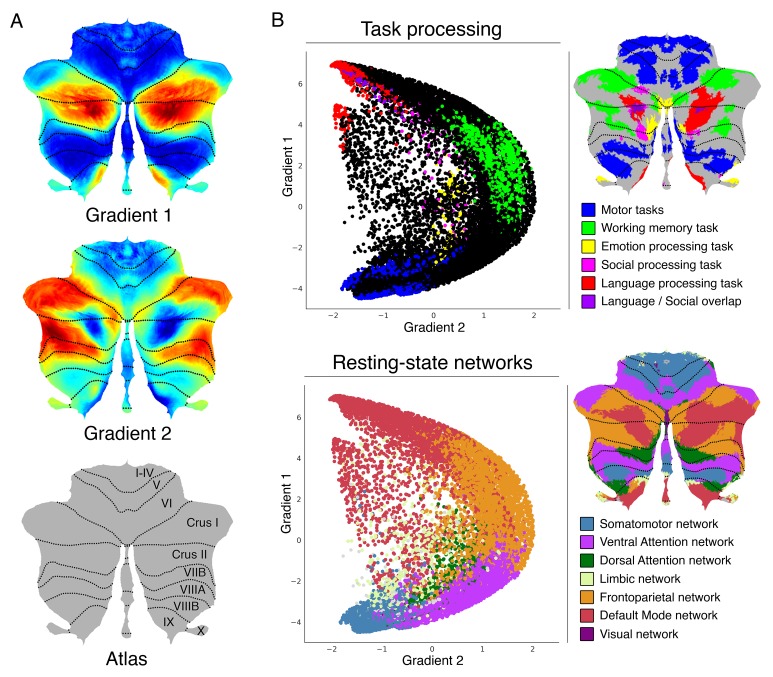
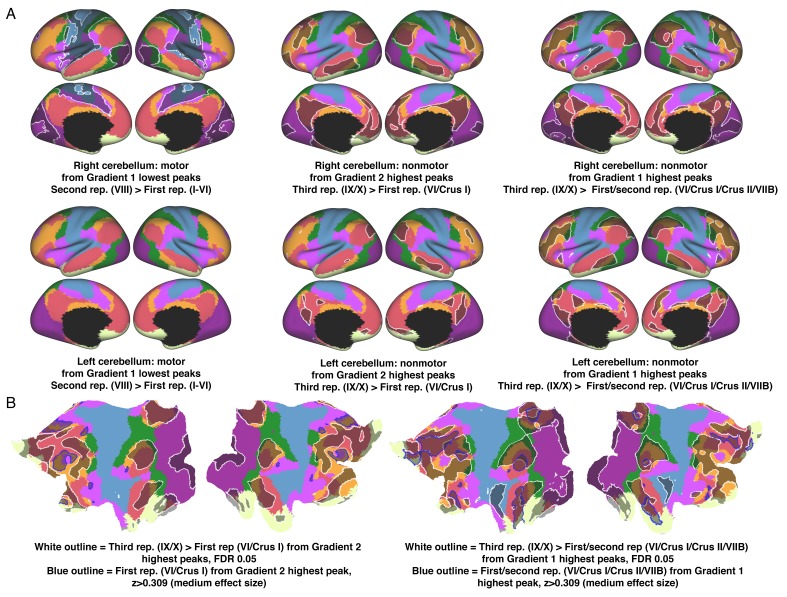
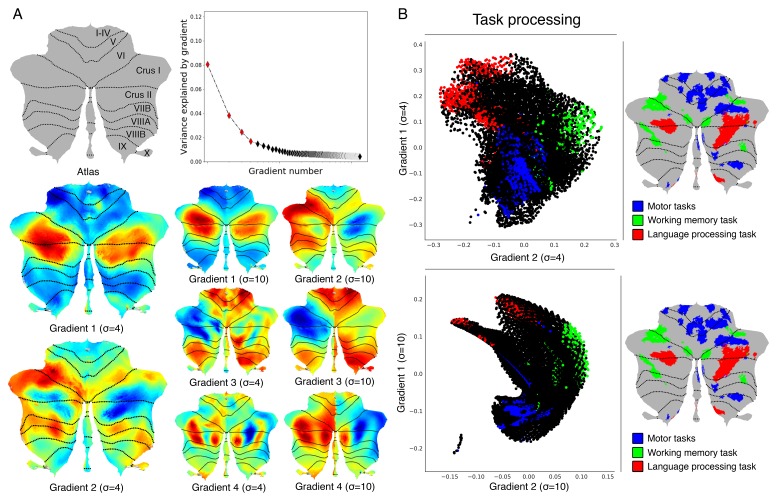
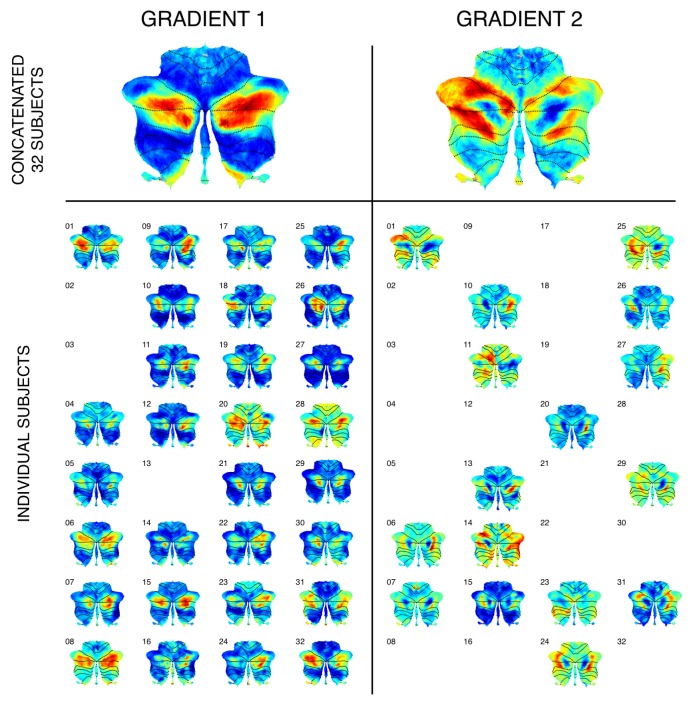
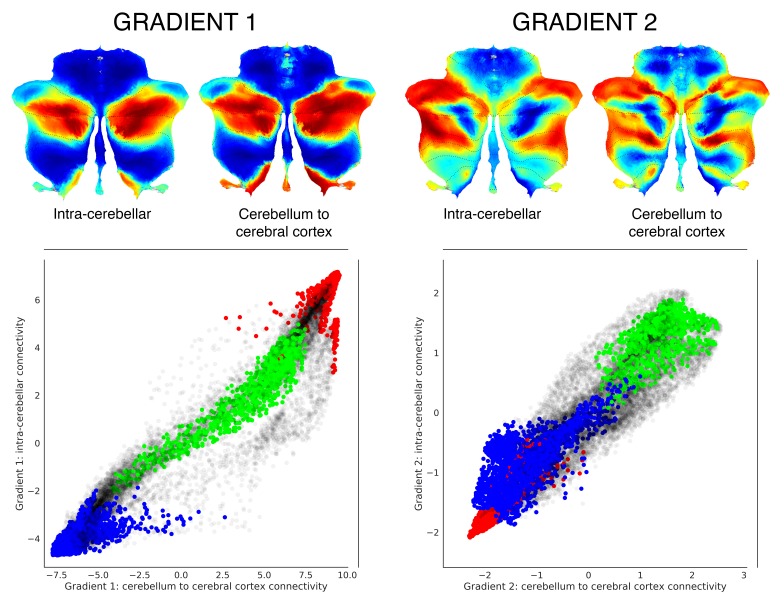
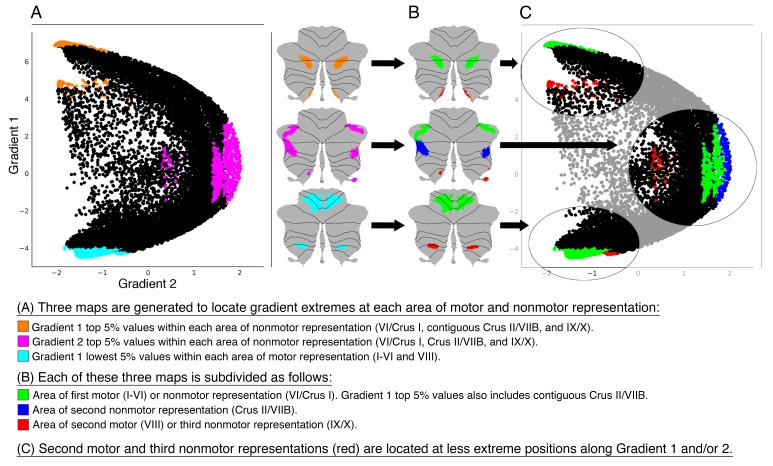
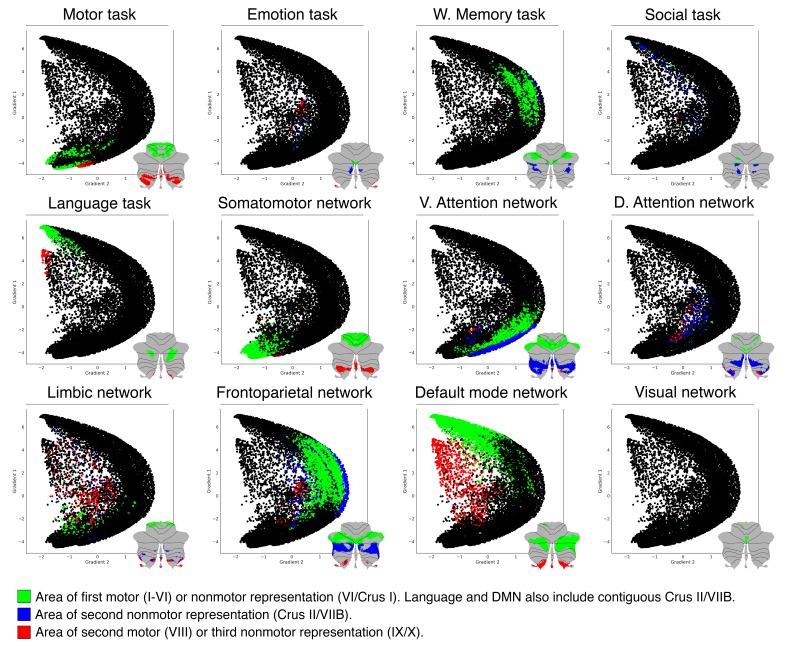
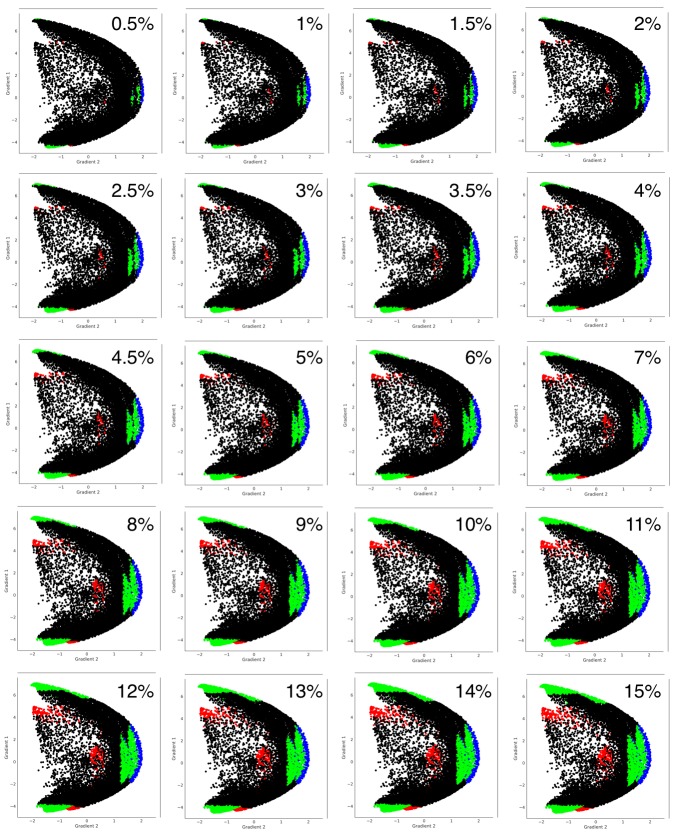
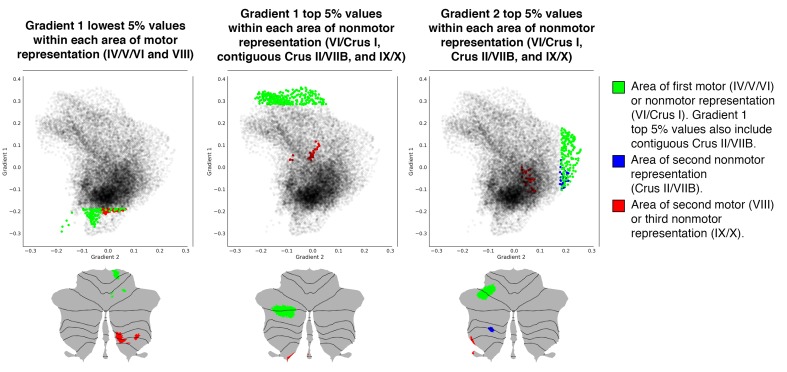
A central principle for understanding the cerebral cortex is that macroscale anatomy reflects a functional hierarchy from primary to transmodal processing. In contrast, the central axis of motor and nonmotor macroscale organization in the cerebellum remains unknown. Here we applied diffusion map embedding to resting-state data from the Human Connectome Project dataset (n = 1003), and show for the first time that cerebellar functional regions follow a gradual organization which progresses from primary (motor) to transmodal (DMN, task-unfocused) regions. A secondary axis extends from task-unfocused to task-focused processing. Further, these two principal gradients revealed novel functional properties of the well-established cerebellar double motor representation (lobules I-VI and VIII), and its relationship with the recently described triple nonmotor representation (lobules VI/Crus I, Crus II/VIIB, IX/X). Functional differences exist not only between the two motor but also between the three nonmotor representations, and second motor representation might share functional similarities with third nonmotor representation.
理解大脑皮层的一个核心原则是,宏观解剖结构反映了从初级到跨模态处理的功能层次结构。相比之下,小脑运动和非运动宏观组织的中心轴仍然未知。在这里,我们应用扩散图嵌入方法对来自人类连接组计划数据集的静息态数据(n=1003)进行了分析,首次表明小脑的功能区域遵循一种逐渐的组织方式,从初级(运动)到跨模态(DMN,无任务焦点)区域。第二个轴从无任务焦点延伸到任务焦点处理。此外,这两个主要梯度揭示了经过充分验证的小脑双运动代表(叶 I-VI 和 VIII)的新的功能特性,以及其与最近描述的三重非运动代表(叶 VI/Crus I、Crus II/VIIB、IX/X)之间的关系。不仅在两个运动代表之间,而且在三个非运动代表之间也存在功能差异,第二个运动代表可能与第三个非运动代表具有相似的功能。