Mekonnen Alemayehu Gonie, Mittiku Yohannes Moges
Department of Nursing, College of Health Science, Debre Berhan University, Po. Box. 445, Debre Berhan, Ethiopia.
Department of Midwifery, College of Health Sciences, Debre Berhan University, Po. Box. 445, Debre Berhan, Ethiopia.
Matern Health Neonatol Perinatol. 2021 Jan 2;7(1):2. doi: 10.1186/s40748-020-00122-2.
Surgical site infection occurs within 30 days after a surgical procedure and involves the skin, subcutaneous tissue, and soft tissue. Surgical site infection following cesarean section is a common postoperative complication and is associated with maternal morbidity and mortality in resource-limited settings. Even though the proportion of surgical site infection and some risk factors were reported by kinds of literature, varying results were stated across studies. There is also limited knowledge on the association between postpartum surgical site infection and the rupture of membrane. Hence, this systematic review and meta-analysis was designed to estimate the pooled proportion of surgical site infection and its association with rupture of membrane following cesarean section in Africa.
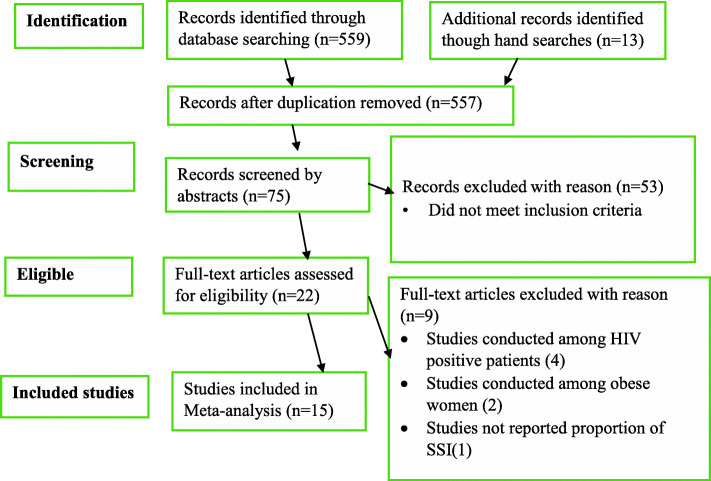
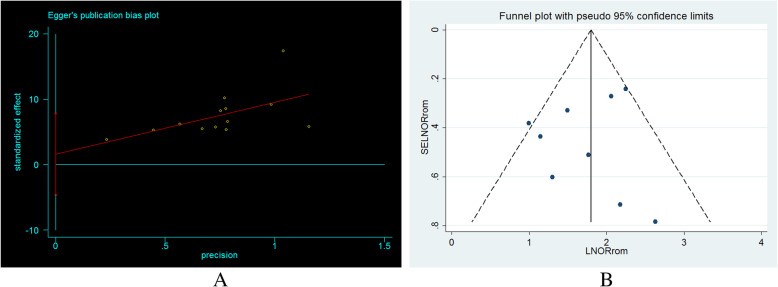
Studies published from January 01, 2000 to January 30, 2020 were searched from MEDLINE via PubMed, Scopus, Medscape, Web-science and CINAHL databases to search relevant published articles. We also performed a manual search of reference lists of key articles to retrieve additional relevant articles. Initially, 559 records were identified and 15 studies included in the analysis. The statistical analysis was performed using STATA 11. Heterogeneity between-study was explored by forest plot and inconsistency index (I). The publication bias was checked by a funnel plot and Egger's test. Pooled estimates of proportion and odds ratio were calculated by a random-effects model with a 95% confidence interval (CI).
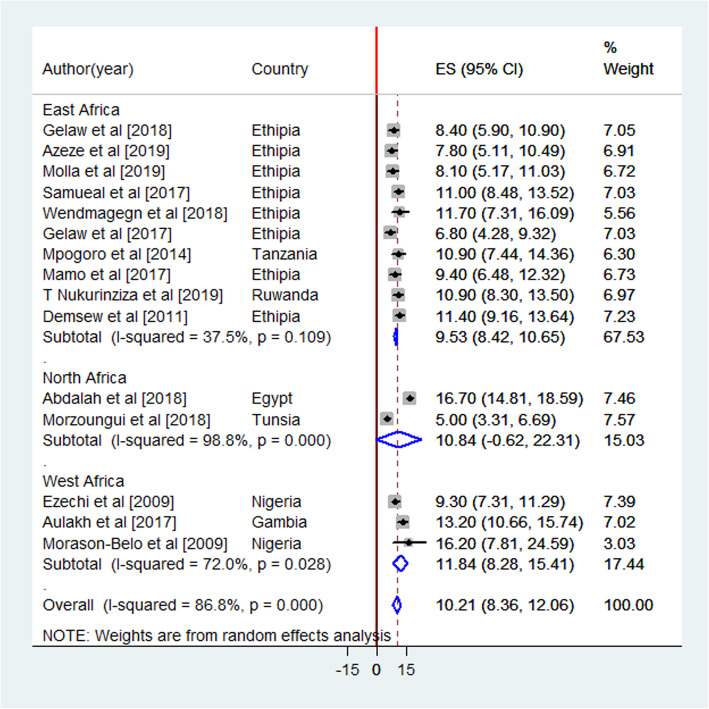
The overall pooled proportion of surgical site infection following cesarean section was 10.21% (I = 86.8, p < 0.000; 95% CI = 8.36, 12.06). The odds of developing surgical site infection among women who had the rupture of membrane before delivery were nearly 6 times higher than those who had not a rupture of the membrane (AOR = 5.65, 95% CI: 3.95-8.07).
The proportion of surgical site infections following the cesarean section is relatively high. Women who had rupture of the membrane before delivery were more likely to develop surgical site infections following the cesarean section. Due attention should be given to the provision of prophylactic antibiotics that can reduce surgical site infection after cesarean delivery.
手术部位感染发生在外科手术后30天内,累及皮肤、皮下组织和软组织。剖宫产术后手术部位感染是一种常见的术后并发症,在资源有限的环境中与孕产妇发病率和死亡率相关。尽管各类文献报道了手术部位感染的比例和一些危险因素,但各研究结果不一。关于产后手术部位感染与胎膜破裂之间的关联,了解也有限。因此,本系统评价和荟萃分析旨在估计非洲剖宫产术后手术部位感染的合并比例及其与胎膜破裂的关联。
通过PubMed、Scopus、Medscape、Web-science和CINAHL数据库从MEDLINE检索2000年1月1日至2020年1月30日发表的研究,以搜索相关已发表文章。我们还对手动检索关键文章的参考文献列表以获取其他相关文章。最初,识别出559条记录,15项研究纳入分析。使用STATA 11进行统计分析。通过森林图和不一致指数(I)探讨研究间的异质性。通过漏斗图和Egger检验检查发表偏倚。采用随机效应模型计算比例和比值比的合并估计值,并给出95%置信区间(CI)。
剖宫产术后手术部位感染的总体合并比例为10.21%(I = 86.8,p < 0.000;95% CI = 8.36,12.06)。分娩前胎膜破裂的女性发生手术部位感染的几率比未发生胎膜破裂的女性高近6倍(调整后比值比 = 5.65,95% CI:3.95 - 8.07)。
剖宫产术后手术部位感染的比例相对较高。分娩前胎膜破裂的女性剖宫产术后更易发生手术部位感染。应适当关注提供可减少剖宫产术后手术部位感染的预防性抗生素。