Nutrition, Immunity and Metabolism Senior Scientist Group, Department of Nutrition and Gerontology, German Institute of Human Nutrition Potsdam-Rehbruecke (DIfE), Nuthetal, Germany.
Institute of Nutritional Science, University of Potsdam, Potsdam, Germany.
BMC Med. 2021 Jan 4;19(1):1. doi: 10.1186/s12916-020-01826-0.
Nutrition and lifestyle have been long established as risk factors for colorectal cancer (CRC). Modifiable lifestyle behaviours bear potential to minimize long-term CRC risk; however, translation of lifestyle information into individualized CRC risk assessment has not been implemented. Lifestyle-based risk models may aid the identification of high-risk individuals, guide referral to screening and motivate behaviour change. We therefore developed and validated a lifestyle-based CRC risk prediction algorithm in an asymptomatic European population.
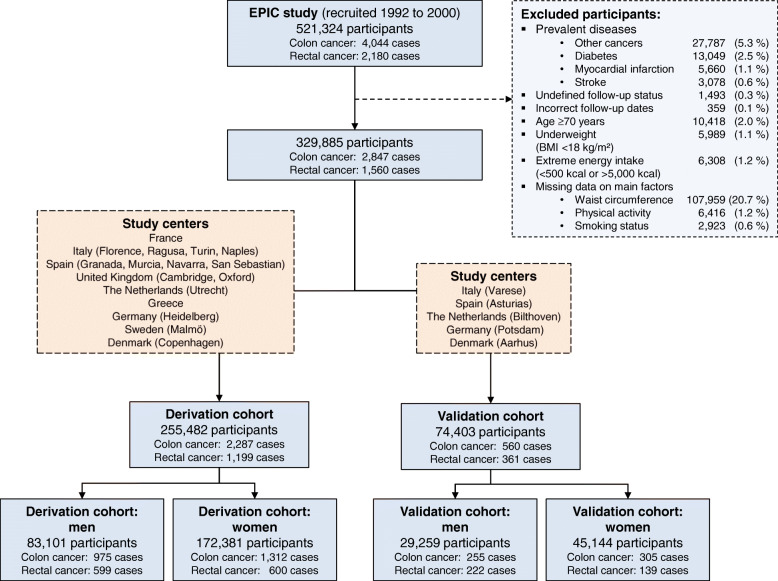
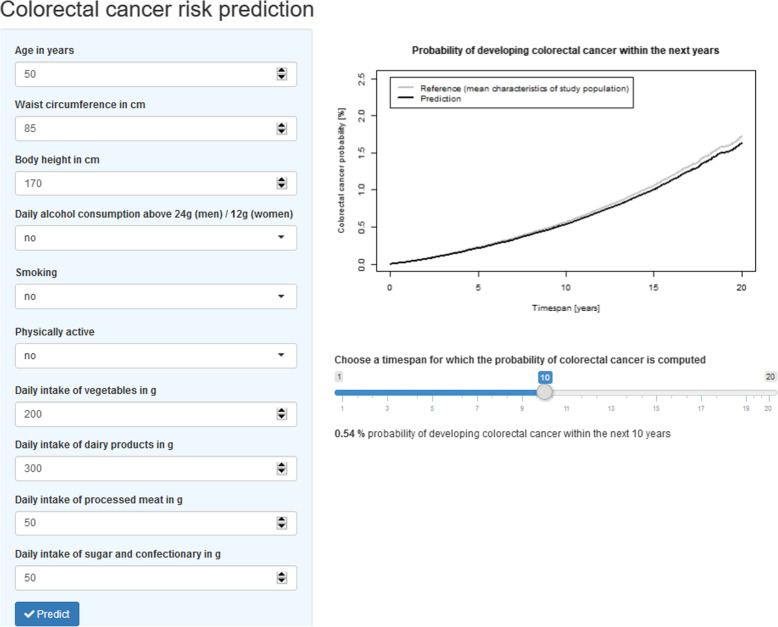
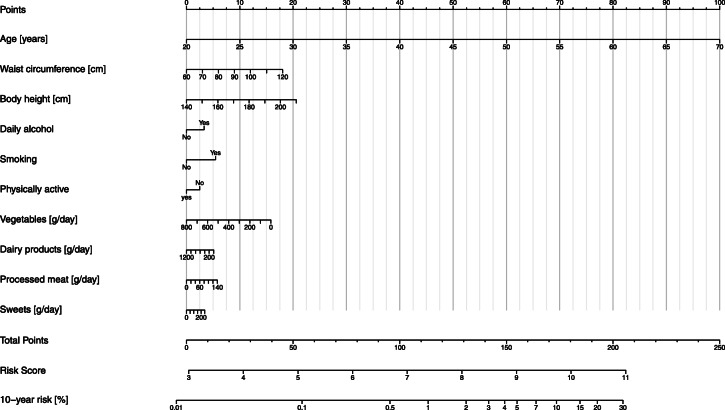
The model was based on data from 255,482 participants in the European Prospective Investigation into Cancer and Nutrition (EPIC) study aged 19 to 70 years who were free of cancer at study baseline (1992-2000) and were followed up to 31 September 2010. The model was validated in a sample comprising 74,403 participants selected among five EPIC centres. Over a median follow-up time of 15 years, there were 3645 and 981 colorectal cancer cases in the derivation and validation samples, respectively. Variable selection algorithms in Cox proportional hazard regression and random survival forest (RSF) were used to identify the best predictors among plausible predictor variables. Measures of discrimination and calibration were calculated in derivation and validation samples. To facilitate model communication, a nomogram and a web-based application were developed.
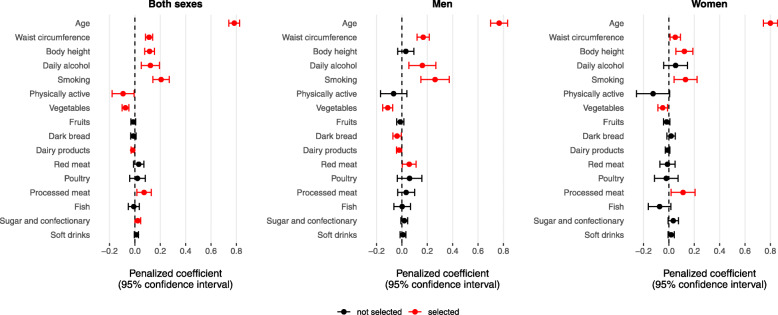
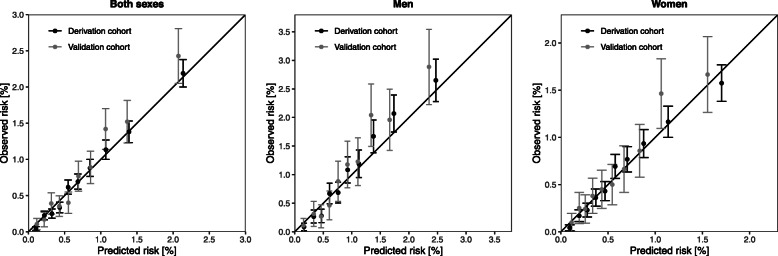
The final selection model included age, waist circumference, height, smoking, alcohol consumption, physical activity, vegetables, dairy products, processed meat, and sugar and confectionary. The risk score demonstrated good discrimination overall and in sex-specific models. Harrell's C-index was 0.710 in the derivation cohort and 0.714 in the validation cohort. The model was well calibrated and showed strong agreement between predicted and observed risk. Random survival forest analysis suggested high model robustness. Beyond age, lifestyle data led to improved model performance overall (continuous net reclassification improvement = 0.307 (95% CI 0.264-0.352)), and especially for young individuals below 45 years (continuous net reclassification improvement = 0.364 (95% CI 0.084-0.575)).
LiFeCRC score based on age and lifestyle data accurately identifies individuals at risk for incident colorectal cancer in European populations and could contribute to improved prevention through motivating lifestyle change at an individual level.
营养和生活方式早已被确定为结直肠癌(CRC)的风险因素。可改变的生活方式行为有可能最大限度地降低长期 CRC 风险;然而,将生活方式信息转化为个体 CRC 风险评估尚未实施。基于生活方式的风险模型可以帮助识别高风险个体,指导筛查转诊,并激励行为改变。因此,我们在一个无症状的欧洲人群中开发和验证了一种基于生活方式的 CRC 风险预测算法。
该模型基于欧洲前瞻性癌症与营养研究(EPIC)中 255482 名年龄在 19 至 70 岁之间、研究基线(1992-2000 年)时无癌症且随访至 2010 年 9 月 31 日的参与者的数据。该模型在五个 EPIC 中心中选择的 74403 名参与者的样本中进行了验证。在中位随访时间为 15 年的时间里,推导和验证样本中分别有 3645 例和 981 例结直肠癌病例。Cox 比例风险回归和随机生存森林(RSF)中的变量选择算法用于在可能的预测变量中识别最佳预测因子。推导和验证样本中计算了区分度和校准度的指标。为了便于模型交流,开发了一个列线图和一个基于网络的应用程序。
最终选择的模型包括年龄、腰围、身高、吸烟、饮酒、体力活动、蔬菜、乳制品、加工肉类、糖和糖果。风险评分在总体和性别特异性模型中均具有良好的区分度。推导队列中 Harrell 的 C 指数为 0.710,验证队列中为 0.714。该模型具有良好的校准度,并显示出预测风险与观察风险之间的高度一致性。随机生存森林分析表明模型具有较高的稳健性。除了年龄之外,生活方式数据总体上提高了模型性能(连续净重新分类改善=0.307(95%CI 0.264-0.352)),尤其是对于 45 岁以下的年轻个体(连续净重新分类改善=0.364(95%CI 0.084-0.575))。
基于年龄和生活方式数据的 LiFeCRC 评分能够准确识别欧洲人群中结直肠癌发病风险的个体,并通过在个体层面上激励生活方式改变来促进预防。