Johanns Vanessa C, Epping Lennard, Semmler Torsten, Ghazisaeedi Fereshteh, Lübke-Becker Antina, Pfeifer Yvonne, Eichhorn Inga, Merle Roswitha, Bethe Astrid, Walther Birgit, Wieler Lothar H
Advanced Light and Electron Microscopy (ZBS-4), Robert Koch Institute, Berlin, Germany.
Microbial Genomics (NG1), Robert Koch Institute, Berlin, Germany.
Front Vet Sci. 2020 Dec 16;7:614513. doi: 10.3389/fvets.2020.614513. eCollection 2020.
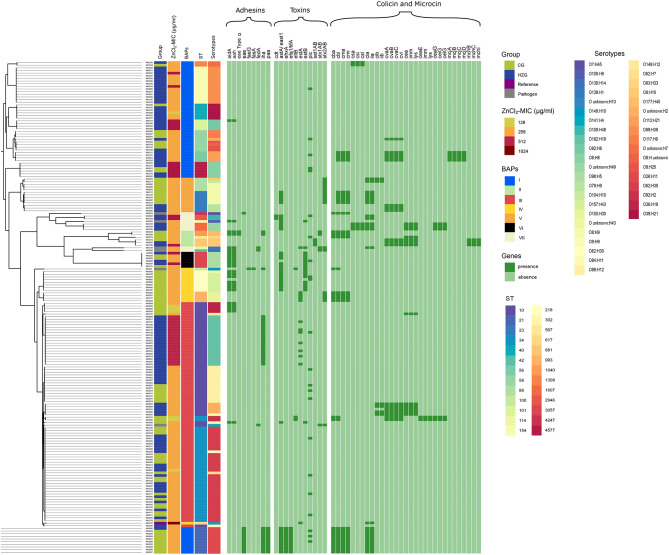
To prevent economic losses due to post-weaning diarrhea (PWD) in industrial pig production, zinc (Zn) feed additives have been widely used, especially since awareness has risen that the regular application of antibiotics promotes buildup of antimicrobial resistance in both commensal and pathogenic bacteria. In a previous study on 179 collected from piglets sacrificed at the end of a Zn feeding trial, including isolates obtained from animals of a high-zinc fed group (HZG) and a corresponding control group (CG), we found that the isolate collection exhibited three different levels of tolerance toward zinc, i.e., the minimal inhibitory concentration (MIC) detected was 128, followed by 256 and 512 μg/ml ZnCl We further provided evidence that enhanced zinc tolerance in porcine intestinal populations is clearly linked to excessive zinc feeding. Here we provide insights about the genomic make-up and phylogenetic background of these 179 genomes. Bayesian analysis of the population structure (BAPS) revealed a lack of association between the actual zinc tolerance level and a particular phylogenetic cluster or even branch for both, isolates belonging to the HZG and CG. In addition, detection rates for genes and operons associated with virulence (VAG) and bacteriocins (BAG) were lower in isolates originating from the HZG (41 vs. 65% and 22 vs. 35%, < 0.001 and = 0.002, resp.). Strikingly, harboring genes defining distinct pathotypes associated with intestinal disease, i.e., enterotoxigenic, enteropathogenic, and Shiga toxin-producing (ETEC, EPEC, and STEC) constituted 1% of the isolates belonging to the HZG but 14% of those from the CG. Notably, these pathotypes were positively associated with enhanced zinc tolerance (512 μg/ml ZnCl MIC, < 0.001). Taken together, zinc excess seems to influence carriage rates of VAGs and BAGs in porcine intestinal populations, and high-zinc feeding is negatively correlated with enteral pathotype occurrences, which might explain earlier observations concerning the relative increase of considering the overall intestinal microbiota of piglets during zinc feeding trials while PWD rates have decreased.
为防止集约化养猪生产中因断奶后腹泻(PWD)造成经济损失,锌(Zn)饲料添加剂已被广泛使用,尤其是自人们意识到常规使用抗生素会促进共生菌和病原菌中抗菌药物耐药性的产生以来。在之前一项对179株从锌喂养试验结束时处死的仔猪中收集的菌株进行的研究中,这些菌株包括从高锌喂养组(HZG)和相应对照组(CG)的动物中分离得到的菌株,我们发现该菌株集合对锌表现出三种不同水平的耐受性,即检测到的最低抑菌浓度(MIC)分别为128、256和512μg/ml氯化锌。我们进一步证明,猪肠道菌群中锌耐受性增强与过量锌喂养明显相关。在此,我们提供了关于这179个基因组的基因组组成和系统发育背景的见解。群体结构的贝叶斯分析(BAPS)显示,对于HZG和CG的分离株,实际锌耐受水平与特定的系统发育簇甚至分支之间缺乏关联。此外,源自HZG的分离株中与毒力相关的基因和操纵子(VAG)以及细菌素(BAG)的检出率较低(分别为41%对65%和22%对35%,P<0.001和P = 0.002)。引人注目的是,携带定义与肠道疾病相关的不同致病型的基因,即产肠毒素性大肠杆菌、肠致病性大肠杆菌和产志贺毒素大肠杆菌(ETEC、EPEC和STEC),在属于HZG的分离株中占1%,而在来自CG的分离株中占14%。值得注意的是,这些致病型与增强的锌耐受性呈正相关(512μg/ml氯化锌MIC,P<0.001)。综上所述,锌过量似乎会影响猪肠道菌群中VAG和BAG的携带率,高锌喂养与肠道致病型的出现呈负相关,这可能解释了早期关于在锌喂养试验期间仔猪整体肠道微生物群中大肠杆菌相对增加而PWD发生率下降的观察结果。