Molfino Alessio, Amabile Maria Ida, Imbimbo Giovanni, Rizzo Veronica, Pediconi Federica, Catalano Carlo, Emiliani Alessandra, Belli Roberta, Ramaccini Cesarina, Parisi Claudia, Nigri Giuseppe, Muscaritoli Maurizio
Department of Translational and Precision Medicine, Sapienza University of Rome, 00185 Rome, Italy.
Department of Surgical Sciences, Sapienza University of Rome, 00185 Rome, Italy.
Cancers (Basel). 2020 Dec 31;13(1):99. doi: 10.3390/cancers13010099.
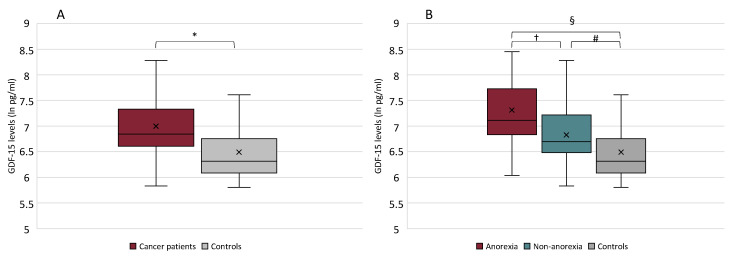
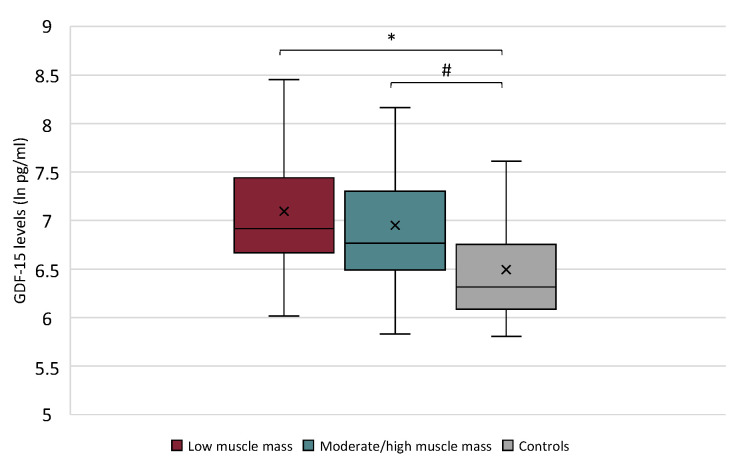
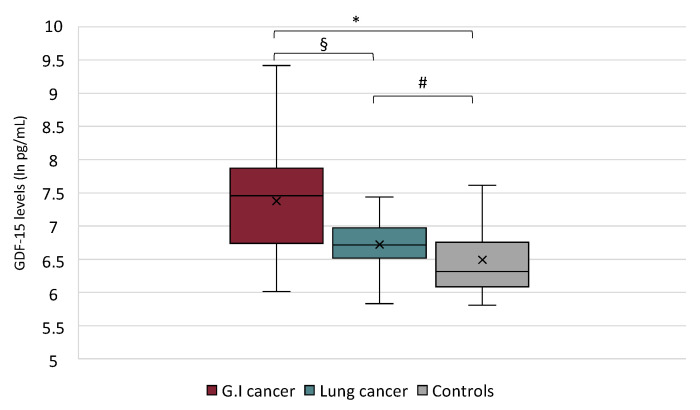
The pathophysiology of cancer anorexia is complex and serum biomarkers, including growth and differentiation factor(s) (GDF), may be modulated. We explored the association(s) between GDF-15 serum levels and anorexia and, secondarily, with low muscle mass and body weight loss in cancer patients. We considered gastrointestinal and lung cancer patients (CP) and healthy BMI-matched controls. The FAACT-questionnaire was administered to diagnose anorexia and we calculated the L3-SMI by CT scan to assess low muscularity, setting their cutoff values at the lowest tertile. GDF-15 serum levels were assessed by ELISA. We enrolled 59 CP and 30 controls; among CP, 25 were affected by gastrointestinal and 34 by lung cancer. Anorexia was present in 36% of CP. Gastrointestinal CP resulted more anorexic compared to lung CP ( = 0.0067). Low muscle mass was present in 33.9% of CP and L3-SMI was lower in gastrointestinal compared to lung CP ( 0.049). The GDF-15 levels were higher in CP vs. controls ( = 0.00016), as well as in anorexic vs. non-anorexic CP ( = 0.005) and vs. controls ( < 0.0001). Gastrointestinal CP showed higher GDF-15 levels vs. lung CP ( = 0.0004). No difference was found in GDF-15 between CP with low muscle mass and those with moderate/high muscularity and between patients with body weight loss and those with stable weight. Our data support the involvement of GDF-15 in the pathogenesis of cancer anorexia. The mechanisms of action of GDF-15 in cancer should be further clarified also regarding the changes in muscularity.
癌症厌食症的病理生理学很复杂,包括生长和分化因子(GDF)在内的血清生物标志物可能会受到调节。我们探讨了GDF-15血清水平与厌食症之间的关联,其次,还探讨了其与癌症患者低肌肉量和体重减轻之间的关联。我们纳入了胃肠道癌和肺癌患者(CP)以及体重指数(BMI)匹配的健康对照者。采用FAACT问卷诊断厌食症,并通过CT扫描计算第三腰椎骨骼肌指数(L3-SMI)以评估肌肉量减少情况,将其临界值设定为最低三分位数。通过酶联免疫吸附测定(ELISA)评估GDF-15血清水平。我们纳入了59例CP患者和30例对照者;在CP患者中,25例为胃肠道癌,34例为肺癌。36%的CP患者存在厌食症。与肺癌CP患者相比,胃肠道CP患者的厌食情况更严重(P = 0.0067)。33.9%的CP患者存在低肌肉量,与肺癌CP患者相比,胃肠道CP患者的L3-SMI更低(P = 0.049)。与对照者相比,CP患者的GDF-15水平更高(P = 0.00016),厌食症CP患者与非厌食症CP患者相比(P = 0.005)以及与对照者相比(P < 0.0001)也是如此。与肺癌CP患者相比,胃肠道CP患者的GDF-15水平更高(P = 0.0004)。在肌肉量低的CP患者与肌肉量中等/高的CP患者之间,以及体重减轻的患者与体重稳定的患者之间,未发现GDF-15存在差异。我们的数据支持GDF-15参与癌症厌食症的发病机制。GDF-15在癌症中的作用机制,还应结合肌肉量的变化进一步阐明。