Akdogan Orhun, Turkmen Sena, Uyar Galip Can, Yucel Kadriye Bir, Tufekci Busra, Gurler Fatih, Yazici Ozan, Ozdemir Nuriye, Ozet Ahmet, Karakaya Cengiz, Sutcuoglu Osman
Department of Medical Oncology, Gazi University, 06560 Ankara, Türkiye.
Department of Medical Biochemistry, Gazi University, 06560 Ankara, Türkiye.
Cancers (Basel). 2024 Dec 12;16(24):4146. doi: 10.3390/cancers16244146.
Immunotherapy has transformed cancer treatment; however, predicting treatment response remains challenging. Serum biomarkers can help identify patients who are most likely to benefit from immunotherapy.
This study evaluates the relationship between serum growth differentiation factor 15 (GDF-15) and interleukin-6 (IL-6) levels and treatment outcomes in cancer patients undergoing second-line immunotherapy.
We conducted a prospective observational study involving 85 patients with non-small-cell lung cancer (NSCLC), renal cell carcinoma (RCC), or malignant melanoma treated with nivolumab. The baseline serum levels of GDF-15 and IL-6 were measured by using ELISA kits. The primary endpoints were progression-free survival (PFS) and overall survival (OS), with cachexia as a secondary outcome.
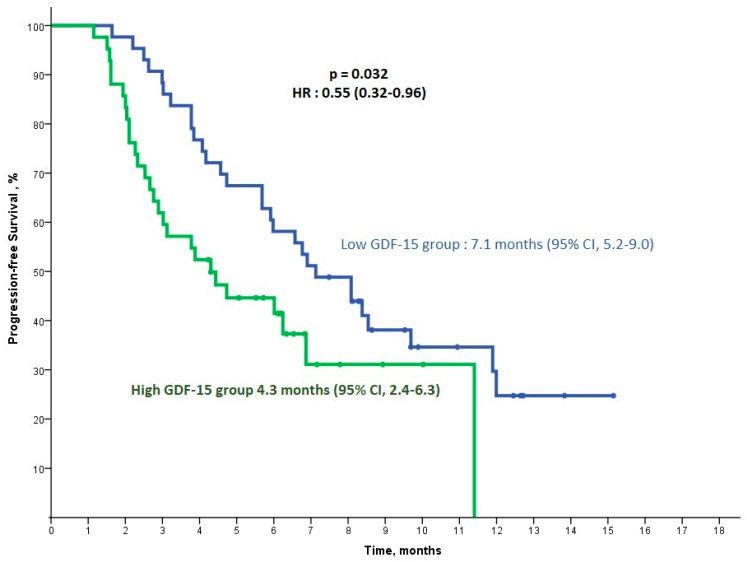
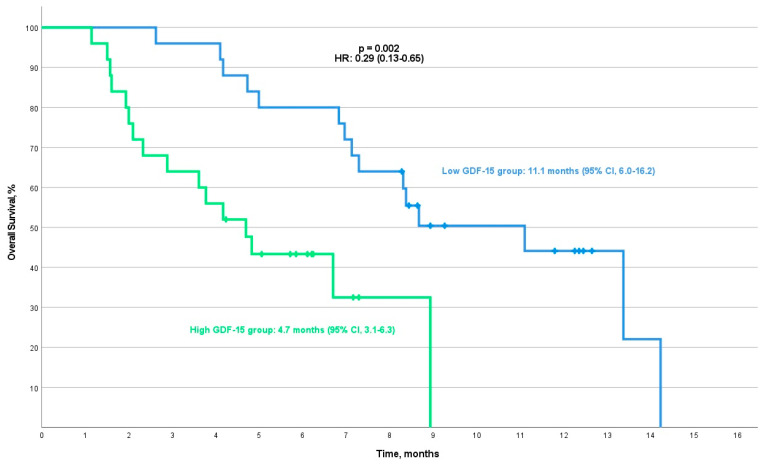
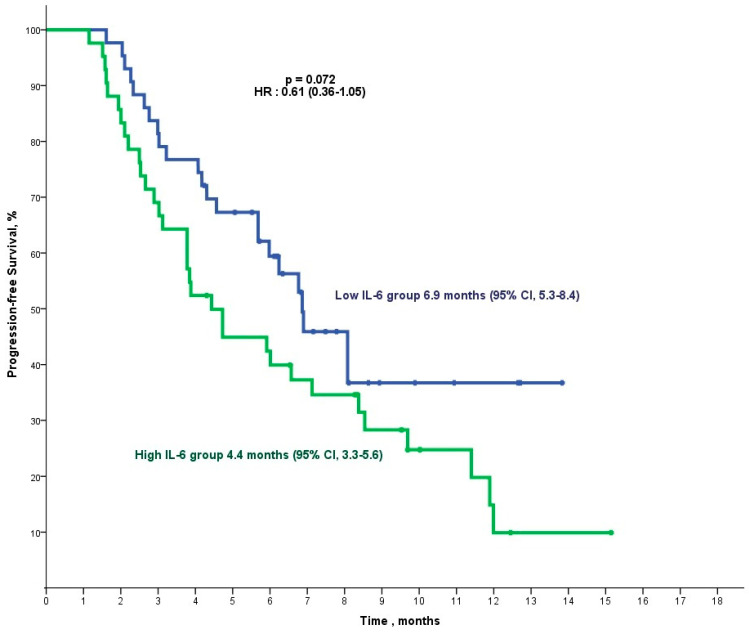
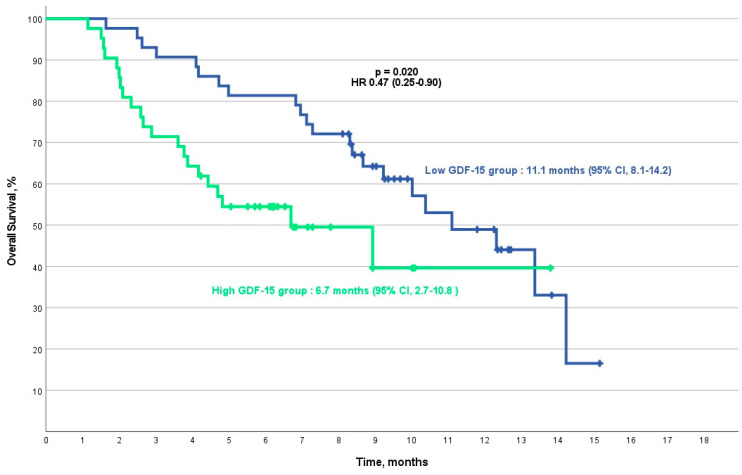
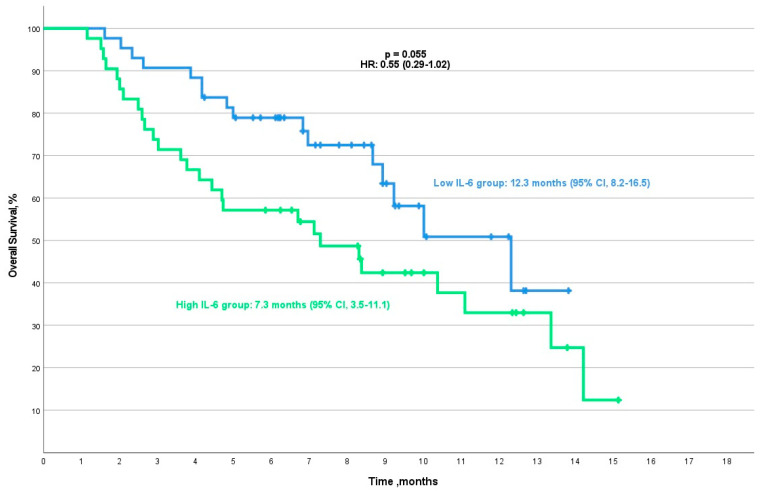
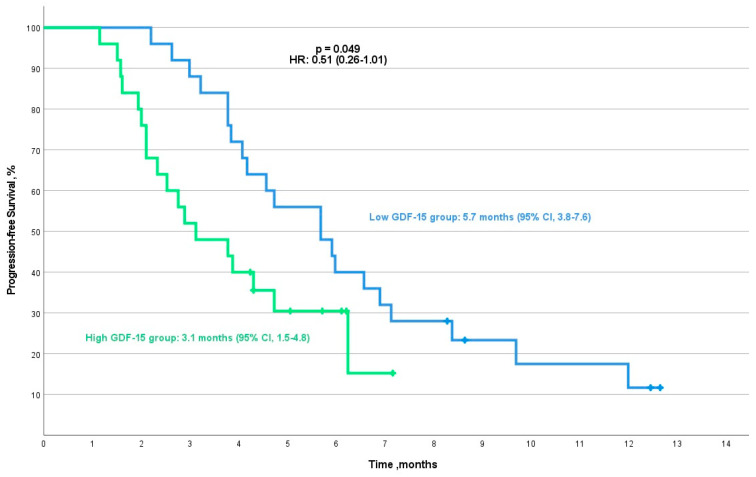
Elevated GDF-15 levels were significantly associated with shorter PFS (HR: 0.55, 95% CI: 0.32-0.96, = 0.032) and OS (HR: 0.47, 95% CI: 0.25-0.90, = 0.020). Higher IL-6 levels correlated with shorter PFS, though statistical significance was not achieved. Additionally, high GDF-15 levels were linked to increased cachexia incidence ( = 0.037).
Our findings indicate that GDF-15 could serve as a prognostic biomarker for immunotherapy response and may also be a target for cachexia management. Further studies should explore its potential to guide clinical decision making in oncology.
免疫疗法已经改变了癌症治疗方式;然而,预测治疗反应仍然具有挑战性。血清生物标志物有助于识别最有可能从免疫疗法中获益的患者。
本研究评估血清生长分化因子15(GDF-15)和白细胞介素-6(IL-6)水平与接受二线免疫疗法的癌症患者治疗结果之间的关系。
我们进行了一项前瞻性观察性研究,纳入了85例接受纳武单抗治疗的非小细胞肺癌(NSCLC)、肾细胞癌(RCC)或恶性黑色素瘤患者。使用酶联免疫吸附测定(ELISA)试剂盒测量GDF-15和IL-6的基线血清水平。主要终点为无进展生存期(PFS)和总生存期(OS),恶病质作为次要结果。
GDF-15水平升高与较短的PFS(风险比:0.55,95%置信区间:0.32-0.96,P = 0.032)和OS(风险比:0.47,95%置信区间:0.25-0.90,P = 0.020)显著相关。较高的IL-6水平与较短的PFS相关,尽管未达到统计学显著性。此外,高GDF-15水平与恶病质发生率增加相关(P = 0.037)。
我们的研究结果表明,GDF-15可作为免疫疗法反应的预后生物标志物,也可能是恶病质管理的靶点。进一步的研究应探索其在肿瘤学中指导临床决策的潜力。